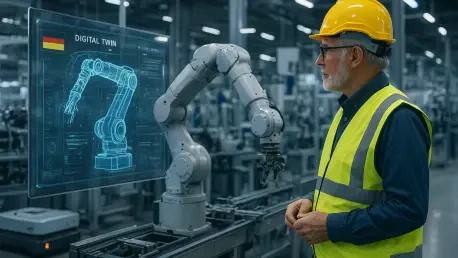

Germany’s industrial AI ambitions have a concrete reference point in Siemens’s claim: virtual production ramp-up could require up to 85 percent less engineering effort. Autonomous factories are the focus of Siemens’s partnership with NVIDIA; the new federal agreement with NVIDIA takes physical AI to a broader industrial agenda. Businesses will need to see whether those ambitions produce repeatable improvements outside a showcase facility.
Factory Results Give the National Agreement a Practical Test
Siemens used its factory in Erlangen to demonstrate how AI solutions could support greater manufacturing autonomy. The company also put potential savings from agent-based production planning at up to 20 percent, saying the approach could help manufacturing adapt more readily.
Each application addresses a different stage of production. Engineering before the start of physical production is the focus of virtual ramp-up, whereas agent-based planning concerns the organization of manufacturing. Executives need that distinction when assessing returns: first establish which operation the industrial AI investment is meant to improve.
For Siemens, Erlangen provides the blueprint it envisages for manufacturing autonomy. Its figures remain vendor claims, though, rather than independently benchmarked results. Neither the baselines nor the testing and measurement details were disclosed, and both percentages represent upper limits.
| Siemens application | Claimed result | Implication for buyers |
|---|---|---|
| Production ramp-up conducted fully virtually | Engineering effort: reduction of up to 85 percent | Assess whether comparable engineering tasks and starting conditions exist in the intended deployment. |
| Production planning using agents | Potential savings: up to 20 percent | Identify the costs covered by the measurement before incorporating the figure into an investment case. |
The figures give Germany’s broader initiative an operational reference point. They don’t establish what another factory should expect. Manufacturers considering similar systems should test them against their own production constraints, measuring any gains from a documented baseline.
Physical AI Links National Policy to Engineering Practice
The Invest in Germany Summit in Berlin was the setting for a Joint Declaration of Intent signed by NVIDIA and Germany’s federal government. At the former power station Kraftwerk, the agreement was outlined by Friedrich Merz, Chancellor of Germany, alongside NVIDIA founder and CEO Jensen Huang. Additional signatures came from two ministries: the Federal Ministry for Economic Affairs and Energy, and the Federal Ministry for Research, Technology, and Space.
Political, industrial, research, and trade-association representatives participate in the government’s Industry 4.0 Platform; the declaration builds on the existing relationship involving that platform and the government. Its stated direction is wider industrial adoption and a modern European industrial AI ecosystem, supported by a joint initiative focused on advanced physical AI models.
With physical AI, the focus shifts to systems that interact with real-world operations. Here, that covers robots and autonomous vehicles as well as digital representations of manufacturing environments. In business terms, the ambition moves AI closer to decisions about how products are designed, handled, and produced.
Huang traced the shift through the history of German companies’ work with NVIDIA. In Huang’s account, gaming hardware, workstations, and automotive design featured in the early 2000s; today’s collaborations reach into manufacturing digital twins and autonomous vehicles. Germany’s autonomous transport activity also includes trucking work involving Lidl, while enterprise interest in world models and digital twins extends beyond NVIDIA’s partners.
The agreement draws on that industrial history, though the declaration itself provides only a framework for cooperation. Its strategic value rests on translating research and infrastructure into tools that manufacturers can use in their operating environments.
Mittelstand Data Becomes an Adoption Decision
Merz directed a central part of his appeal toward the Mittelstand, Germany’s small and medium-sized businesses. Merz urged company leaders to make accumulated operational data available for AI use, arguing that it represents a major advantage for Germany.
Adoption therefore requires more than model development. Businesses hold the industrial knowledge, so access depends on what those companies decide to share. Before opening data to an AI initiative, a manufacturer should specify its permitted use and identify the workflow it should improve.
Three deployment questions follow from that approach:
- What operational problem will the data support? A production-planning project and a robotic application require different business objectives.
- What access will partners receive? Firms should set clear limits on both the information shared and its use.
- How will improvement be verified? Internal measurements should establish whether a deployment produces value under local conditions.
Huang argued that Germany’s manufacturing expertise, supported by its mathematics and science capabilities, would be augmented by AI rather than displaced. His assessment offers no assurance about how each implementation will perform. Businesses can bring new tools into existing engineering practice while keeping accountability for operational decisions intact.
Investment Broadens the Applications Beyond Manufacturing
Agile Robots, Avelios Medical, Mirelo, and Reflex Aerospace are the intended recipients of investments Huang announced. Those commitments sit within NVIDIA’s nearly $10 billion European pledge covering businesses, universities, and research institutions. Earlier investments by the company went to n8n, Neura Robotics, and Black Forest Labs.
The application landscape spans several markets, as those four proposed investments illustrate. Manufacturing, logistics, and healthcare are the markets for AI-enabled robotics developed by Agile Robots in Munich, with products including robotic arms and the Agile ONE humanoid. Clinical and administrative records and workflows are the intended core of an AI-native hospital information system under development at Munich-based Avelios Medical.
Video-related audio is Mirelo’s focus, with models covering music, speech, and sound effects. For satellites it designs in Berlin, Reflex Aerospace puts the time to launch readiness at about 12 months rather than years. Each serves a distinct product market, illustrating the breadth of specialized businesses that NVIDIA plans to support through the wider initiative.
Research infrastructure adds another dimension. A fault-tolerant quantum computer was simulated at 104-qubit scale by NVIDIA researchers using JUPITER at the Jülich Supercomputing Centre; JUPITER is described as Europe’s largest supercomputer. NVIDIA characterized it as an unprecedented run in scale and detail. That research result is separate from evidence of factory productivity and should be evaluated as such.
Merz proposed meeting Huang at least annually to review progress. A useful assessment would distinguish research achievements, investment commitments, and measured operational gains. Germany’s initiative matters now because it brings those activities into a shared industrial agenda; its practical success will depend on turning company-held knowledge and advanced models into deployments with demonstrable results.