
From Digital Dominance to Physical Automation a New Frontier for Grab
In a strategic pivot from software-centric operations to physical automation, Southeast Asian super-app Grab has made a decisive move into the world of robotics with its acquisition of Infermove. This is not merely a technological experiment but a calculated response to the immense economic pressures threatening the profitability of the on-demand delivery industry. As the sector grapples with razor-thin margins and escalating expenses, Grab is betting that bringing advanced robotics in-house will be the key to building a more resilient and cost-effective logistics network. This article will dissect the motivations behind this acquisition, explore the specialized technology at its core, and analyze the broader implications for an industry at a critical inflection point.
The Economic Imperative of Navigating the On Demand Delivery Squeeze
The on-demand delivery market, once a darling of venture capital, has matured into a high-stakes, low-margin battleground. Following a period of hyper-growth, platform operators like Grab now face a harsh economic reality. Customer expectations for fast, cheap, and reliable service remain sky-high, yet the costs to meet those demands are spiraling upward. Rising labor costs, volatile fuel prices, and increasing regulatory scrutiny across Southeast Asia have created a perfect storm, squeezing profitability and forcing companies to find new pathways to operational efficiency. In this environment, relying solely on optimizing driver routes through software is no longer sufficient; the next frontier of cost savings lies in automating the physical movement of goods.
Unpacking the Acquisition Strategy Technology and Integration
A Strategic Hedge Against Escalating Operational Costs
At its core, Grab’s acquisition of Infermove is a direct play to control its largest and most unpredictable expense: the cost of human labor for last-mile delivery. For a platform that facilitates millions of transactions daily, even marginal improvements in per-delivery cost can translate into substantial bottom-line impact. By internalizing robotics development, Grab aims to create a more sustainable economic model that is less vulnerable to wage inflation and labor shortages. This move represents a long-term strategy to de-risk its core business, giving the company direct control over the pace of automation, the operational scope of its robotic fleet, and the critical cost-trade-offs involved in deployment, thereby reducing its dependence on third-party technology vendors whose priorities may not align with its unique market needs.
The Bet on Real World AI and Specialized Robotics with Infermove
Grab’s choice of Infermove was highly deliberate, bypassing generic, off-the-shelf robots for a more specialized solution. Infermove’s key differentiator is its AI, which is trained on real-world movement data rather than in sterile, simulated environments. This is a critical distinction. Its systems learn from the complex, often chaotic ways humans navigate dense urban landscapes—data generated, in part, by Grab’s own fleet of couriers on bicycles and scooters. This methodology allows the robots to master the countless “edge cases” of city logistics, from navigating crowded pavements to reacting to unpredictable obstacles, a feat that simulated training often fails to achieve. By acquiring this capability, Grab is investing in an AI that understands the real world it must operate in.
A Hybrid Future Integrating Robots to Augment Human Couriers
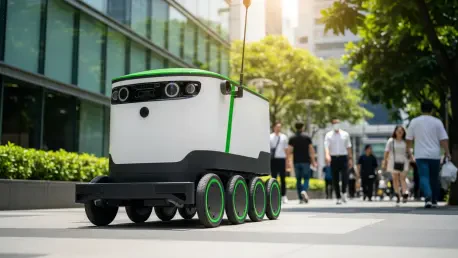
Contrary to fears of mass displacement, Grab’s vision is not one of a fully automated workforce but a hybrid model where robots augment human capabilities. The initial strategy focuses on deploying robots for highly repetitive, short-distance tasks within the logistics chain, such as first-mile pickups from a merchant hub or last-mile deliveries within a dense housing complex. In these controlled scenarios, robots can help smooth out demand spikes during peak hours, reduce wait times, and free up human couriers for more complex, long-distance deliveries. To nurture this vision, Infermove will operate as an independent entity under Grab’s CTO, an organizational structure designed to protect its innovative culture while ensuring its development aligns with Grab’s overarching operational goals.
The Next Wave of Embedding AI into the Physical Logistics Backbone
Grab’s acquisition signals a broader industry trend where major digital platforms are evolving beyond using AI as a mere software optimization tool. The new imperative is to embed intelligence deep within core physical operations. While this leap into hardware carries higher initial costs and risks, it promises more profound and durable gains in efficiency. Owning the entire technology loop—from data collection via the app to physical delivery via proprietary robots—creates a powerful, self-reinforcing cycle. Real-world operational data from the robots feeds back into the AI, making it smarter and more efficient, which in turn improves the physical operation. This tight integration is becoming a key competitive differentiator for platform companies whose success is defined by their mastery of real-world logistics.
Key Takeaways and Navigating the Path to Autonomous Logistics
The primary takeaway from Grab’s strategic move is that automation in the on-demand sector is shifting from a novelty to a competitive necessity. The acquisition of Infermove is an investment in long-term operational sustainability, driven by the urgent need to manage costs in a challenging market. By keeping the technology and its data feedback loop in-house, Grab gains a significant advantage in accelerating the development and refinement of its robotic systems. However, it is crucial to maintain a realistic perspective. Pavement-based robots are not a panacea; significant hurdles remain, including navigating adverse weather, complying with varied local regulations, and gaining public acceptance. The ultimate measure of success will not be the number of robots deployed but their tangible impact on lowering the cost-per-delivery without compromising service quality.
A Calculated Gamble on a More Sustainable and Automated Future
In conclusion, Grab’s venture into robotics represented a fundamental effort to master the complex interplay between artificial intelligence, proprietary data, and real-world physical operations. In a market where efficiency dictated survival, this deep integration was no longer a futuristic concept but a present-day strategic imperative. The move was a calculated gamble, but one that underscored a critical truth for modern platform economies: long-term growth and profitability would belong to those who could most effectively and economically bridge the gap between the digital and physical worlds. For Grab, the path to a more sustainable future may well have been paved by the very robots it was now building.