
The recent victory of the “Spider Conch Chair” at the AI Design Awards in Barcelona has ignited a fresh wave of discussion about the role of artificial intelligence in the creative sphere. Crafted by Utah Valley University Entertainment Design professor Brandon Truscott, this award-winning piece, a sculptural chair made from speckled cream-and-ivory resin with a solid walnut base, serves as a powerful testament to a new paradigm of artistic creation. Rather than viewing AI as an autonomous creator or a threat to human artists, Truscott’s work champions a collaborative model where technology acts as a powerful extension of human vision. This approach challenges the prevailing anxieties within the art world, reframing the conversation from one of replacement to one of synergy. Truscott’s methodology demonstrates that while AI can generate a vast sea of possibilities, the artist remains the essential navigator, curating, refining, and imbuing the final product with intent and a unique aesthetic sensibility, proving that the human element is not just relevant but more critical than ever in an age of machine-generated content.
Redefining the Creative Workflow
The Artist as Curator
The integration of artificial intelligence into the design process fundamentally reshapes the artist’s role, shifting the focus from pure creation to meticulous curation and refinement. Professor Brandon Truscott likens this new dynamic to the advent of photography, another technological tool that was initially met with skepticism but eventually became a respected artistic medium. In his workflow, AI is tasked with generating hundreds of initial concepts at a speed no human could match. However, this torrent of digital information is merely the raw material. The true artistic labor, according to Truscott, begins after the initial generation. He estimates that a staggering 90% of his project time is dedicated to sifting through these AI-generated outputs, identifying promising elements, and painstakingly editing and combining them to align with his specific creative vision. This iterative process involves a deep dialogue between the artist and the machine, where human intuition guides the technological capabilities, ensuring the final piece is not a random product of an algorithm but a deliberate work of art that reflects a distinct personal style and intent.
A Symphony of Advanced Tools
Achieving a cohesive and unique artistic outcome with AI requires more than just a single prompt; it involves orchestrating a diverse suite of specialized tools. Brandon Truscott’s process is a prime example of this multi-faceted approach, employing a range of platforms like MidJourney for initial image generation, Google Gemini for refining concepts and maintaining character consistency across different outputs, and even Suno for composing complementary musical scores. This demonstrates that the modern AI-assisted artist must be a polymath of sorts, fluent in the languages and capabilities of various technologies. Crucially, Truscott integrates his own proprietary imagery and meticulously crafted prompts into the workflow. This step is vital for maintaining creative control and steering the AI away from generic, algorithmically predictable results. By feeding the systems with his own unique inputs, he ensures that his personal artistic DNA is woven into the fabric of the final creation, transforming the AI from a simple generator into a sophisticated, personalized collaborator that amplifies his vision rather than supplanting it.
Navigating New Artistic Frontiers
Addressing Industry Skepticism
The rapid rise of generative AI has understandably been met with apprehension and skepticism within the creative industries, with primary concerns revolving around intellectual property, the sourcing of training data, and the potential devaluation of human skill. Brandon Truscott’s work directly confronts these issues by presenting a model for ethical and responsible integration. His success at the AI Design Awards provides a compelling counter-narrative to the dystopian view of AI as a job-killer. Instead, it showcases technology as a powerful tool that can augment and accelerate the creative process without diminishing the artist’s role. His award-winning designs serve as tangible proof that AI can be leveraged as an extension of human creativity, enabling the exploration of concepts that might be too time-consuming or complex to develop using traditional methods alone. This approach helps to demystify AI for other artists, demonstrating that when guided by a strong artistic vision and a rigorous curatorial process, these tools can open up new frontiers for innovation and expression while keeping the human creator firmly in control of the final output.
The Tangible Results of Collaboration
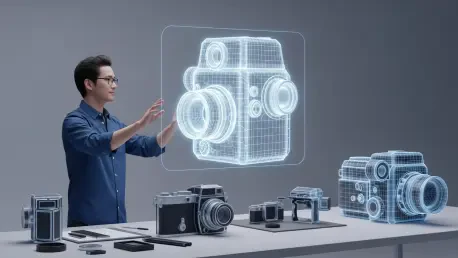
The practical outcomes of this human-AI partnership are best exemplified by the diverse and imaginative portfolio that earned Truscott recognition at the AI Design Awards. The “Spider Conch Chair,” the first-place winner in its category, is a masterclass in this fusion, translating a digitally conceived form into a functional, sculptural piece with real-world materials and artisanal quality. Beyond this flagship creation, his other finalist designs showcase the versatility of the collaborative approach across different product categories. The “RYU Dragon Camera” blends retro-futuristic aesthetics with a warm mix of wood and metal, while “The Lemon Claw” reimagines a simple citrus reamer with the sleek lines of mid-century modern design. The “EMS Ironhorse” envisions a luxury electric bicycle with intricate, artisanal details, and the conceptual image “DeBug” delves into a more abstract exploration of the human-AI relationship itself. Each of these concepts demonstrates how a clear artistic vision can guide generative tools to produce designs that are not only innovative but also grounded in established design principles and aesthetic appeal, bridging the gap between digital possibility and physical reality.
The Imperative of AI Literacy
As an educator at Utah Valley University, Brandon Truscott has extended his work beyond personal creation and into the realm of advocacy, championing the cause of AI literacy for the next generation of artists and designers. He has actively encouraged students to embrace these emerging technologies, not as a shortcut, but as an essential component of a modern creative toolkit that will provide them with a significant competitive advantage in a rapidly evolving industry. It was understood that while the rate of creation would continue to be accelerated by artificial intelligence, the distinctly human skills of curation, critical thinking, and nuanced editing would ultimately define the artistic value and commercial success of any final work. The core of his message has been clear: proficiency with these tools would soon become as fundamental as understanding color theory or composition. His approach has fostered an environment where future creators could learn to harness AI’s power responsibly, ensuring that technology serves as a catalyst for innovation rather than a replacement for human ingenuity and artistic soul.