
A $50 million Series A gives RealSense its own capital base after 14 years within Intel. The newly independent camera company is betting that rising demand for machine perception warrants a business built around it. Its next priorities connect that bet to practical deployment: safer robot interactions with people and better access control.
Key Points
- Intel Capital and other strategic investors backed the company’s move to independence.
- CEO Nadav Orbach ties the increased interest to advances in AI as robotics becomes a central market.
- The new funding will go toward commercial expansion and technology development, including safety and access-control applications.
Independence gives the perception business room to expand
The separation changes how the company can respond to demand. Orbach said operating independently and securing outside funding could give the business a better route to scaling than remaining within Intel.
With approval from former Intel CEO Pat Gelsinger, planning began last year. The company’s plans now include expanding its go-to-market team and improving its technology.
That allocation reveals the immediate challenge. A perception supplier needs to develop its sensing capabilities, but it also needs to get those capabilities into products and operating environments. Commercial capacity becomes more consequential as applications spread beyond a single market.
RealSense already serves more than 3,000 customers. Orbach said interest has accelerated over the past three to four years as AI has improved, particularly as robotics applications have expanded. The funding provides a way to respond to that demand; it doesn’t establish how quickly the independent business will grow.
Robotics gives 3D perception a clearer market
The company’s path to robotics wasn’t obvious from the start. Orbach described how the company explored several applications early on, including gesture-based interfaces for computers and phones. Robots eventually emerged as its strongest fit.
The shift reflects a practical distinction in computer vision. Recognizing something in an image and understanding where it sits in a physical environment serve different purposes. A machine working around objects or people needs that spatial information to operate.
In Orbach’s view, machines need to read their surroundings in three dimensions, with enough speed and accuracy to plan actions. Improving AI lets robots attempt more, though carrying out those actions still requires a usable view of their environment.
The market opportunity sits at that connection between intelligence and sensing. Better reasoning alone doesn’t remove the need for physical-world inputs.
Depth cameras connect visual inputs to physical tasks
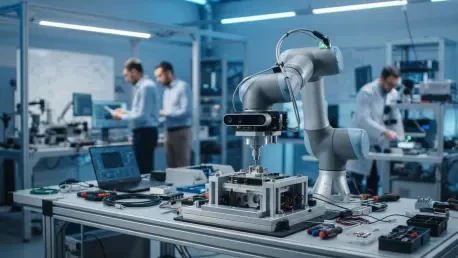
RealSense cameras capture two views at different angles, using stereoscopic imaging to extract depth information. Infrared light helps enhance the process. The technology gives robots, drones and autonomous vehicles perception capabilities and also supports facial authentication.
Its relevance extends beyond mobile machines. Chipotle has used the cameras alongside AI restaurant software company PreciTaste to detect when food containers need replenishment. Orbach also said fish farms have expressed interest in measuring volume within their pens.
Those examples have different commercial contexts, but a common deployment logic: spatial sensing turns a visible scene into information an operation can use. The restaurant application tracks container levels; the fish-farm interest concerns volume measurement. Neither requires framing depth sensing as a general-purpose AI product.
Safety and access control shape the next development phase
The company’s stated technology priorities bring perception closer to decisions involving people. It plans improvements aimed at safer human-robot interactions and stronger access control.
These are demanding directions. In the first, spatial understanding supports machines operating near humans. In the second, facial authentication connects visual sensing to entry decisions. How reliably the technology works in its intended setting determines its business value.
The funding announcement offers neither new performance benchmarks nor specific product commitments. Customers assessing the independent supplier will need to look next for concrete improvements to those capabilities, along with the commercial support needed to deploy them.