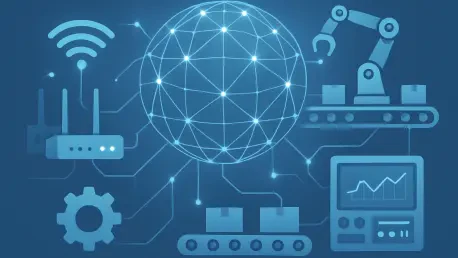

A sophisticated robotic fleet within a high-throughput distribution center can come to a grinding halt not because of a mechanical failure or a software bug, but due to a momentary flicker in the wireless signal that disrupts its synchronization protocols. This scenario highlights a pivotal shift in the industrial landscape where the primary bottleneck for efficiency has migrated from the physical durability of hardware to the invisible architecture of the data network. As we navigate the complexities of 2026, the reliance on high-performance connectivity has reached a critical threshold, transforming the network from a background utility into the very lifeblood of autonomous operations. While engineering teams once focused almost exclusively on torque, speed, and battery life, they now find themselves grappling with the realities of packet loss and signal propagation. The transition toward total automation is no longer just a challenge of robotics; it is an infrastructure crisis that demands a fundamental reassessment of how machines communicate within a workspace. Without a stable and resilient digital foundation, even the most advanced artificial intelligence remains tethered to the limitations of its environment, unable to fulfill its operational potential in a demanding market.
The Evolution of Distributed Intelligence
Historically, the world of industrial automation was characterized by isolated systems that functioned within highly controlled, on-premise environments, often referred to as “siloed” configurations. In these legacy setups, machines operated using localized networks that were physically disconnected from the broader internet, ensuring that latency remained predictable and external dependencies were non-existent. However, this paradigm has been entirely replaced by a distributed model where robots and autonomous systems no longer rely solely on their internal processing power. Modern automation now functions as an interconnected ecosystem, where machines are integrated into a complex web of cloud computing and edge processing. This connectivity allows for the continuous exchange of data, enabling real-time optimization of logistics routes and the seamless deployment of software updates across an entire fleet. While this integration enhances intelligence, it also creates a vulnerability by making the network a core component of the machine’s operational viability.
The technical demands of this new era are defined by what experts often call the “triple threat” of latency, reliability, and bandwidth, each posing a unique risk to autonomous stability. In a fast-paced automated environment, a delay of only a few milliseconds can represent the difference between a successful maneuver and a catastrophic collision, particularly when multiple units move through a shared space. Reliability issues often manifest as intermittent connection drops that trigger safety protocols, which can result in “cascading failures” where a single stalled unit creates a logjam for the entire operation. Furthermore, the bandwidth requirements for modern robots have reached unprecedented levels, as high-resolution sensors and continuous video streams are necessary for safe navigation and object recognition. When the underlying infrastructure lacks the throughput to handle these data volumes, the performance of the system degrades significantly, effectively “blinding” the autonomous unit and rendering its advanced hardware useless. This performance gap remains a primary hurdle for scaling automation in 2026.
Overcoming the Utility Mindset
One of the most significant obstacles to successful automation is an organizational tendency to view connectivity as a background utility, much like electricity or water. Decision-makers frequently allocate vast amounts of capital toward tangible assets, such as state-of-the-art robotic arms or proprietary artificial intelligence models, while treating the network as a secondary concern. This strategic blind spot creates a single point of failure that can compromise the entire investment, as even the most expensive hardware is rendered ineffective if it cannot communicate reliably. When systems become distributed, the network is no longer a peripheral service; it is a critical component of the machine’s functional stack. Treating infrastructure as an afterthought leads to significant losses in return on investment, as sophisticated systems remain idle or operate at reduced capacity due to poor data routing. Organizations must shift their perspective to recognize that the digital path is just as important as the physical robot, requiring the same level of scrutiny and financial commitment during the planning phase.
To mitigate the inherent risks of a centralized network failure, many forward-thinking companies are adopting hybrid architectures that emphasize edge resilience and redundancy. This strategy involves moving critical decision-making hardware physically closer to the robotic units, allowing essential safety and navigation functions to continue even if the connection to the central cloud is temporarily severed. However, while edge computing provides a localized buffer, it is not a complete solution, as these systems still require periodic synchronization and data aggregation to maintain high-level coordination. True resilience is therefore achieved through a multi-path connectivity approach, where organizations utilize a combination of fiber, private 5G networks, and low-earth orbit satellite links to ensure constant uptime. By building redundancy into the communication layer, businesses can ensure that their automated operations remain fluid and responsive, regardless of localized signal interference. This shift toward a more robust infrastructure model is essential for any operation looking to maintain a competitive edge in 2026 and beyond.
Designing a Unified Automation Stack
The successful deployment of autonomous technology now requires a fundamental change in design philosophy, where infrastructure is treated as a strategic layer of the engineering stack. This approach demands a granular mapping of the connectivity environment, involving rigorous testing for latency spikes and dead zones under heavy operational loads before a single machine is deployed on the floor. Engineers must analyze the digital terrain with the same precision they apply to the physical workspace, ensuring that signal propagation is consistent across all areas of operation. Achieving this level of performance necessitates a new era of collaborative engineering between robotics developers, network providers, and system integrators who must work in unison rather than in isolation. When these groups collaborate from the outset, they can identify potential bottlenecks and design intelligent routing protocols that optimize data flow. This proactive integration prevents the unforeseen failures that often plague large-scale deployments, ensuring that the infrastructure is fully prepared to support the sophisticated demands of modern automation.
Looking back at the initial phases of the automation boom, it became clear that the strength of the digital path determined which organizations successfully scaled their operations. Moving forward, businesses prioritized the creation of “self-healing” networks that automatically rerouted data during congestion, ensuring that autonomous fleets maintained peak efficiency without human intervention. The integration of infrastructure as a core pillar of system design allowed for a more predictable return on investment and reduced the frequency of expensive downtime events. Leadership teams recognized that the journey from the cloud to the robot was a complex one, requiring a strategic focus on the invisible threads that bound the system together. By investing in multi-layered connectivity and edge-based safety protocols, companies moved beyond the limitations of legacy networks to embrace a more resilient future. Ultimately, the transition to fully automated environments relied on a comprehensive understanding of connectivity as a strategic asset. Those who adopted this perspective successfully unlocked the full potential of their robotics investments.