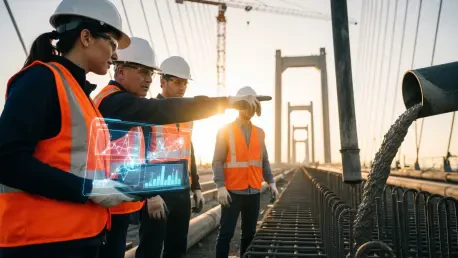

The rhythmic clang of steel, the coordinated movement of a dozen hands securing a massive formwork panel, and the seamless flow of materials across a bustling job site create a complex symphony of human collaboration. For decades, project managers have tried to quantify the efficiency of this performance with stopwatches and clipboards, yet the true dynamics of teamwork have remained an elusive, unreadable score. Now, a breakthrough in artificial intelligence offers a way to finally understand the intricate interplay that defines a successful construction project, moving beyond the actions of individuals to capture the collective rhythm of the entire crew.
This challenge has long been the Achilles’ heel of construction management. The industry’s productivity has stagnated in part because its primary asset—collaborative human effort—has been notoriously difficult to measure and optimize. Traditional methods are slow and subjective, while first-generation technologies have focused myopically on individual workers, missing the bigger picture. A new AI framework developed by researchers at National Taiwan University addresses this critical gap by teaching machines to see construction not as a collection of isolated tasks, but as a series of interconnected, team-based achievements. This shift in perspective could unlock unprecedented gains in efficiency, safety, and the future of automation.
Beyond the Individual Scorecard
On any active construction site, a worker’s productivity score tells a dangerously incomplete story. The industry has long been captivated by metrics that track the output of a single person—how many bricks are laid, how many bolts are tightened. However, construction is fundamentally a team sport. A carpenter’s efficiency is directly tied to the timeliness of the material handler, whose work depends on the crane operator, who in turn relies on clear communication from the ground crew. Viewing these workers as independent units creates a distorted and often misleading assessment of overall project health.
This siloed approach poses a significant problem: how can technology evolve from simply tracking isolated actions to truly understanding collaborative success? An AI that flags a worker for being “idle” may fail to recognize that this individual is performing a critical safety watch for a teammate or is waiting for a crucial component to be delivered. By focusing only on the individual, managers risk misinterpreting essential collaborative pauses as wasted time, leading to flawed decision-making and potentially disrupting a well-functioning team dynamic. The true challenge lies in developing systems that can interpret the context behind the actions.
The Limits of Stopwatches and Siloed AI
The dilemma of accurately measuring on-site work is decades old. Traditional methods like manual work sampling and field rating, while foundational, are relics of a bygone era. These techniques are profoundly time-consuming, requiring trained observers to spend hours on-site, and the data they produce is often compromised by subjective interpretation and observer bias. More importantly, these manual spot-checks fail to capture the fluid, moment-to-moment interactions that determine a crew’s effectiveness, offering only a static snapshot of a dynamic process.
The advent of computer vision and first-generation AI seemed to promise a solution. These systems have achieved notable success in automatically recognizing discrete individual actions from video footage, correctly identifying activities like “hammering,” “carrying,” or “welding.” Yet, they inherited the fundamental flaw of their manual predecessors. By treating each worker as an isolated entity, these early AI models created a fragmented view of site operations. They could count the number of times a hammer was swung but could not comprehend the collaborative purpose behind the action, perpetuating an incomplete and siloed perspective on productivity.
A New Vision for a Connected Crew
To overcome these limitations, the National Taiwan University research team developed a sophisticated multi-granular crew activity recognition framework. This system is engineered to analyze site video with a more holistic and realistic lens, assessing work at three interconnected levels. At the base is the individual worker level, where the AI identifies the elemental actions of a single person. The most significant innovation occurs at the crew level, where the system moves beyond individual tasks to recognize collective activities, such as a team coordinating to place rebar or a group working in unison to pour concrete. Finally, the site level provides a high-level summary of all major operations underway.
The technical power behind this framework lies in a novel graph-based modeling system. The AI conceptualizes the job site as a dynamic network, where each worker is a “node.” It then learns the relationships, or “edges,” between these nodes by analyzing visual features and spatial proximity from video data. By interpreting how workers move and position themselves relative to one another while performing certain actions, the model can intelligently infer when they are part of a functional, collaborating crew. This allows it to distinguish between a group of people simply working near each other and a team actively engaged in a shared objective.
From the Lab to the Job Site
The AI framework was not merely a theoretical exercise; it was rigorously tested using an extensive video dataset from active construction sites in Taipei. The system analyzed a wide range of common activities, including formwork installation, rebar work, and concrete pouring, to validate its real-world performance. The results were compelling, with the model achieving an overall F1 score exceeding 73%, a metric that confirms its high accuracy in recognizing both individual actions and complex crew-based operations simultaneously.
A key discovery from this validation was that crew-based analysis provides far more accurate and actionable insights than monitoring individuals alone. For example, a simplistic AI might classify a worker standing still as “non-productive.” The new framework, however, can understand the context, recognizing that the worker might be in a necessary holding pattern while a teammate completes a preceding task. This ability to differentiate between unproductive idleness and essential “collaborative downtime” prevents the misclassification of workflow and gives project managers a truer, more nuanced understanding of site efficiency.
The Blueprint for a Collaborative Future
This crew-aware AI has immediate applications that could reshape construction management. It promises to revolutionize productivity analysis by providing data that reflects the interdependent nature of the work. It can also enhance safety by identifying unsafe team dynamics or communication breakdowns before an incident occurs. For project managers, this translates into the power to make more informed, data-driven decisions that optimize workflow and support effective teamwork.
The researchers acknowledge the system’s current limitations and have a clear roadmap for future development. The next phase will focus on incorporating temporal modeling to better understand task duration and sequencing, as well as analyzing worker-object interactions with tools and materials. Ultimately, the vision extends beyond monitoring to active collaboration. As Professor Jacob J. Lin explained, “If we want robots to truly collaborate with people, we must first understand how human teams work together.” This research built the foundation for creating robotic teammates that can integrate seamlessly into human crews, guided by an AI that understands the subtle art of teamwork. Professor Chuin-Shan Chen added that such AI is “a key enabler for construction automation,” turning raw site data into the actionable understanding needed for smarter, more adaptive systems.
The development of this AI framework marked a pivotal moment in construction technology. It demonstrated that by shifting the analytical focus from the individual to the team, a far more accurate and useful picture of on-site operations emerged. The research not only provided a powerful new tool for project managers but also laid the essential groundwork for the next generation of construction automation, where human and robotic teams could one day build side by side. This deeper understanding of human collaboration was the critical first step toward creating a truly intelligent and cooperative construction site.