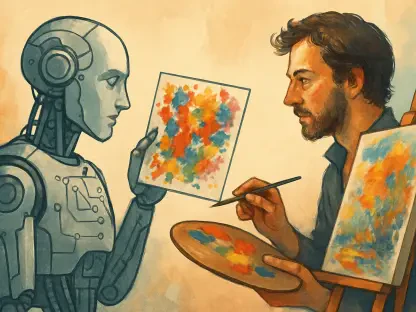

Artificial intelligence has rapidly transcended its role as a speculative concept to become a foundational, present-day force that is actively and fundamentally reshaping the global economy. This invisible hand of technology is not merely augmenting existing business processes but is completely rewriting the operational playbooks across industries, driving a monumental shift from reactive problem-solving to proactive, predictive action that was once the domain of science fiction. Across every major sector, a set of common, transformative themes has emerged: the hyper-personalization of goods and services, the intelligent automation of complex and repetitive tasks, and the profound augmentation of human capabilities, freeing workers to focus on strategic and creative endeavors. In this new landscape, the integration of AI is no longer a distant strategic choice for forward-thinking companies but has become a critical and immediate necessity for survival, competitiveness, and relevance in an increasingly automated and data-driven world.
Revolutionizing Core Human Services
Transforming Healthcare and Medicine
The impact of artificial intelligence in healthcare has been nothing short of revolutionary, primarily by enabling a critical transition from a historically reactive model to one centered on predictive and preventive medicine. Machine learning algorithms now serve as indispensable tools that significantly augment the capabilities of medical professionals, particularly in the realm of diagnostics. In fields such as radiology and pathology, AI-powered imaging analysis systems can scrutinize scans and tissue samples to detect diseases and subtle abnormalities with a level of speed and accuracy that often surpasses human experts. This capability leads to far earlier diagnoses for conditions like cancer, enabling more timely and effective treatment interventions. This enhancement of diagnostic precision represents a fundamental step forward in patient care, as it provides clinicians with deeper insights and reduces the potential for human error in interpreting complex medical data, ultimately contributing to better health outcomes for patients globally.
Beyond improving diagnostics, AI is also accelerating the entire drug discovery and development pipeline, a process that has traditionally been notoriously slow and expensive. By analyzing massive and disparate datasets encompassing genetic information, clinical trial results, and biological markers, AI algorithms can identify potential therapeutic compounds and predict their efficacy much more rapidly than conventional research methods. In the sphere of direct patient care, AI-powered chatbots and virtual health assistants are enhancing the accessibility and efficiency of services by offering immediate support, answering routine questions, and performing initial triage, thus freeing up human healthcare providers to handle more complex cases. The overarching result of this integration is the emergence of a healthcare ecosystem that is becoming more proactive, intelligently personalized, and operationally efficient, paving the way for a new standard in the delivery of medical services.
Redefining the Financial Sector
The financial industry has become one of the most enthusiastic and comprehensive adopters of artificial intelligence, leveraging the technology to dramatically enhance its speed, accuracy, and security. Algorithmic trading, driven by sophisticated AI models, now dominates global stock markets by executing millions of trades at speeds impossible for human traders. These systems continuously analyze vast streams of market data to identify subtle patterns and capitalize on fleeting opportunities, fundamentally altering the dynamics of modern finance. In the critical domain of security, AI-driven fraud detection systems provide an essential line of defense for both institutions and consumers. By monitoring transactions in real-time and learning the patterns of normal behavior, these systems can instantly identify and flag suspicious activities, stopping financial crimes before they can escalate into significant losses and fortifying the integrity of the entire financial network.
For consumers, the rise of AI-powered robo-advisors signifies a profound democratization of financial planning and wealth management. These automated platforms offer personalized, goal-oriented investment advice at a fraction of the cost of traditional human advisors, making sophisticated financial strategies accessible to a much broader audience. Internally, banks and fintech companies are deploying AI to refine and automate a wide range of critical processes, including risk assessment, credit scoring, and customer service. By analyzing extensive datasets, AI can generate more accurate credit risk profiles and streamline the loan approval process. This deep integration of intelligence into core financial operations is not just an incremental improvement; it is making the industry more precise, responsive, and fundamentally data-driven from the ground up, setting a new benchmark for performance and customer expectation.
Reshaping Commerce and the Supply Chain
Building the Smart Factory and Logistics Network
AI is the central nervous system of the modern “smart factory,” elevating industrial automation to an unprecedented level of sophistication and efficiency. Within these advanced manufacturing facilities, AI-powered robotics and autonomous systems work in concert to optimize assembly lines, adjusting their operations in real time to maximize output and adapt to changing production demands. Integrated sensor networks, coupled with machine learning algorithms, perform continuous quality control by detecting microscopic defects that would be imperceptible to the human eye, ensuring higher standards and reducing waste. A key innovation in this space is predictive maintenance, where AI analyzes data from machinery to forecast potential equipment failures before they occur. This proactive approach drastically reduces unplanned downtime, saves on costly emergency repairs, and extends the lifespan of critical assets, making the entire production process more reliable and cost-effective.
This technological integration extends far beyond the factory floor, revolutionizing the entire transportation and logistics industry. AI algorithms are now central to optimizing complex supply chains, planning the most efficient delivery routes by continuously analyzing dynamic variables like traffic patterns, weather conditions, and delivery windows. This reduces fuel consumption, lowers operational costs, and minimizes delays. The development of autonomous vehicles, including self-driving trucks and delivery drones, is gradually reshaping how goods are moved. In warehousing and fulfillment centers, AI-powered robots handle the sorting, packaging, and transport of items with exceptional speed and accuracy, enabling companies to meet the growing demands for rapid delivery. The ultimate goal of this transformation is the creation of a fully integrated, intelligent logistics network that is faster, cheaper, and more predictable than ever before.
Personalizing the Customer Journey
In the fiercely competitive sectors of retail and e-commerce, artificial intelligence is being used to fundamentally redefine the shopping experience, making it more intuitive, engaging, and deeply personalized for every consumer. E-commerce platforms now universally employ sophisticated AI algorithms to provide tailored product recommendations. By analyzing a user’s browsing history, past purchases, and even on-site behavior, these recommendation engines can predict consumer preferences with remarkable accuracy, driving sales and enhancing customer satisfaction. Alongside this, dynamic pricing algorithms constantly adjust product prices based on factors like demand, competitor pricing, and inventory levels to optimize revenue and clear stock efficiently. This level of personalization creates a more relevant and compelling online environment where customers feel understood, encouraging loyalty and repeat business in a crowded digital marketplace.
This AI-driven disruption extends from the digital storefront to the physical and operational backbones of retail. Behind the scenes, AI powers predictive inventory management systems that analyze sales data and market trends to forecast future demand, preventing costly stockouts of popular items and minimizing overstocking of slow-moving products. In customer service, 24/7 AI chatbots have transformed the support landscape by efficiently handling a high volume of routine inquiries, freeing human agents to focus on more complex or sensitive customer issues. This disruption is also permeating brick-and-mortar stores, where AI-driven analytics are used to monitor in-store shopper behavior, optimize product placement for maximum visibility, and facilitate frictionless automated checkout systems. The clear trend across the industry is toward creating a seamless, intelligent, and highly personalized shopping journey that bridges the gap between the online and offline worlds.
Innovating Content and Learning
Fueling Media and Entertainment
AI is comprehensively rewriting the rules of both content creation and consumption within the dynamic media and entertainment landscape. Streaming platforms leverage sophisticated machine learning algorithms to analyze vast quantities of user data, including viewing habits, ratings, and even the time of day a user watches. This allows them to provide highly personalized recommendations for movies, shows, and music that are key to driving user engagement and minimizing subscription churn. This analytical power not only enhances the user experience but also informs content acquisition and production decisions, enabling these platforms to invest in projects with a higher likelihood of success. The result is a media ecosystem where content is not just offered but is intelligently curated and delivered to align perfectly with individual tastes, transforming passive viewing into an active, personalized journey of discovery.
In the realm of content creation itself, artificial intelligence is rapidly becoming an invaluable tool for creatives and news organizations alike. It assists news outlets with automated reporting, data journalism, and real-time fact-checking, allowing journalists to produce more in-depth stories at a faster pace. In the film and television industries, AI accelerates time-consuming post-production tasks like video editing, color grading, and the generation of complex visual effects. It is even being used to compose original musical scores and generate scripts, acting as a creative partner to human artists. In the gaming industry, AI is used to create intelligent, responsive in-game opponents that learn from player behavior and to procedurally generate vast, dynamic game worlds, ensuring that no two gameplay experiences are exactly alike and blurring the lines between the creator and the technology.
Crafting the Future of Education
The education sector is on the cusp of a revolution, with AI promising to make learning more personalized, accessible, and effective for students of all ages and backgrounds. Adaptive learning platforms are at the forefront of this change, using AI to tailor educational content to each student’s unique learning pace and style. These systems can instantly identify where a student is struggling and provide targeted support, or recognize when a student has mastered a concept and introduce more advanced material. This continuous adjustment ensures that learners remain engaged and challenged without becoming overwhelmed or bored. By providing immediate, constructive feedback, these platforms help reinforce learning and build student confidence, transforming the traditional one-size-fits-all classroom model into a dynamic, individualized educational experience.
For educators and academic institutions, AI offers powerful tools to streamline administrative tasks and gain deeper insights into student performance. It can automate the grading of assignments, manage scheduling, and organize educational resources, thereby freeing up valuable teacher time to focus on instruction and mentorship. Furthermore, AI-powered analytics can process large datasets to predict student success, identify at-risk learners who may require additional support, and highlight areas where the curriculum could be improved. AI-powered tutors are also becoming increasingly available, offering students around-the-clock assistance with homework and test preparation. By enabling scalable and highly customized learning experiences, AI holds the immense potential to democratize education, breaking down geographical and economic barriers to make high-quality instruction available to a truly global audience.
A Paradigm Redefined by Intelligence
In retrospect, the pervasive and powerful influence of artificial intelligence became the definitive competitive differentiator of the modern era. The disruption it caused was not merely incremental but truly transformative, as it forged entirely new business models while rendering outdated ones obsolete with astonishing speed. Businesses that actively embraced and integrated AI into their core operations were positioned to gain immense and sustainable advantages in operational efficiency, product innovation, and customer satisfaction. Conversely, those that failed to adapt to this technological shift risked being left behind in a landscape that was fundamentally and irrevocably reshaped by intelligent systems. The AI revolution was not a future event to be planned for; it was a present-day reality that unfolded rapidly, pushing the boundaries of what was possible and redefining the very relationship between humanity and technology.