
The safety of a modern skyscraper or a bustling hospital often depends on structural components that no human eye has seen since the day the drywall was installed. While these buildings appear stoic and unwavering, their internal skeletons are subject to the silent stresses of thermal expansion, moisture infiltration, and the lingering aftershocks of regional tremors. Until recently, identifying a buckled stud or a corroded joint required a destructive “rip-and-see” approach, forcing engineers to tear down perfectly good walls just to check if the metal behind them was still holding strong.
Researchers at the University of Houston have recently introduced a diagnostic breakthrough that finally allows engineers to “see” through solid walls, transforming how we monitor the structural integrity of the buildings where we live and work. This innovation arrives at a critical juncture as the construction industry increasingly relies on materials that are efficient but difficult to monitor. By merging the penetrating power of radar with the cognitive speed of artificial intelligence, the team has created a non-invasive window into the hidden world of modern infrastructure.
The Invisible Threat Lurking Behind Modern Drywall
Maintaining the safety of a building often feels like solving a puzzle with missing pieces, as the most critical load-bearing components are frequently buried beneath layers of cladding and finishes. A sudden seismic tremor or a slow-moving leak can compromise a structure’s skeleton without leaving a single visible crack on the surface. Because these defects remain hidden, they can aggregate over time, leading to sudden failures that jeopardize both property and human life. This lack of transparency has long been the “Achilles’ heel” of structural health monitoring, creating a gap between perceived safety and actual stability.
The challenge is exacerbated by the fact that many modern buildings are designed with aesthetics and insulation as priorities, which further encases the structural frame in dense, multi-layered materials. When an engineer walks through a facility today, they are essentially looking at a mask. Without a way to look deeper, the industry has remained stuck in a reactive cycle, often waiting for visible signs of distress—such as sagging ceilings or jammed doors—before investigating the catastrophic damage already occurring within the wall cavities.
Why Traditional Building Inspections Are Failing the Modern Era
The construction landscape has shifted heavily toward the use of cold-formed steel (CFS), which now supports over 30% of nonresidential structures in the United States due to its sustainability and cost-effectiveness. However, these lightweight steel studs and joists are notoriously difficult to inspect once a project is finished. Unlike massive hot-rolled steel beams used in previous generations, CFS members are thinner and more susceptible to local buckling or corrosion if exposed to unrecognized environmental stressors.
Historically, checking for moisture-related corrosion or structural buckling required an invasive process that was not only prohibitively expensive and labor-intensive but also caused significant operational downtime for businesses and residents alike. Tearing out walls creates dust, noise, and waste, often making the inspection process almost as damaging as the potential defect itself. Consequently, many property managers defer these inspections, opting for a “wait and see” approach that inherently increases the long-term risk of structural failure in aging urban centers.
Synergizing Ground-Penetrating Radar with Artificial Intelligence
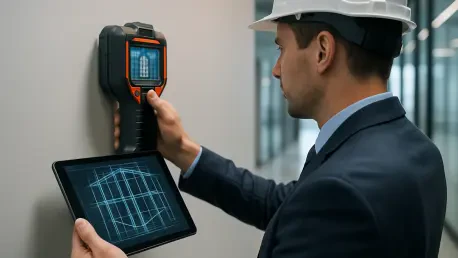
The solution to this “blind spot” lies in a sophisticated pairing of Ground-Penetrating Radar (GPR) and a specialized AI tool known as “InternImage.” GPR functions by sending electromagnetic pulses through wall surfaces, which bounce back as distinct echoes when they hit steel components. While these raw radar scans are often too complex for the human eye to interpret quickly—frequently appearing as a chaotic mess of gray squiggles—the AI acts as a digital translator. It processes these signals at lightning speed, identifying the precise signatures of steel amidst the background interference of insulation and wiring.
By using a novel training technique called “GPR-CutMix,” the system can filter out background electronic noise and irregular stud spacing, allowing the AI to automatically identify, box, and categorize structural defects like buckling or shifting with high precision. This technique is particularly vital because real-world construction is rarely as “clean” as a laboratory model. The AI was trained to recognize that a slight deviation in an echo pattern is not just a glitch, but a mathematical indicator of a structural anomaly that requires immediate engineering attention.
Insights from the Forefront of Structural Engineering
The development of this framework, detailed in the Journal of Computing in Civil Engineering, marks a significant leap in civil engineering. Lead researcher Vedhus Hoskere and industry expert Muhammad Taseer Ali emphasize that this technology moves structural assessment from a reactive “guess-and-check” method to a proactive, data-driven science. By utilizing a vast library of radar images that account for various architectural environments, the team created a tool that ensures what is out of sight is no longer out of mind. The result is a system that understands the “language” of steel reflections, even when those reflections are obscured by heavy cladding.
Experts suggest this represents a broader trend toward “smart” infrastructure management, where vision foundation models and geophysical tools work in tandem to extend the lifespan of urban environments. This shift is not merely about finding problems; it is about establishing a continuous record of a building’s health. By comparing scans over several years, engineers can now observe how a building “ages” internally, allowing for a level of precision in maintenance that was previously relegated to the world of high-tech manufacturing or aerospace engineering.
Implementing Non-Destructive Evaluation in Facility Management
For property managers and engineers, this technology provides a clear framework for maintaining large-scale infrastructure without the need for a sledgehammer. The process begins with rapid GPR scanning across entire floors, which is particularly vital for post-disaster assessments following hurricanes or earthquakes. Once the data is fed through the AI interpreter, facility managers receive a digital map of hidden anomalies, allowing them to focus maintenance budgets exclusively on confirmed problem areas. This targeted approach not only ensures building safety but also provides a scalable, cost-effective strategy for long-term health monitoring.
Looking forward, the integration of these tools into standard building protocols served as a blueprint for more resilient cities. This methodology shifted the focus toward preventive care, where minor adjustments were made long before a structural issue became a crisis. By embracing these non-destructive techniques, the industry moved away from guesswork and toward a future where the hidden components of our world remained as visible and manageable as the surfaces we see every day. The transition ensured that urban development remained sustainable, safe, and transparent for all stakeholders involved.