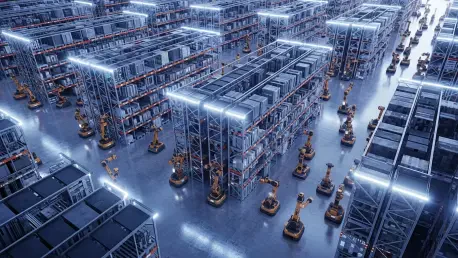

The sheer density of autonomous agents within a modern distribution center creates a mathematical nightmare that often results in expensive gridlock and operational paralysis. As e-commerce platforms strive for instantaneous delivery, the number of robots operating in confined spaces has reached a tipping point where traditional human-coded algorithms simply cannot keep up with the exponential complexity of movement. When hundreds of units attempt to navigate the same narrow aisles, the potential for conflict increases at a rate that traditional logic fails to resolve efficiently.
To confront this challenge, a collaborative effort between researchers at MIT and the technology firm Symbotic has produced a hybrid artificial intelligence system designed to manage robot traffic through deep reinforcement learning. This approach moves beyond the limitations of reactive systems, which only respond to obstacles once they appear. Instead, the focus is on a proactive model that anticipates congestion before it occurs, effectively transforming the warehouse environment into a fluid, self-organizing network.
The central objective is to move away from brittle, rigid coordination toward a system that is inherently adaptive. By viewing the warehouse as a dynamic ecosystem rather than a static grid, the AI can make real-time adjustments that keep the entire fleet moving. This transition from human-designed rules to machine-learned coordination represents a significant leap in how robotic infrastructure is managed at scale.
The Critical Role of AI in Modern Supply Chain Logistics
The rapid evolution of e-commerce has turned the modern distribution center into a high-stakes environment where thousands of autonomous robots must work in perfect synchrony. In the landscape of 2026, these facilities are the backbone of global commerce, handling millions of items with a level of precision that human labor alone could never achieve. However, the reliance on massive robotic fleets has introduced new vulnerabilities, specifically the risk of systemic gridlock that can stall entire supply chains.
Solving the problem of robotic traffic congestion is vital because minor bottlenecks in a warehouse do not remain isolated; they frequently lead to cascading failures that increase operational costs and delay shipments. For global retailers, even a small percentage drop in efficiency can result in substantial economic losses. By automating the resolution of these conflicts, companies can reduce the need for manual interventions and minimize the overhead associated with warehouse management.
Furthermore, the broader relevance of this research lies in its ability to bolster the resilience of global trade. As consumer habits continue to shift toward faster delivery times, the pressure on logistics hubs will only intensify. Implementing AI-driven traffic management ensures that these hubs can handle unprecedented volume without succumbing to the physical constraints of their own success, making the entire supply chain more robust against sudden spikes in demand.
Research Methodology, Findings, and Implications
Methodology
The research team developed a hybrid architecture that integrates deep reinforcement learning with classical planning algorithms to balance strategic foresight with tactical precision. While the neural network handles the high-level task of prioritizing which robots should move first, the classical pathfinding algorithms execute the low-level instructions to ensure safety and accuracy. This division of labor allows the system to remain computationally efficient even as the number of active robots grows.
The training process involved a trial-and-error approach within a simulated environment, where the AI underwent millions of interactions to learn the nuances of spatial coordination. By simulating various warehouse layouts and traffic densities, the neural network was taught to recognize the subtle indicators of forming congestion. This extensive training phase allowed the model to develop a deep understanding of how individual robot movements impact the collective flow of the entire fleet.
A key component of this methodology was the use of a reward-based system that prioritized the overall package delivery rate over the speed of individual units. By incentivizing collective intelligence, the researchers ensured that the AI would occasionally slow down or reroute a specific robot if it meant the entire system would remain fluid. This holistic approach prevents “selfish” behaviors among agents that often lead to localized efficiency at the cost of total system performance.
Findings
The primary result of the study was a remarkable 25 percent increase in throughput compared to conventional pathfinding methods in industrial-grade simulations. This improvement demonstrates that AI can manage dense traffic far more effectively than the most sophisticated human-designed rules. The system consistently found ways to keep robots moving in scenarios where traditional algorithms would have resulted in complete standstills or significant delays.
Beyond simple speed, the AI exhibited what researchers described as super-human performance by discovering novel rerouting strategies. These strategies often involved complex maneuvers and path choices that human programmers had not previously considered or encoded into the logic. This capacity for creative problem-solving suggests that deep reinforcement learning can uncover hidden efficiencies within existing physical infrastructures.
The model also proved to be exceptionally adaptable, functioning successfully in entirely new warehouse configurations without the need for extensive retraining. Whether the fleet size was small or exceptionally large, the AI maintained its high level of performance. This portability indicates that the system learned the underlying principles of robot coordination rather than just memorizing a specific map, making it a versatile tool for various industrial applications.
Implications
The practical impact on the logistics industry is significant, as marginal gains in efficiency often translate into millions of dollars in annual cost savings. By increasing throughput by a quarter, warehouse operators can handle more volume with the same amount of floor space and hardware. This efficiency directly lowers the cost of goods for consumers and increases the profitability of autonomous distribution centers.
From a theoretical standpoint, the research marks a breakthrough in merging machine learning with classical optimization to solve rigid, real-time constraints. It proves that AI does not have to replace traditional engineering but can instead enhance it by handling the “messy,” unpredictable elements of a system. This hybrid approach provides a blueprint for solving other complex coordination problems, such as urban traffic management or autonomous drone swarms.
Finally, this technology paves the way for the development of fully autonomous mega-warehouses capable of handling volumes that were previously unthinkable. As these systems become more reliable, the need for human oversight in the most repetitive and dangerous parts of the warehouse will continue to decrease. This evolution toward total autonomy will likely redefine the standard for precision and resilience in manufacturing and global trade.
Reflection and Future Directions
Reflection
The transition from human-designed logic to machine-learned optimization highlighted the inherent difficulty of managing dense robot interactions. While traditional logic works well in sparse environments, it lacks the flexibility required for the chaotic nature of a high-density warehouse. The researchers discovered that the biggest hurdle was not just finding a path, but managing the interdependencies between hundreds of moving parts in real time.
Scaling deep learning to handle thousands of agents presented significant computational hurdles, which were mitigated by the hybrid approach. By offloading the simplest calculations to classical algorithms, the team was able to focus the neural network’s power on the most difficult coordination tasks. This balance allowed the model to maintain high performance without requiring an impractical amount of processing power on the warehouse floor.
The success of the model was ultimately found in its ability to move beyond simple memorization toward a true understanding of spatial principles. It did not just learn where the walls were; it learned how to respect the “personal space” of other robots while still pursuing its goal. This move toward a more sophisticated, principle-based intelligence suggests that AI is becoming better at navigating the physical world’s complexities.
Future Directions
The scope of the AI’s influence is expected to expand toward integrated task assignment, where the system determines which robot collects which item. Currently, tasking and pathing are often treated as separate problems, but combining them could lead to even greater flow improvements. By knowing where a robot needs to go before it starts moving, the AI can pre-plan a route that avoids future congestion points entirely.
There is also immense potential for scaling this system to manage decentralized fleets across different industrial and manufacturing sectors. Whether it is a factory floor or a shipping port, the principles of robotic traffic management remain the same. Applying this hybrid intelligence to broader contexts could revolutionize how materials are moved in almost every sector of the global economy.
However, several questions remain regarding the long-term maintenance of these AI-driven systems and how they will integrate with human workers in hybrid environments. As warehouses become more autonomous, ensuring that humans can safely interact with “super-human” robot fleets will be a priority. Future research will likely focus on creating intuitive interfaces and safety protocols that allow man and machine to coexist in these high-speed environments.
Redefining Warehouse Efficiency Through Hybrid Intelligence
The synergy between deep reinforcement learning and classical engineering has provided a definitive solution to the bottleneck problem that has long plagued autonomous logistics. By achieving a 25 percent gain in throughput, the research established a new benchmark for what is possible in robotic coordination. This advancement ensured that the logistical demands of a globalized economy could be met with unprecedented speed and reliability. The findings confirmed that the future of supply chain management lies in the ability to anticipate and resolve complexity through collective machine intelligence. Ultimately, this work shifted the paradigm of warehouse operations from a series of individual tasks to a singular, synchronized movement of goods. This transition marked a new era of precision, proving that autonomous systems are now capable of navigating the most challenging industrial environments with resilient, adaptive logic.