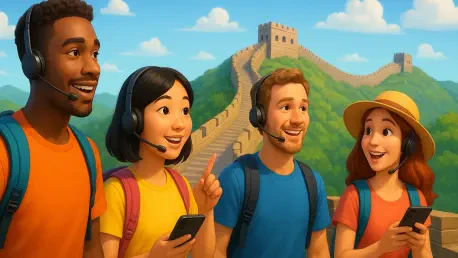

Standing before the architectural majesty of the Colosseum or the silent sentinels of the Great Wall of China often loses its inherent magic when the intricate stories behind the weathered stone are lost in a sea of unintelligible translation. For decades, international travelers have faced a frustrating choice: join a massive group in a language they barely understand or pay a premium for a private interpreter. This linguistic friction has long acted as a silent gatekeeper, dictating who gets to truly understand a culture and who merely observes it from the periphery. However, a quiet revolution is currently unfolding through headsets and smartphones, transforming the fundamental nature of global exploration.
Artificial intelligence is no longer just a futuristic concept confined to tech labs; it is actively dismantling the linguistic walls that have historically limited the scope of global tourism. In 2026, the travel industry is witnessing a pivot where data-driven insights and real-time processing allow for a more inclusive, high-fidelity exploration of the world’s most iconic sites. This shift toward digital integration represents more than a mere gadget upgrade; it is a fundamental reconfiguration of how cultural knowledge is shared across borders, ensuring that the nuances of history are accessible to everyone, regardless of their native tongue.
The End of the Language Barrier in Global Exploration
The dream of seamless communication has finally transitioned from science fiction to a standard operational reality for many top-tier travel providers. By leveraging neural networks that have been trained on millions of linguistic pairings, these systems can now interpret cultural idioms and historical terminology that would have baffled earlier iterations of translation software. This advancement ensures that the “soul” of a destination—the local legends and the specific regional humor—is preserved even when the listener speaks a language entirely different from the guide.
Moreover, the psychological impact on the traveler cannot be understated. When the barrier of misunderstanding is removed, the sense of isolation often felt in foreign lands begins to dissipate, replaced by a deeper connection to the local environment. This democratization of information allows for a more spontaneous form of travel where curious individuals can venture off the beaten path without the fear of being unable to ask questions or comprehend the significance of what they are seeing. It effectively turns every monument into an open book that anyone can read.
From Radio Waves to Neural Networks: The Evolution of Tour Tech
To understand where guided travel is headed, one must look at where it started—moving from basic megaphone-wielding guides to the radio-frequency systems that initially solved the problem of distance. While these analog tools ensured that a guest at the back of a group could hear the speaker, they were powerless against the problem of linguistic diversity. Tour operators frequently encountered “mixed-nationality departures” where a single group might consist of individuals speaking five different primary languages. This logistical nightmare often forced companies to split groups or hire multiple translators, which inevitably squeezed profit margins and diluted the overall guest experience.
The transition to AI-driven digital processing became a necessity as travelers began to demand more personalized and sophisticated interactions. Today, the reliance on basic radio waves is being supplemented by intelligent platforms that can process multiple streams of data simultaneously. This evolution marks the end of the “one-size-fits-all” narrative, moving the industry toward a model where the technology adapts to the audience rather than the audience struggling to adapt to the limitations of the technology. By bridging the gap between analog reliability and digital intelligence, tour tech has entered a new era of efficiency.
Breaking the “Mixed-Nationality” Deadlock With Aura
The introduction of specialized AI platforms like Aura is fundamentally changing the economics and inclusivity of group travel by offering sophisticated solutions to age-old problems. Modern systems now support up to 200 languages, allowing travelers to hear real-time translations in their native tongue via existing radio infrastructure. This is particularly vital because it removes the requirement for complex app downloads or high-speed data plans, which can often be a barrier for older travelers or those visiting remote areas with poor cellular reception.
Beyond mere translation, the technology now facilitates layered storytelling for diverse interests. On a single tour, a guide can provide a standard narrative while simultaneous digital channels offer a simplified version for children or a technical deep-dive for history buffs. Furthermore, inclusivity has moved beyond language to include physical accessibility; live subtitles can be streamed directly to smartphones to support guests who are deaf or hard of hearing. Unlike open-source AI that might “hallucinate” facts, these travel-specific systems use operator-approved, verified content to ensure that every historical detail remains accurate and culturally sensitive.
The “Guide-First” Philosophy: Why AI Won’t Replace the Human Element
Industry experts and long-standing travel organizations argue that the most successful technology remains “invisible,” supporting the human connection rather than replacing it. Travelers still crave the nuance, personality, and spontaneous humor that only a human guide can provide. By acting as an AI companion, these platforms handle the heavy lifting of real-time translation and data retrieval, which frees the guide to focus on emotional engagement and group safety. The technology serves as a bridge, not a substitute, ensuring that the heart of the tour remains authentically human.
When a guide is no longer stressed by the need to repeat themselves in multiple languages or check facts on the fly, they can better read the room and adjust their energy to match the group’s mood. The guide remains the storyteller, the navigator, and the cultural ambassador, while the AI functions as a high-powered assistant working silently in the background. This hybrid approach creates a synergy where the precision of the machine complements the empathy of the person, resulting in a journey that is both intellectually informative and emotionally resonant.
Strategies for Integrating AI Translation Into Tour Operations
For tour operators and Destination Management Companies looking to modernize, the transition to AI translation requires a clear framework for implementation. The first step involves auditing demographic needs to identify which languages are currently underserved in their departures, allowing for a prioritized rollout. Operators should also adopt a “built-in” mentality, ensuring that features like live subtitling and multi-channel audio are a standard part of the tour experience rather than an afterthought. This proactive approach ensures that every guest feels valued and included from the moment the tour begins.
To maintain brand integrity, it is crucial to curate a verified content library that feeds the AI system with the company’s specific research and regional anecdotes. Finally, staff training is essential to ensure that guides view AI as a powerful tool for answering unexpected questions rather than a competitor. The most successful organizations were those that treated tech integration as a holistic shift in service quality. They recognized that by streamlining the translation process, they could expand their market reach and provide a higher level of personalization that was previously impossible. This strategic adoption allowed for a more robust and resilient business model that thrived by connecting people more deeply with the world around them.