
The industrial landscape is currently witnessing a silent revolution where the traditional boundaries between digital logic and the tangible world are dissolving into a unified, physics-aware intelligence. For decades, the path to innovation was paved with the debris of failed prototypes, as engineers relied on a grueling cycle of build, break, and redesign. This reactive approach, however, has become an unsustainable burden in an age where a single error in a billion-dollar data center or a micro-precision robotic arm can result in catastrophic financial loss. The emergence of Physical AI is fundamentally flipping this script, moving the “breaking point” from the factory floor to a high-fidelity virtual world where the laws of nature are the ultimate judge.
This transformation is not merely about better software; it is about teaching machines to understand the immutable consequences of gravity, heat, and friction before a single physical component is ever manufactured. By grounding artificial intelligence in the rigorous framework of multi-physics simulation, the industry is transitioning toward a “simulation-first” architecture. This shift ensures that the next generation of industrial technology is born out of a digital truth that mirrors reality with uncanny precision, allowing for a level of optimization that was previously unimaginable.
The End of Trial-and-Error Engineering
In the current high-stakes environment, the luxury of physical experimentation has largely evaporated. As systems grow in complexity, the number of variables involved in a successful deployment—such as thermal dissipation in high-density server racks or the structural integrity of high-speed robotic joints—has outpaced the capabilities of human intuition. Physical AI addresses this by creating a sandbox where every action is governed by real-world physics. This allows developers to simulate millions of scenarios in a fraction of the time it would take to build a single physical prototype, ensuring that when the hardware finally hits the floor, it performs exactly as predicted.
Furthermore, this move away from trial-and-error reduces the environmental and economic footprint of innovation. Companies no longer need to waste raw materials or energy on iterative physical testing that often yields marginal gains. Instead, the computational power of modern AI clusters is used to refine designs to near-perfection. This methodology not only accelerates the development cycle but also democratizes high-end engineering, as smaller firms can now leverage virtual environments to compete with industrial giants that traditionally relied on massive physical R&D budgets.
Bridging the Chasm Between Digital Design and Physical Reality
The contemporary shift toward Physical AI is driven by the realization that modern industrial systems have become too intricate for traditional, compartmentalized modeling. In the past, electrical engineers, mechanical designers, and software developers often worked in silos, leading to unforeseen conflicts during system integration. Today, system-level modeling has become the new standard, allowing for the simulation of entire ecosystems—from power distribution grids to the mechanical stress on a single screw—within a unified digital framework.
This holistic approach is powered by the multi-physics mandate, which integrates thermal, mechanical, and electrical simulations into a single “source of truth.” Digital twins now serve as dynamic blueprints that evolve alongside their physical counterparts, providing a continuous feedback loop that informs hardware and software optimization. By simulating the micro-second lags in networking or the subtle shifts in heat distribution across a massive AI cluster, engineers can preemptively solve bottlenecks that would otherwise lead to expensive downtime or equipment failure.
The Convergence of Simulation, Silicon, and the Cloud
Realizing the full potential of Physical AI requires a sophisticated synergy between hardware providers, simulation experts, and cloud infrastructure. The expanded partnership between Cadence and Nvidia exemplifies this, as they integrate multi-physics simulation tools with CUDA-X and the Omniverse environment. This unified stack allows for the modeling of complex interactions within electronic systems at an unprecedented scale, ensuring that the infrastructure supporting modern AI is as robust as the algorithms themselves.
Simultaneously, the automation of semiconductor layouts is being revolutionized by AI-driven tools like Google Cloud’s ChipStack AI and Gemini models. By utilizing AI to manage the “back-end” of chip design—the physical mapping of circuits onto silicon—engineers are achieving productivity gains of up to 10 times. This creates a fascinating recursive loop: AI is now being used to design the very hardware that will execute future AI tasks, while cloud-native scaling allows engineering teams to access the massive computational resources required for these simulations on demand.
Expert Perspectives on the Accuracy-Quality Correlation
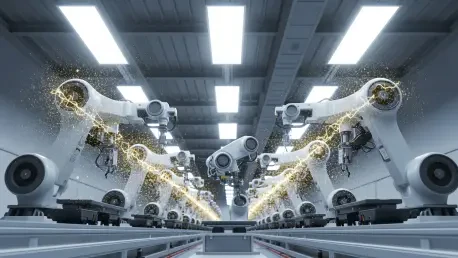
Industry leaders increasingly argue that the intelligence of an AI model is only as robust as the data used to train it, and in the industrial sector, that data must be physically accurate. This has led to the rise of the “sim-to-real” workflow, where companies like ABB, FANUC, and KUKA prioritize virtual commissioning. By testing robotic operations in a virtual space that perfectly replicates the physics of the factory floor, these companies can reduce deployment costs and ensure safety protocols are flawless before a robot ever moves in the real world.
Anirudh Devgan, CEO of Cadence, has noted that the precision of underlying physics models directly dictates the reliability of the resulting AI. This principle even extends to the frontier of quantum computing. Nvidia’s “Ising” models act as a sophisticated control plane for quantum processors, using AI to manage the fragile nature of qubits. By providing three times higher accuracy in decoding processes, these AI models help stabilize quantum systems, proving that physics-based intelligence is the essential bridge between experimental science and commercial application.
Strategies for Implementing a Simulation-First Framework
Transitioning to a Physical AI-driven workflow requires a structured approach that prioritizes the generation and use of high-quality synthetic datasets. By generating training data within physics engines, organizations can bypass the slow and often dangerous process of real-world data collection. This strategy allows AI models to encounter and learn from “edge cases”—rare but critical failure scenarios—that might never occur during limited physical testing, resulting in a more resilient and capable end product.
To successfully adopt this framework, companies must also embrace cloud-native scaling for electronic design automation. This allows for the dynamic allocation of resources, enabling teams to run massive parallel simulations that would overwhelm on-premise hardware. Finally, integrating virtual commissioning into the standard production pipeline ensures that every component of an automated assembly line is verified in a digital space. This holistic strategy not only accelerates time-to-market but also establishes a foundation for continuous innovation in an increasingly complex industrial world.
The integration of physics into the heart of artificial intelligence redefined the fundamental approach to industrial engineering. Developers successfully transitioned from reactive troubleshooting to predictive design, ensuring that complexity no longer equaled fragility. As these technologies matured, the focus shifted toward creating self-optimizing systems that maintained peak efficiency through continuous virtual-physical synchronization. This progression solidified a new era where the digital and physical worlds operated as a single, harmonious entity, driving unprecedented gains in both productivity and reliability.