
In the high-stakes world of aerospace and high-tech manufacturing, the difference between a flawless component and a catastrophic failure often lies in microscopic defects that the naked eye—and even standard cameras—simply cannot see. To navigate the complexities of modern quality control, we turn to the expertise of a technologist specializing in artificial intelligence and machine learning. This conversation explores a breakthrough in multimodal sensor fusion, examining how advanced state-space models are moving beyond the limitations of traditional RGB imaging. We delve into the mechanics of cross-sensor semantic guidance, the challenges of maintaining sub-millimeter precision in vibrating factory environments, and the future of real-time industrial anomaly detection.
Traditional RGB cameras often overlook geometric scratches or heat dissipation issues. How do these undetected flaws specifically impact reliability in aerospace manufacturing, and what technical hurdles must be cleared to effectively merge thermal and depth data into a single, cohesive inspection workflow?
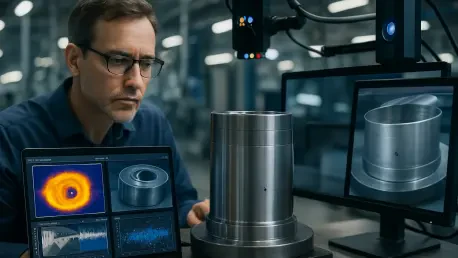
In the aerospace sector, the stakes are incredibly high because a single undetected micro-crack or a pocket of subsurface delamination can lead to catastrophic structural failure under the extreme pressures of flight. Traditional RGB cameras are often blinded by the surface finish of composite materials, failing to see the heat dissipation irregularities that signal an internal weakness or the subtle dents that compromise aerodynamics. The primary technical hurdle in merging thermal and depth data is that these sensors operate on different spatial scales and spectral frequencies, making it difficult to synchronize them without losing fine detail. When we attempt to fuse these modalities, we often face the “quadratic cost” of dense attention mechanisms, which can slow down the system so much that it becomes unusable on a fast-moving production line. Furthermore, if the fusion isn’t “alignment-aware,” even a tiny physical shift between the thermal lens and the depth scanner can create ghost images or artifacts that lead to expensive false alarms or, worse, missed defects.
Thin, oblique defects require long-range context that often triggers excessive computational costs. How do state-space recurrences maintain linear efficiency while capturing these orientation-sensitive patterns, and could you walk us through the step-by-step process of exchanging semantic guidance between different sensors at high-level feature stages?
To solve the efficiency problem, we utilize state-space recurrences through a framework called MambaAlign, which processes data in a way that scales linearly rather than quadratically. This allows the system to scan across long-range pixels to identify thin, diagonal scratches that a local window might miss, all without the massive memory overhead typical of global attention models. The process begins by extracting features from each sensor independently, and then, at the high-level semantic stages, we implement a “Cross Mamba Interaction.” In this step, the “semantic guidance” from the thermal sensor—say, a hot spot indicating a friction point—is used to tell the RGB stream exactly where to look for visual discoloration. By only exchanging this complex information at the deeper, more abstract layers of the network, we keep the computation lightweight while ensuring both sensors are working in harmony to confirm the presence of a defect.
Harsh factory environments frequently cause sensors to become slightly misaligned, resulting in fragmented anomaly maps. How does a top-down reconstruction mechanism preserve precise localization under these conditions, and what specific metrics confirm that this approach provides more actionable data for engineers compared to traditional attention-heavy models?
Factory floors are noisy, vibrating environments where a sensor can easily be knocked out of alignment by just a few millimeters, which usually causes standard AI models to produce “fragmented” or messy anomaly maps that engineers can’t interpret. Our approach uses a top-down reconstruction mechanism that takes the high-level “fused” understanding and meticulously reconstitutes it back down to the low-level pixel channels. This ensures that even if the raw inputs are slightly shifted, the final output is a tight, cohesive map that points to the exact location of the flaw with high precision. The data proves this works: we’ve seen an improvement of approximately 5.0% in pixel-level AUROC and a 6.5% boost in the area under the per-region overlap curve (PRO) compared to previous methods. For an engineer, these numbers mean the system isn’t just saying “something is wrong,” but is providing a clear, sharp heat map of the defect that reduces the time spent on manual verification.
High-speed conveyor belts demand real-time processing and low memory overhead to avoid production bottlenecks. Given the need for a 30-frame-per-second standard, how does this fusion framework optimize performance for electronic component inspection, and what anecdotal evidence shows its effectiveness in reducing manual quality control labor?
To prevent production bottlenecks, the MambaAlign framework is specifically optimized to maintain a processing speed of nearly 30 frames per second, which is the gold standard for keeping up with modern high-speed conveyor belts. By replacing heavy global attention layers with state-space recurrences, we reduce the memory footprint significantly, allowing the system to be deployed on edge devices right at the inspection station rather than requiring a massive server room. In practical applications like printed circuit board assembly, this has been a game-changer because it can catch micro-cracks or missing components that are invisible to the human eye but show up clearly in fused thermal-geometric patterns. This reduces the grueling manual labor of quality control, as workers no longer have to squint at thousands of identical boards; instead, they only step in when the system flags a “tighter,” more reliable anomaly, drastically cutting down on the volume of scrap and human error.
What is your forecast for industrial anomaly detection?
I believe we are moving toward a future where “invisible” defects will no longer exist because every production line will utilize a unified, multimodal “nervous system.” As state-space models continue to mature, we will see sensors like ultrasound and hyperspectral imaging being integrated into this 30-frame-per-second workflow without adding any significant cost or complexity. Within the next few years, the standard for quality control will shift from reactive sorting to proactive, alignment-aware systems that can detect the structural “DNA” of a part as it is being built. This will eventually lead to nearly zero-waste manufacturing, where the AI doesn’t just find a crack after it happens, but identifies the thermal and geometric precursors to that crack before the component even leaves the assembly station.