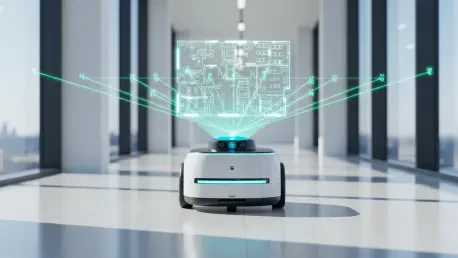

While humans effortlessly connect a snapshot of a room with its abstract representation on a blueprint, this intuitive leap has long remained a monumental hurdle for artificial intelligence. Multi-modal computer vision represents a significant advancement in this domain, aiming to bridge the gap between disparate data types. This review will explore the evolution of technology for linking visual modalities, such as photographic images and architectural floor plans, by analyzing its key features, performance metrics, and the profound impact it has on various applications. The purpose of this analysis is to provide a thorough understanding of this technology, its current capabilities, and its potential for future development.
An Introduction to Cross-Modal Correspondence
At the heart of this technological leap lies the principle of cross-modal correspondence, which addresses the long-standing challenge of teaching machines to link different types of visual data. The concept involves establishing a direct relationship between a view from one perspective or modality, like a ground-level photo, and another, such as a top-down schematic. This goes far beyond simple object recognition; it is about creating a unified understanding from fundamentally different sources of information.
Achieving this correspondence is pivotal for enabling machines to develop a more human-like grasp of spatial contexts. Traditional computer vision has excelled at interpreting photographs, but its capabilities have been largely confined to that single modality. By learning to correlate photos with abstract representations like floor plans, AI systems can begin to comprehend the geometric and structural relationships within an environment, moving toward a more holistic and context-aware form of intelligence.
Core Innovations and a New Technical Framework
The C3Po Model for Pixel-Level Accuracy
A central innovation in this field is a new machine learning model designed for this task, nicknamed C3Po, which stands for “Cross-View Cross-Modality Correspondence by Pointmap Prediction.” The model’s primary function is to establish precise, pixel-level matches between a photograph taken from any viewpoint inside a building and its corresponding two-dimensional floor plan. It effectively learns to answer the question: “Where on this map does this specific point in the photo exist?”
This model represents a paradigm shift in how machines perform spatial interpretation. Instead of approximating a general area, C3Po is trained to predict a specific coordinate on the floor plan for every single pixel within an input photograph. Its performance has set a new standard, demonstrating a level of accuracy that was previously unattainable and signaling a move toward more granular and reliable machine perception.
The C3 Dataset as a Foundational Resource
A key theme in the advancement of AI is the critical role of high-quality data. Recognizing that a primary barrier to progress was the lack of suitable training materials, researchers developed the C3 dataset. This massive and meticulously curated collection contains 90,000 paired floor plans and photographs, covering nearly 600 unique scenes. Such diversity ensures that models trained on this data are exposed to a wide range of architectural styles, interior layouts, and lighting conditions, fostering more robust and generalizable learning.
The true significance of the C3 dataset lies in its detailed annotations. It includes an astonishing 153 million pixel-level correspondences and 85,000 camera poses, which provide the ground-truth information necessary for training a model with this level of precision. By rectifying the “data gap” that historically limited vision models when processing non-photographic inputs, this dataset serves as a foundational resource for the entire computer vision community, enabling the development of more versatile and powerful systems.
Emerging Trends in 3D Computer Vision
The progress in cross-modal correspondence reflects a much broader trend across the entire field of artificial intelligence: the shift toward multi-modal systems. The consensus is that the next generation of intelligent systems must be able to ingest, process, and synthesize information from an array of sources, including text, images, sounds, and schematic diagrams. This capability is essential for building a comprehensive and nuanced understanding of the world.
This line of research serves as a pioneering step in bringing 3D computer vision in line with this trend. While areas like natural language processing have seen rapid advances with large, multi-modal models, 3D vision has been perceived as lagging. The successful development of systems that can link photos to plans helps push the domain toward a new frontier, one where AI can integrate diverse spatial inputs to form a more complete digital picture of reality.
Real-World Applications and Use Cases
The practical implications of precise photo-to-plan mapping are vast and already emerging in several sectors. In robotics and autonomous navigation, this technology allows machines to better orient themselves within complex indoor environments, correlating what their cameras see with a pre-existing map to navigate more accurately and safely. Similarly, in fields like architecture and construction, it streamlines the creation of advanced 3D models and digital twins by automating the alignment of real-world imagery with design schematics.
Beyond these core areas, the technology enables unique and impactful use cases. For instance, it can power sophisticated indoor navigation aids for individuals with visual impairments, providing precise turn-by-turn directions within unfamiliar buildings. It also dramatically simplifies the digital reconstruction of physical spaces for virtual reality applications, real estate showcases, and historic preservation, reducing the manual labor required to align thousands of photographs with architectural plans.
Overcoming Key Technical Challenges
The primary technical challenge this technology addresses is the inherent difficulty computers face when comparing dramatically different visual representations. A photorealistic image is composed of color, texture, and light, while a floor plan is an abstract line drawing representing structural boundaries. Finding direct correspondences between these two domains is not a trivial task for an algorithm that lacks human intuition.
Prior methods struggled significantly with this problem, often producing localization errors that rendered them impractical for real-world use. The breakthrough came not just from a better model, but from the recognition that the model needed better data. The development of a specialized, large-scale dataset was the essential component that mitigated this limitation, providing the necessary volume and quality of examples for an AI to learn the complex patterns connecting a 3D scene to its 2D abstraction.
The Future of Spatially-Aware AI
Looking forward, this technology lays the groundwork for the next generation of spatially-aware AI. The long-term vision is the development of large-scale 3D computer vision models capable of seamlessly integrating all types of inputs related to a scene—from photographs and floor plans to LiDAR scans and textual descriptions. Such a model would possess a deep, multi-faceted understanding of its environment.
The potential breakthroughs from such an integrated approach are significant. It could lead to far more capable autonomous systems, such as delivery drones that can navigate the interior of a skyscraper or household robots that can intuitively understand the layout of a home. Ultimately, the goal is to imbue AI with a more holistic and profound environmental awareness, bringing its perceptual capabilities closer to our own.
Conclusion and Overall Assessment
This research represents a pivotal advancement in computer vision, offering a potent solution to the complex problem of cross-view, cross-modality correspondence. The C3Po model establishes a new benchmark for performance, achieving a 34% reduction in error over previous state-of-the-art methods. In tandem, the C3 dataset provides the field with a foundational resource to train a new generation of spatially intelligent systems.
The creation of these tools marked a turning point for the field. It demonstrated a tangible pathway toward building AI that can process and synthesize disparate forms of spatial information with high fidelity. This work not only solved a long-standing technical problem but also unlocked new possibilities for enhancing the autonomy and environmental awareness of intelligent systems, setting the stage for future innovations in robotics, navigation, and digital modeling.