
The evolution from single-interaction chatbots to sophisticated, stateful artificial intelligence agents capable of executing complex workflows has introduced an infrastructural bottleneck that threatens to stall progress. These advanced agentic systems are designed to reason over extended periods, utilize external tools, and maintain persistent memory to inform their actions, but the very data center architectures that enabled previous AI breakthroughs are now fundamentally ill-equipped to handle their unique demands. As the computational cost associated with remembering vast interaction histories grows at an exponential rate, it is becoming clear that existing hardware cannot keep pace. This widening gap between the memory requirements of agentic AI and the capabilities of current infrastructure necessitates a paradigm shift in how AI memory is stored, managed, and accessed, creating a critical barrier to the widespread, cost-effective deployment of this transformative technology.
The Widening Disparity in Memory Performance
At the core of this challenge lies the Key-Value (KV) cache, the operational memory component that stores the intermediate states of a transformer model, allowing it to generate new content without recomputing an entire conversational history. For agentic AI, this cache becomes the system’s persistent memory, growing linearly with the length of each interaction sequence. Organizations are currently trapped in an inefficient and costly dilemma, forced to choose between two deeply flawed options for managing this vital data. The first option is to store the KV cache directly on the GPU’s High-Bandwidth Memory (HBM), which offers the ultra-low latency required for real-time interaction. However, HBM is an exceedingly scarce and expensive resource. As foundation models scale into the trillions of parameters and context windows expand to millions of tokens, the sheer size of the KV cache can easily overwhelm the available HBM, making this approach economically unviable and unscalable for large-scale agentic deployments.
The alternative strategy involves offloading the KV cache to slower, general-purpose storage systems like traditional Network-Attached Storage or Storage Area Networks. While this approach effectively solves the capacity problem, it introduces unacceptable levels of latency, often measured in milliseconds. This delay is catastrophic for real-time agentic interactions, as it leaves powerful and costly GPU accelerators sitting idle while they wait for data to be retrieved from the slower tier. This idleness not only cripples the performance and responsiveness of the AI agent but also dramatically inflates the Total Cost of Ownership (TCO) by wasting enormous amounts of energy and valuable compute resources. Furthermore, these general-purpose systems are burdened with features like heavy durability guarantees and data replication, overheads that are entirely unnecessary for the KV cache, which is derived, ephemeral data that can be easily regenerated if lost, making them a profoundly inefficient solution for this specific workload.
An Engineered Solution for AI Context
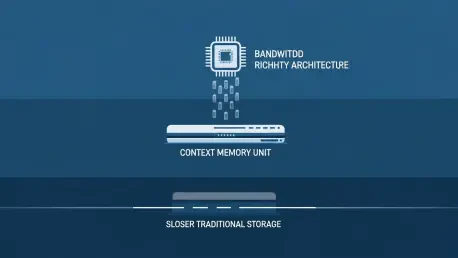
To resolve this architectural mismatch, a new, purpose-built memory tier has been introduced, effectively creating an intermediate layer engineered to handle the unique characteristics of AI context memory. This solution, exemplified by platforms like NVIDIA’s Inference Context Memory Storage (ICMS), is an Ethernet-attached flash storage layer designed explicitly for the high-velocity, ephemeral, and latency-sensitive nature of gigascale AI inference workloads. The platform integrates directly into the compute pod and utilizes advanced Data Processing Units (DPUs), such as the NVIDIA BlueField-4, to offload the management and movement of the context data from the host CPU. This strategic offloading frees up the main processor to focus on other critical tasks while simultaneously streamlining the entire data handling process. This architecture creates a vast, low-power memory pool that provides petabytes of shared capacity, allowing multiple agents to leverage it concurrently and fundamentally decoupling the growth of an agent’s memory from the finite and costly supply of GPU HBM.
The introduction of this dedicated context tier has yielded significant and measurable improvements in both performance and efficiency across the board. By intelligently “pre-staging” memory blocks—moving them from the intermediate tier back to the GPU’s HBM just before they are needed—this system minimizes the idle time of the GPU decoder. This proactive data management results in a performance enhancement of up to five times higher tokens-per-second for long-context workloads, enabling smoother and more responsive agentic interactions. In parallel, the architecture delivers substantial power savings by eliminating the wasteful overhead associated with general-purpose storage protocols that are irrelevant for KV cache management. This targeted design provides up to five times better power efficiency compared to traditional methods of offloading context, which directly reduces operational costs and improves the overall energy footprint of the data center, making large-scale AI more sustainable.
Redefining the Data Center for an Agentic Future
The practical implementation of this new architecture has required a holistic shift in data center design and management, extending far beyond the hardware itself. The solution is underpinned by high-performance networking, specifically technologies like NVIDIA Spectrum-X Ethernet, which provides the high-bandwidth, low-jitter connectivity needed to treat this new storage tier as a seamless extension of local memory. Its success, however, depends critically on a mature software and orchestration layer. Frameworks such as NVIDIA Dynamo, the Inference Transfer Library (NIXL), and the DOCA framework work in concert to manage the intelligent placement and movement of KV cache blocks between the memory tiers, ensuring data is available precisely when and where the AI model needs it. This concept is already gaining significant traction across the industry, with major storage vendors, including Dell Technologies, HPE, and Pure Storage, actively developing platforms integrated with advanced DPus to support this revolutionary architecture.
This evolution toward memory-intensive agentic AI has rendered the traditional separation of fast compute and slow, persistent storage obsolete. The adoption of a dedicated, purpose-built context memory tier represents a critical architectural innovation that allows enterprises to scale AI agents with massive memories without being constrained by the prohibitive cost of GPU HBM. For organizations planning future infrastructure investments, evaluating the efficiency of the entire memory hierarchy has become as vital as the selection of the GPU itself. This requires CIOs to reclassify KV cache as a distinct data type—”ephemeral but latency-sensitive”—and deploy topology-aware orchestration software to co-locate compute jobs near their cached context. While this architecture increases usable capacity and compute density, it also demands more robust planning for power distribution and cooling, cementing a new paradigm for high-performance data center strategy.