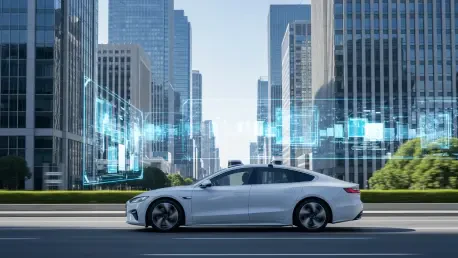

The global push toward fully autonomous transportation has reached a critical juncture where the limitations of traditional, hand-coded software are giving way to the vast potential of physical artificial intelligence. This shift is not merely an incremental upgrade but a fundamental reimagining of how vehicles perceive, interpret, and react to the unpredictable nature of real-world driving environments across the globe. By establishing a strategic technical framework, industry leaders are now addressing the historical fragmentation that has long plagued the sector, particularly the reliance on disparate components from multiple vendors that often leads to soaring project risks and unsustainable development costs. The current collaboration between major hardware and software providers aims to dissolve these barriers, offering a production-ready advanced driver assistance system that bridges the gap between experimental prototypes and mass-market deployment. This integration simplifies the complex engineering required to bring reliable autonomy to the average consumer.
Transitioning Toward Data-Driven Driving Intelligence
Wayve’s core technological philosophy represents a departure from rule-based autonomy, which traditionally depends on hyper-detailed, location-specific mapping that is difficult to scale effectively. Instead, the focus has shifted toward a unified foundation model trained on massive, diverse datasets harvested from driving scenarios across various continents and road types. This “embodied AI” methodology allows a vehicle to learn driving behaviors through continuous real-world exposure, granting it the ability to navigate unfamiliar streets without the need for bespoke engineering for every new city or region. Such a system is designed to generalize its knowledge, applying learned patterns from one environment to another with remarkable fluidity. This capability is essential for overcoming the “long tail” of edge cases—those rare and unpredictable events that rule-based systems often struggle to resolve. By prioritizing adaptive learning over rigid programming, the industry is creating vehicles that exhibit more human-like intuition on the road.
Powering this sophisticated software requires a compute architecture that can handle intense neural processing while maintaining the highest levels of energy efficiency and safety. The Snapdragon Ride system-on-chips provide the necessary foundational hardware, offering a safety-certified environment that includes robust redundancy, real-time system monitoring, and secure isolation of critical functions. This hardware layer is specifically optimized to run complex AI models at the edge, ensuring that decisions are made in milliseconds without relying on constant cloud connectivity. The synergy between high-performance silicon and adaptive software layers allows for a seamless flow of data, from sensor input to steering commands, while minimizing the power draw that can impact the range of electric vehicles. As these processors become more integrated into the vehicle’s central architecture, they enable a more holistic approach to safety, where every component is designed to work in concert to protect passengers and pedestrians alike in increasingly dense urban traffic.
Standardizing Scalability and Brand Differentiation
A primary challenge for modern automakers is the need to implement reliable autonomous capabilities across an entire fleet without ballooning the total cost of ownership or development time. The current trend toward pre-integrated hardware and software stacks offers a streamlined path to deployment, allowing manufacturers to adopt an open architecture that remains platform-agnostic. This flexibility ensures that software remains portable across different vehicle tiers and model years, enabling a consistent user experience whether the system is installed in a budget-friendly sedan or a luxury SUV. By utilizing a standardized core, companies can focus their engineering resources on fine-tuning the brand-specific features that drive consumer loyalty and market distinction. This approach also secures long-term optionality, as both hardware and software providers explore the transition from current driver assistance levels to the eventually deployment of fully autonomous Level 4 robotaxi fleets.
The balance between industry-wide standardization and unique brand identity is becoming the cornerstone of successful automotive business strategies in the physical AI era. While automakers utilized standardized hardware and software cores to control operational overhead, the open framework permitted them to retain total control over the brand-specific experiences that defined their presence in the market. Industry leaders increasingly viewed these pre-integrated alignments as the most practical route to delivering complex intelligence without the risks associated with in-house development from scratch. By combining high-performance compute capabilities with a flexible intelligence layer, the sector moved toward a more efficient path for deploying automated driving features. This synthesis of specialized hardware and adaptive models functioned as the primary driver in reducing development cycles, ensuring that manufacturers remained competitive in a rapidly evolving global landscape while they transitioned from simple assistance to more complex systems.
Future Considerations for Automated Mobility
To remain relevant in the evolving mobility sector, automotive manufacturers should prioritize the adoption of unified AI architectures that reduce the need for expensive, localized mapping updates. Future roadmaps must focus on the integration of end-to-end neural networks that can handle both perception and planning in a single, cohesive framework, as this reduces latency and improves overall system reliability. Stakeholders should also invest in safety-critical hardware that supports over-the-air updates, ensuring that vehicles can benefit from the latest AI breakthroughs without requiring physical hardware replacements. This strategy will be vital as the industry moves from “hands-off” driving to “eyes-off” operation, where the vehicle assumes full responsibility for safety. By fostering collaborations that bridge the gap between silicon innovation and machine learning, the automotive industry can accelerate the delivery of safer, more efficient transportation solutions that are ready for the diverse demands of global roads.