
The sophisticated physical agility of modern legged robots often belies a fundamental limitation in their ability to acquire new skills directly from the people they are designed to assist. A groundbreaking framework developed by a collaborative research team is challenging this status quo by drawing inspiration from an age-old partnership: the intuitive learning dynamic between a human and a dog. This innovative approach moves beyond the confines of pre-programmed instructions, offering a pathway toward robots that can learn, adapt, and evolve through natural interaction, potentially transforming their role in our daily lives.
This research, a joint effort by experts from Korea University, ETH Zurich, and the University of California Los Angeles, introduces an interactive training system designed to give robots the capacity for continuous, real-world learning. The work addresses one of the most significant hurdles in modern robotics: the gap between a robot’s advanced mechanical capabilities and its cognitive inflexibility. By emulating the tried-and-true methods of canine training, the system enables even non-expert users to teach complex behaviors, paving the way for a new generation of truly collaborative robotic partners.
The Challenge: Breaking Free from Pre-Programmed Limitations
Despite significant advancements in mechanical engineering, today’s most advanced legged robots operate under a rigid set of constraints. Their ability to navigate complex terrain, climb stairs, or recover from a stumble is impressive, yet these skills are typically the result of countless hours of programming and simulation-based training. Consequently, their operational knowledge is static. When faced with a novel task or an unfamiliar environment, they cannot improvise or learn a new solution on the fly, a critical failure point that severely restricts their utility in unpredictable human-centric settings like homes, hospitals, or disaster sites.
This inherent rigidity means that a robot’s usefulness is fundamentally limited to its pre-installed skill set. If a user needs the robot to perform a task it was not originally designed for, the only solution has been a complex and time-consuming process of reprogramming by an expert. This dependency creates a major barrier to widespread adoption, preventing these physically capable machines from becoming truly personalized and adaptable assistants. The research aims to dismantle this barrier, envisioning a future where robots can be taught new skills as easily as one might teach a dog a new trick.
The Inspiration: Emulating the Human-Canine Learning Model
The core of this research represents a significant paradigm shift, moving away from the traditional, code-heavy methods of robotic training toward a more organic, interactive alternative. The inspiration comes directly from observing the intuitive and highly effective learning process that unfolds between a dog and its trainer. This relationship is not based on programming but on communication, feedback, and shared understanding, allowing for the fluid acquisition of complex behaviors through demonstration and reinforcement.
This human-canine model offers a compelling blueprint for human-robot interaction. Professional trainers often use a technique known as “luring,” where a reward is used to physically guide a dog into performing a desired action, such as sitting or lying down. Over time, the physical lure is replaced by a verbal command or hand signal as the dog internalizes the connection between the cue and the action. This research successfully translates this principle to robotics, creating a system where physical guidance serves as the initial teacher, gradually giving way to learned responses based on human commands.
Research Methodology, Findings, and Implications
Methodology
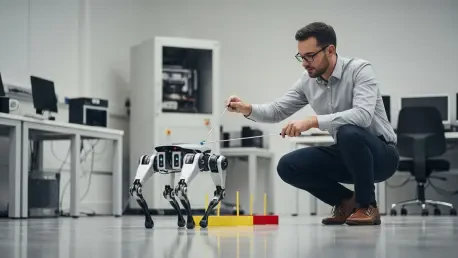
Researchers developed an interactive framework centered on the dog-training technique of luring. To achieve this, they employed a physical “teaching rod” that a user moves to guide the robot’s actions. For instance, to teach the robot to navigate a zigzag course, the user simply moves the rod in the desired pattern, and the robot learns the necessary sequence of leg movements and body adjustments by following it. This direct physical guidance provides the robot with clear, unambiguous data about the target behavior, forming the foundation of the learning process.
Once the robot demonstrates proficiency in following the physical lure, the system transitions to the next phase: associating the learned motor skills with specific commands. The user can then prompt the robot to perform the new skill using gestures or verbal cues, effectively phasing out the teaching rod. A crucial innovation that makes this process highly efficient is a scene reconstruction module. This technology captures the initial real-world interactions and uses them to generate a high-fidelity digital simulation of the environment. The robot can then practice the new skill independently within this virtual space for thousands of iterations, dramatically accelerating the learning curve without requiring continuous human supervision.
Findings
The effectiveness of this dog-inspired training approach was rigorously tested in a series of experiments with a real four-legged robot. The results demonstrated the framework’s ability to facilitate the rapid acquisition of diverse and agile skills. The robot successfully learned to perform complex behaviors, including approaching a user on command, accurately jumping over obstacles of varying heights, and navigating a winding course by zigzagging between objects.
These experiments validated the methodology with remarkable quantitative success. Across the range of taught behaviors, the robot achieved an overall task success rate of 97.15%. This high level of performance, achieved after a relatively brief period of interactive training and simulated practice, confirms that the hybrid approach is a powerful and viable method for teaching robots new skills. The findings provide strong evidence that emulating the principles of animal training can effectively bridge the gap between human intention and robotic action.
Implications
The implications of this framework extend far beyond the laboratory, suggesting a future where robots are more accessible and customizable. By allowing non-expert users to teach robots new behaviors directly, this system has the potential to make them profoundly more adaptable to the specific needs of an individual or a household. Instead of being constrained by a fixed set of factory-installed abilities, a robot could be personalized to perform unique tasks, from navigating a cluttered apartment to assisting a person with mobility challenges in a specific way.
This research presents a powerful alternative to the complex and specialized knowledge of programming currently required to modify a robot’s behavior. It empowers users to become teachers, fostering a collaborative relationship where the robot’s skill set can evolve over time. This capability is a critical step toward the seamless integration of robots into complex and ever-changing human environments, making them more like helpful partners and less like single-purpose tools.
Reflection and Future Directions
Reflection
A primary challenge the research team faced was the inherent inefficiency of collecting enough real-world interaction data to train a robust learning model. Teaching a robot through physical interaction alone can be a slow and laborious process, often requiring thousands of repetitions to achieve reliability. This data bottleneck has long been a significant obstacle for interactive machine learning.
The team’s innovative hybrid solution proved to be the key to overcoming this limitation. By combining a small number of crucial, data-rich teaching sessions in the real world with extensive, independent practice in a digitally reconstructed environment, they were able to achieve the best of both worlds. The real-world guidance provided the foundational understanding, while the high-fidelity simulation enabled the robot to refine and master the skill with exceptional data efficiency. This approach significantly accelerated the learning curve and proved essential to the project’s success.
Future Directions
With the core framework now validated, the research team plans to expand its capabilities to teach more sophisticated skills. The immediate goal is to address complex “loco-manipulation” tasks, which require the robot to coordinate its movement with object interaction—for example, picking up an object while walking or opening a door. These tasks represent a higher degree of difficulty and are essential for robots to become truly functional in human spaces.
Looking further ahead, the team aims to apply this interaction-based methodology to different types of robots, most notably humanoid platforms. Teaching a bipedal robot to perform sophisticated, whole-body behaviors through natural human interaction presents an exciting and formidable challenge. Success in this area could unlock new possibilities for humanoid robots in fields ranging from elder care to collaborative manufacturing, bringing the vision of intuitive human-robot collaboration closer to reality.
Conclusion: A New Era of Collaborative Robotics
By drawing inspiration from the intuitive and effective process of dog training, this research provided a viable and highly efficient framework for teaching robots new and complex skills. The successful implementation of a “luring” system, combined with a data-efficient simulation module, allowed a quadruped robot to learn agile behaviors with an exceptionally high success rate. This work marked a significant advance beyond the rigid constraints of pre-programmed robotics.
The findings heralded a pivotal shift toward a new generation of robots capable of continuous learning and adaptation through natural collaboration with humans. This approach not only makes advanced robotics more accessible to the average user but also fosters a more dynamic and personalized relationship between people and machines. Ultimately, this research laid crucial groundwork for the seamless integration of intelligent, adaptable robots into the fabric of everyday life, transforming them from programmed tools into genuine partners.