
Microsoft Garage is ending after 17 years, leaving a practical question for companies investing in new technology: how do you give useful experiments room to grow? Quinn Hawkins, who helped establish the program, credits its longevity to supporting employees who wanted to build, rather than requiring them to win approval for an idea. His account offers a useful lens for AI tool development, where a small workplace problem can be a more productive starting point than a sweeping business proposal.
Useful Software Began With a Problem Someone Wanted to Fix
Microsoft already had grassroots innovation initiatives with larger budgets when the Garage began, Hawkins recalls. Those programs generally invited employees to submit proposals, vote on them and fund selected winners. He argues that this process favored familiar ideas and people comfortable promoting them, while making unusual insights harder to recognize.
The Garage removed that selection step. Employees could work on small projects without first persuading a committee that their idea deserved support. A frustrating part of someone’s daily work was enough reason to start.
CodeFlow illustrates how that approach could produce software with wider value. Clark Roberts, Victor Boctor and Mike Cook built it because reviewing code felt unnecessarily painful. Their project spread among Microsoft engineering teams and ultimately reached Visual Studio.
Other experiments addressed equally specific needs. Philip Su created Dr. Who to make finding colleagues inside Microsoft quicker. Truong Do built Mouse Without Borders because he wanted to control several computers using a single keyboard and mouse; it became the Garage’s first publicly released project.
These examples distinguish the program from an idea competition. Each began with a user who understood the problem well enough to build a solution. Hawkins believes none would have won a vote, yet all proved useful.
For teams experimenting with AI, the relevant lesson is about how work begins. A hypothetical assistant for an awkward internal task could be tested against that task before anyone makes claims about a new platform. The first question becomes whether the tool helps its intended user, with broader ambition following the evidence.
| Garage practice | What it made possible | Question for an AI tool team |
|---|---|---|
| Let employees build without a vote | Testing ideas that lacked broad initial support | Can someone try a small prototype before seeking wider approval? |
| Start with a personal work problem | A clear reason to use the resulting software | Which specific task would the tool improve? |
| Allow useful projects to spread | A route from local use toward wider adoption | What would justify extending the experiment to another team? |
A Small Central Budget Created Local OwnershipA Small Central Budget Created Local Ownership
The Garage’s limited funding shaped its operating model. Hawkins describes an initial setup consisting of himself, a contractor and modest spending on food and event supplies. Compared with better-funded initiatives, that looked like a disadvantage.
It also meant the central team couldn’t simply pay for every request. When employees at Microsoft’s Hyderabad campus wanted a science fair, the Garage offered support but asked them to arrange funding themselves.
Hawkins says that requirement had two effects. Motivated employees took responsibility for organizing the event, and local leaders became invested once they agreed to fund it. The fair belonged to the campus rather than feeling like an activity imposed from elsewhere.
Bing and the Developer Division followed a similar pattern, sponsoring their own events. Leaders attended because they had a stake in the outcome. Successful fairs then gave the Garage concrete examples to show the next group considering one.
That approach distributed responsibility as well as costs. In Hawkins’s assessment, competing programs with substantial central funding remained more isolated, while the Garage became something multiple groups felt they owned.
An AI experimentation program could use the same principle without copying the event format. A central team might provide guidance while a participating business unit identifies the task and commits time to testing. That arrangement would make local involvement part of the experiment, rather than treating employees as an audience for technology chosen elsewhere.
There’s a trade-off. Requiring local backing can screen for commitment, but it may also make participation harder for teams with less capacity. The practical aim should be clear ownership, not using a lack of resources as proof that a worthwhile idea deserves to disappear.
Large Revenue Targets Can Interrupt Early Learning
Hawkins connects another Garage decision to a story involving Steve Ballmer’s visit to Office Labs. Chris Pratley told him that Ballmer subsequently asked where the next billion-dollar opportunity was.
For Hawkins, the question captures a mismatch between small experiments and large-company expectations. A business earning tens of millions annually could represent a major entrepreneurial success while still looking too small inside Microsoft. Meanwhile, projects aimed at enormous markets could require resources that grassroots teams couldn’t obtain.
He also points to Facebook and Twitter as businesses whose early versions lacked a revenue model. His argument is that requiring a credible path to billions before experimentation starts can eliminate opportunities before their potential becomes visible.
The Garage avoided that promise. Its purpose was to help employees develop skills, release projects, connect with colleagues across Microsoft and improve work within their existing teams.
Ben Gilbert, who took over the Garage after Hawkins, described its output largely in terms of culture and retaining talented employees who returned to their regular roles with renewed energy. That is a different measure from creating a standalone business.
For an AI program, the distinction should influence what gets measured. A limited experiment might reasonably be assessed through questions such as:
- Does the prototype improve the task it was built to address?
- Can the team explain its limitations and the conditions under which it works?
- Has testing produced useful learning, even if the tool won’t be expanded?
- Is there a committed owner for any further development?
Those questions aren’t evidence that a project will become commercially significant. They provide a way to decide its next step without demanding a scale of success that the initial experiment was never designed to demonstrate.
The People Carried the Building Habit Beyond the Program
Hawkins describes Garage participants as employees who wanted the stability of a corporate job alongside the freedom to pursue something of their own. Many already spent evenings and weekends writing software. The program gave that motivation somewhere to go.
Several later moved into prominent technology roles. Su went on to become a technology CEO and a site lead for Facebook and OpenAI. Vijaye Raji built Small Basic as a side project before founding Statsig and becoming CTO of Applications at OpenAI.
The CodeFlow builders also continued into engineering leadership. Boctor became a Technical Fellow at Airbnb; Roberts leads engineering at TaxBit; Cook became an engineering leader at Clipboard Health. Those careers don’t establish that the Garage caused their later success, but they show the kind of people it attracted.
Gilbert had a similar background, developing iPhone apps outside his main job before leading the program. Hawkins connects that willingness to make something to Gilbert’s later work with David Rosenthal on Acquired.
The relevance for AI organizations is broader than recruiting specialist talent. A useful internal environment gives motivated employees permission to investigate problems they understand, while letting them retain a connection to their everyday work. Some value may remain with the team even when a prototype never becomes a product.
Freedom Needs an Identity and Sensible Boundaries
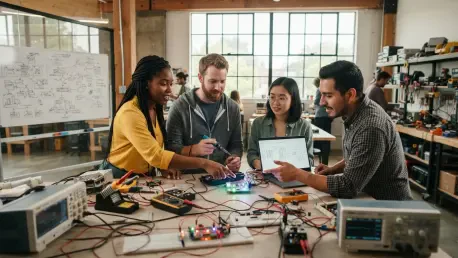
The Garage also cultivated a deliberately less formal atmosphere. Hawkins recalls a provocative sticker borrowed from J Allard’s Xbox work, increasingly ambitious volcano demonstrations and access to a laser cutter after limited training.
Some employees disliked the language. Others worried that the emphasis on building excluded colleagues who couldn’t code, a criticism Hawkins accepts. He saw a distinctive identity as part of running a small experimental program, even when it didn’t appeal to everyone.
An AI initiative should consider that tension carefully. Enthusiastic builders need room to experiment, but a coding-centered culture could overlook people who understand the work a proposed tool is meant to support. Participation and technical freedom are separate design choices.
The more theatrical Garage activities also shouldn’t be treated as a deployment model. For AI tools, the freedom to create a prototype needs to sit alongside deliberate decisions about testing, access and responsibility before wider use.
Hawkins expects the Garage’s influence to persist through its participants and their relationships. Its closure brings that legacy into focus just as companies are deciding how to organize AI experimentation: begin with a concrete problem, give someone ownership and judge the next step on what testing reveals. That offers a practical way to support new tools without making every small project carry the expectations of an entire business.