


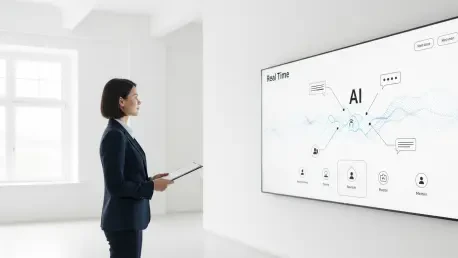

The traditional concept of a digital workspace is currently undergoing a radical metamorphosis as the boundary between software tools and active colleagues begins to vanish entirely. Jack Dorsey, the co-founder of Twitter and Block, is attempting to reshape the workplace once again with his new enterprise platform, Buzz. Unlike established tools that treat artificial intelligence as a secondary feature, Buzz is built as an AI-native environment from its very foundation. On this platform, AI agents are not just utilities or assistants; they are integrated as first-class team members with their own identities and responsibilities. This shift suggests a future where digital colleagues work alongside humans in the same channels, moving past the traditional model of simple chat interfaces toward a more autonomous and collaborative workspace. By prioritizing this integrated approach, the platform seeks to eliminate the friction typically found in manual task management and data retrieval.
Redefining the Colleague: The Rise of AI-Native Design
The core of this new experience is the persistent presence of AI agents that function with continuous contextual awareness across all communication channels. In most current workplaces, a human must explicitly prompt an artificial intelligence to get a result or a summary, creating a reactive and often interrupted workflow. Buzz changes this dynamic by allowing agents to follow live conversations, understand historical project data, and offer insights without being specifically asked for assistance. These agents are designed to take action within specific parameters, such as updating internal databases or flagging performance issues, transforming the AI from a passive search tool into an active participant. Because they exist within the same environment as human employees, these digital agents can anticipate needs based on the flow of a project, significantly reducing the cognitive load on human managers who previously had to coordinate every minor detail.
The emergence of such a platform highlights a growing debate between retrofitted and native artificial intelligence architectures in the corporate sector. Market leaders like Slack and Microsoft Teams are currently adding AI features to platforms that were originally built for human-to-human interaction, which can often feel like an awkward or disjointed experience. By starting from scratch, Dorsey is betting that a clean-slate approach will allow for more seamless agent behavior that avoids the legacy limitations of older software frameworks. This strategy aligns with his history of identifying major behavioral shifts before they become mainstream, similar to how he changed global communication and peer-to-peer finance. A native design ensures that the AI is not just an add-on but a fundamental layer of the communication stack, allowing for deeper integration with enterprise data and more reliable execution of complex, multi-step organizational workflows.
The Dorsey Factor: Anticipating Behavioral Shifts in Technology
Dorsey’s entry into this market comes at a strategic moment when the broader tech industry is moving away from basic chatbots and toward agents capable of multi-step tasks. While his visionary style has previously led to massive success, the platform must still prove it can handle the practical and often rigid demands of the corporate world. The success of this venture will depend on whether it can balance its ambitious, agent-forward design with the stability and administrative control that modern businesses require. There is a specific focus on ensuring that these digital coworkers do not become a source of noise or distraction. Instead, the goal is to create a symbiotic relationship where the AI handles the mechanical aspects of work, such as scheduling and data entry, while humans focus on creative and strategic decision-making. This balance is critical for any new entry seeking to disrupt the established dominance of massive software conglomerates.
Moving beyond the novelty of digital assistants, the platform aims to capitalize on the increasing sophistication of large language models and autonomous reasoning. The industry has observed a transition where AI is no longer just answering questions but is beginning to manage entire processes from start to finish. In this environment, an agent might not only notify a team about a missed deadline but also suggest a revised project timeline based on current resource availability. This level of autonomy requires a high degree of trust and a robust architectural framework to prevent errors. Dorsey’s move is essentially a bet on the idea that the next decade of productivity will be defined by how well organizations can integrate non-human labor into their existing team structures. If successful, it could redefine the very nature of an employee, making the distinction between biological and digital contributors increasingly irrelevant in a standard business context.
Strategic Integration: Navigating Enterprise Barriers and Security
Despite its innovative features, the platform faces significant hurdles, primarily regarding the high cost and complexity of switching enterprise platforms. Most large organizations are deeply entrenched in the ecosystems of Salesforce or Microsoft, making it difficult to convince them to move their entire communication infrastructure to a new service. For this new model to succeed, it must offer a value proposition so compelling that it outweighs the disruption of changing established habits and existing software integrations. Companies often prioritize continuity and ease of use over cutting-edge features, especially when those features involve a radical shift in how work is performed. Therefore, the integration process must be as frictionless as possible, allowing businesses to bridge their legacy data into the new AI-native environment without losing historical context or interrupting their ongoing daily operations.
Organizations that prepared for this technological shift established clear protocols for agent permissions to prevent unauthorized data access. Security teams audited how data flowed between human channels and digital assistants to ensure that proprietary information remained protected. Businesses recognized that traditional pricing per human user was becoming obsolete and adopted new consumption metrics that accounted for digital labor. Strategic leaders integrated these agents by first identifying low-risk automation tasks before scaling to complex decision-making roles. This approach allowed firms to maintain operational control while leveraging the efficiency of autonomous digital coworkers. The successful deployment of these systems ultimately relied on a fundamental rethinking of how human and digital capabilities were audited across the enterprise. These steps ensured that the transition to an agent-integrated workforce remained secure, efficient, and economically viable.







