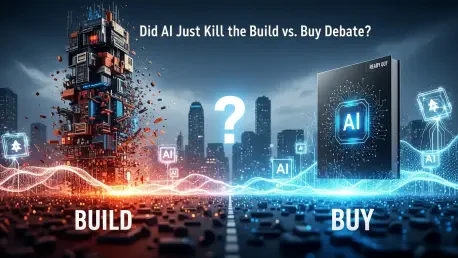

In an environment where a customer experience associate with zero coding knowledge can diagnose a software bug, generate a solution, and deploy a fix in less time than it takes to brew a pot of coffee, the foundational pillars of corporate technology strategy have not just been shaken—they have been pulverized. For generations of executives, the “build versus buy” question was the definitive strategic crossroad for any software need, a complex calculation of cost, risk, and competitive advantage. That entire framework, once the bedrock of IT and finance departments, is rapidly becoming a relic of a bygone era. The emergence of powerful, accessible AI tools has not merely offered a new answer to an old question; it has fundamentally changed the question itself, creating a new operational paradigm that prioritizes speed, empirical learning, and the democratization of technical power.
A Decades Old Question Rendered Obsolete by a 15 Minute Fix
The strategic landscape of enterprise software was once defined by a clear and rigid binary choice. Companies faced a monumental decision with long-term consequences: invest heavily in a custom-built solution tailored to unique internal processes or purchase a standardized, off-the-shelf product from a third-party vendor. This choice influenced budgets, staffing, and operational roadmaps for years. It was a high-stakes deliberation, as a misstep could lead to bloated expenses, inefficient workflows, or a critical loss of competitive edge. The entire decision-making process was built on a set of stable assumptions about the high cost and specialized skills required for software development.
Today, that stability has been shattered. The very notion that software creation is the exclusive domain of highly trained engineers is dissolving. A customer support agent, armed with an intuitive AI coding assistant, can now directly address a user-reported issue, transforming a plain-English problem description into functional code. This is not a theoretical future but a practical reality. A process that once required creating a ticket, waiting for it to be prioritized in an engineering sprint, development, testing, and finally deployment—a cycle that could take weeks or months—can now be compressed into a matter of minutes. This profound shift renders the old build vs. buy framework obsolete by dismantling its core premise: that building is inherently slow, expensive, and difficult.
The Old Playbook Why Build Versus Buy Was the Only Game in Town
The traditional logic underpinning the build vs. buy debate was a straightforward calculus of strategic value. Organizations were advised to build software that was core to their competitive advantage—the proprietary algorithms, unique user experiences, or specialized operational systems that set them apart. For standardized functions like human resources, payroll, or accounting, where differentiation offered little benefit, buying a proven, off-the-shelf solution was the prudent path. This division created a clear, defensible strategy that allowed companies to focus their most valuable and scarce resource—engineering talent—on what truly mattered.
This strategic clarity was reinforced by the prohibitive economics of building custom software. The undertaking required a massive and sustained investment that went far beyond initial development. It meant recruiting, retaining, and managing dedicated teams of expensive engineers, designers, and project managers. Development cycles were notoriously long and unpredictable, often stretching for months or even years. Perhaps most significantly, the launch of a custom application was only the beginning of a long tail of costs associated with maintenance, bug fixes, performance monitoring, and inevitable updates, creating an ongoing and often unpredictable drain on company resources.
In contrast, buying software from an established vendor offered a safe harbor from this storm of complexity and risk. Purchasing an off-the-shelf product provided a faster, more predictable, and often more cost-effective path to acquiring needed functionality. Timelines were shorter, costs were clearly defined through licensing or subscription fees, and the risks associated with development were transferred to the vendor. Furthermore, buying came with the assurance of professional support, regular updates, and a feature set that had been tested and validated by a broad market of users, making it the default choice for any non-critical business function.
The Tsunami of Change How AI Demolished the Core Assumptions
The recent explosion of AI-powered code generation tools has acted as a great equalizer, demolishing the traditional barriers to software creation. Tools capable of translating natural language prompts into sophisticated code have shattered the long-held constraints of cost, time, and specialized knowledge. The ability to build is no longer gated by fluency in programming languages like Python or JavaScript but by the ability to clearly describe a problem in English. This radical accessibility has democratized development, transforming it from a niche specialty into a capability available to a much broader swath of the workforce.
This technological disruption has given rise to a new paradigm that inverts the old decision-making process: build to learn what to buy. The new model is an empirical and cyclical process that de-risks major technology investments. It begins with empowering an employee or team closest to a business problem to build a lightweight prototype using AI. This rapid, low-cost development allows them to gain a visceral, hands-on understanding of their actual needs. Only after achieving this “hard-earned clarity” do they approach the commercial market. The critical question is no longer a speculative “Will this solve our problem?” but a far more powerful, evidence-based query: “Is this commercial product significantly better than the working solution we have already built ourselves?”
The most profound impact of this shift is the true democratization of problem-solving. It moves the power to create solutions from a centralized engineering department to the individuals on the front lines who experience the business challenges most acutely. A financial analyst can prototype a custom reporting tool, or a marketing manager can build a script to automate a tedious data-entry task. This decentralization not only accelerates innovation by unburdening engineering teams from smaller requests but also fosters a more capable and empowered workforce, fundamentally changing how work gets done across the entire organization.
Insights from the New Front Line a 15 Minute Fix and a Physicists Warning
The transformative potential of this new reality is best illustrated through concrete examples. Consider the compelling case of a customer experience (CX) team member with no formal coding background. After receiving a customer complaint about a minor but persistent bug on the company website, this employee used an AI development environment to investigate. By describing the issue in plain language, the tool helped identify the problematic section of code. The employee then prompted the AI to generate a fix, which was submitted to the engineering team for a quick review and deployed. The entire process, from initial customer complaint to a live production fix, was completed in just 15 minutes, showcasing a level of agility previously unimaginable.
However, alongside this immense opportunity comes a significant risk, a modern-day trap that physicist Richard Feynman once described as “cargo cult science.” Companies, eager to appear innovative, risk superficially adopting AI without fundamentally changing their internal processes. They purchase software with an “AI” label and integrate chatbots, believing they are becoming “AI-native.” In reality, they are merely building a symbolic airstrip where the cargo planes of productivity never land. The true value of AI is not unlocked by buying products with the right buzzwords, but by cultivating a culture where employees are empowered to use AI as a tool to build, experiment, and solve their own problems directly. Without this fundamental shift in workflow and empowerment, any investment in AI technology becomes little more than expensive decoration.
A Practical Framework for the Post Debate Era
Navigating this new landscape requires a new playbook. The first step is to identify a high-friction business problem. Instead of pursuing a vague mandate to “implement AI,” successful organizations focus on a specific, tangible challenge that slows down a team or creates a poor customer experience. This grounds the effort in real-world value from the outset. Once the problem is defined, the next crucial step is to empower the problem-owner. The individual or team most affected by the issue should be equipped with accessible AI development tools and given the autonomy to experiment with solutions. This ensures that the person with the deepest contextual understanding is driving the innovation.
The goal of this initial phase is not to build a scalable, enterprise-grade application, but to build for clarity. The team should be tasked with creating a rapid, functional prototype designed to test assumptions and discover the true requirements of a viable solution. This hands-on process generates invaluable institutional knowledge that can never be acquired from a vendor’s sales presentation. Armed with a working prototype and this hard-earned clarity, the organization can then evaluate the commercial market from an entirely new position of power. The conversation with vendors changes dramatically. The question becomes, “Does your product solve our validated problem significantly better than what we already built ourselves?” This approach transforms a company from a dependent customer into an informed buyer, ensuring that any subsequent purchase delivers overwhelming and undeniable value.
What became clear was that the fundamental calculus of software acquisition had been irrevocably altered. The rigid, binary choice between building or buying, a decision that had defined corporate strategy for decades, was replaced by a more fluid, intelligent, and empirical process. Organizations that embraced this shift moved faster, allocated capital more effectively, and developed a deeper understanding of their own operational needs. They stopped wasting millions on shelfware that solved problems they never truly had. The ultimate disruption came not from a new piece of software, but from a new way of thinking, where any employee with a good idea could build a prototype that accomplished 80% of what a company was about to spend a fortune to acquire, changing the rules of the game for good.