
The recent $12 million oversubscribed Seed 2 funding for Helix Earth marks a pivotal moment in the evolution of the built environment, signaling that the investment community is ready to bet on tangible hardware over purely digital solutions. Led by Veriten and supported by a global syndicate, this capital injection demonstrates a clear shift toward technologies that address the massive energy footprint of commercial infrastructure. By repurposing advanced liquid-gas chemistry originally intended for space travel, the Houston-based startup is targeting the most significant energy drain in modern buildings: the conventional HVAC system.
From NASA Labs to the $150 Billion HVAC Market
For decades, the $150 billion commercial air conditioning sector has struggled with a fundamental inefficiency where units must overcool air simply to manage humidity levels. This legacy approach results in staggering energy waste and inflated operational costs for building owners across the globe. Understanding this historical bottleneck is essential for appreciating why previous green initiatives often stalled due to high costs and the “rip and replace” requirement of new installations. Helix Earth enters this landscape with a strategy that prioritizes compatibility, reflecting a maturing industry that values immediate, scalable impact over theoretical perfection.
Revolutionizing Energy Use Through Decoupled Dehumidification
The Technical Breakthrough: Decoupling Temperature and Moisture
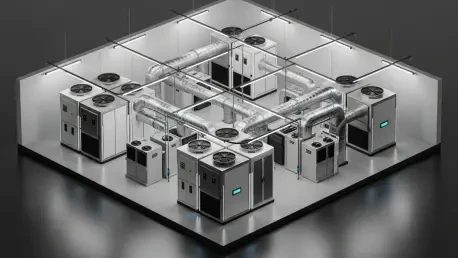
The proprietary liquid-gas chemistry allows the system to separate the cooling process from dehumidification, a feat that standard HVAC units cannot achieve efficiently on their own. By managing moisture independently, the hardware ensures that cooling coils do not have to work double duty, leading to an order-of-magnitude leap in overall system performance. This technical precision translates into more stable indoor environments, which is particularly critical for sectors managing sensitive electronic equipment or perishable inventory.
Breaking the Cost Barrier: The Retrofit Advantage
One of the primary barriers to sustainable building management has always been the prohibitive capital expenditure associated with new hardware. Helix Earth bypasses this obstacle by offering a “drop-in” solution that enhances existing systems rather than demanding their removal. This approach shortens the payback period for property owners and extends the operational life of current assets. Real-world applications suggest that this modular philosophy is the fastest route to decarbonizing the commercial sector without disrupting daily business operations.
Expansion: Industrial Filtration and Carbon Capture
The versatility of the underlying chemistry extends far beyond climate control and into the complex realms of industrial air purification and CO2 sequestration. By integrating filtration directly into existing industrial workflows, the company challenges the misconception that carbon capture must be a massive, standalone utility-scale operation. This flexibility allows for a multifaceted approach to environmental remediation, providing industries with a tool that scales alongside evolving regional carbon taxes and air quality regulations.
Shaping the Future of the Built Environment
Looking ahead from 2026 and beyond, the intersection of aerospace innovation and commercial real estate will likely be defined by “smart” hardware that integrates perfectly with modern building management systems. Experts anticipate that stricter humidity and air quality mandates will become the norm, driven by both climate volatility and public health requirements. As Helix Earth scales its manufacturing capabilities, the success of this NASA-derived technology will likely inspire further public-private partnerships, accelerating the transition of high-stakes research into mainstream terrestrial applications.
Actionable Strategies for Sustainable Asset Management
Stakeholders in the commercial sector should prioritize identifying “efficiency leaks” where legacy systems are currently failing to manage moisture effectively. Decision-makers should favor modular, add-on solutions that offer measurable data for ESG reporting, as this transparency will be vital for future compliance and investor relations. By adopting technologies that decouple energy-intensive processes, businesses can insulate themselves from rising utility rates while simultaneously moving toward their broader sustainability objectives.
The Long-Term Impact of Scalable Innovation
The strategic deployment of this $12 million funding round provided the necessary foundation for a fundamental shift in how the commercial sector viewed energy consumption. It became clear that the integration of aerospace-grade chemistry into ground-level hardware offered a pragmatic path toward total system optimization. This development encouraged property managers to rethink the lifecycle of their existing infrastructure and paved the way for more sophisticated carbon management strategies. Ultimately, the transition to a high-efficiency model proved that the most effective solutions were those that balanced technical brilliance with economic accessibility.