


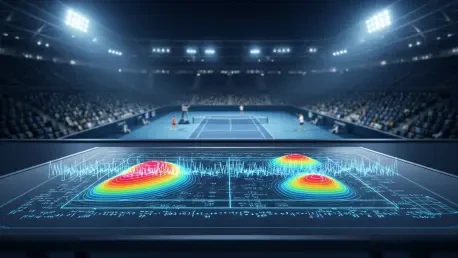

Standing at the baseline of a sun-drenched court in Indian Wells, a professional player prepares to launch a serve that could change the entire trajectory of their season and career. While the audience sees the tension in the player’s shoulders and hears the rhythmic bounce of the ball, sophisticated artificial intelligence systems are seeing something entirely different. They are processing thousands of historical data points, real-time atmospheric conditions, and the biometric fluctuations of the athletes to produce a live win probability that shifts with every micro-movement. In this high-stakes environment, the challenge lies not just in collecting the data, but in translating the chaotic, emotional reality of a tennis match into a structured digital framework. Modern forecasting has moved far beyond simple win-loss records, evolving into a multi-layered analytical process that seeks to quantify the intangible elements of the sport. By leveraging machine learning architectures, analysts can now strip away the noise of the crowd and the drama of the moment to reveal the underlying mathematical truths that govern the outcome of every set. This transformation of raw information into actionable intelligence represents the pinnacle of sports technology in 2026, offering a level of insight that was previously reserved for the most seasoned professional coaches and scouts.
1. Gathering Initial Data Points
The journey from a live match to a digital prediction begins with the massive accumulation of fundamental statistical markers that define a player’s professional profile. This foundational layer includes exhaustive datasets covering tournament tiers, official player rankings, and the granular details of thousands of previously completed matches. However, the true value of this initial gathering phase lies in its depth, as it captures every ace, double fault, and break point converted across diverse global circuits. These raw numbers serve as the skeletal structure of the predictive model, providing a historical baseline against which current performances can be measured. Without this broad historical context, a single victory might be misinterpreted as a sign of rising dominance rather than a statistical outlier. The systems must ingest data from various sources, ensuring that the information is comprehensive enough to account for the vast differences between a high-stakes Grand Slam final and a lower-tier Challenger event where the pressures and rewards differ significantly.
Building upon these basic statistics, the data collection process must also incorporate environmental and situational variables that often go unnoticed by the casual observer. This includes the geographical location of the tournament, the specific time of day the match is scheduled, and the historical performance of the athletes during specific months of the year. For instance, a player might demonstrate a consistent peak in physical condition during the North American hard-court swing but struggle with the humidity of the Asian swing. By amassing these peripheral data points, the AI begins to construct a more nuanced picture of an athlete’s professional journey. The integration of this diverse information requires robust data pipelines capable of handling various formats and frequencies, ensuring that the model has access to the most relevant facts before any complex analysis begins. This stage is less about finding answers and more about ensuring that the model has a sufficiently large and varied “library” of facts to reference during the more advanced stages of the prediction process.
2. Filtering Out Irrelevant Information
Once the massive influx of data has been collected, the next critical step involves a rigorous purification process designed to remove inconsistencies and misleading signals. In the world of professional sports, data is rarely perfect; it is often plagued by recording errors, missing entries, or anomalies caused by external disruptions. For example, a match that ends abruptly due to a player’s injury or retirement can produce a scoreline that suggests a dominant victory when, in reality, the outcome was decided by physical failure rather than tactical superiority. The filtering phase involves the application of complex algorithms that identify and flag these distorted data points, ensuring they do not skew the final forecast. By cleaning the dataset, the system ensures that the “noise” of rare accidents does not drown out the “signal” of genuine performance trends. This meticulous preparation is what separates a basic statistical tool from a professional-grade predictive engine capable of operating under high-pressure conditions.
Furthermore, the filtering process must account for extreme environmental factors that can fundamentally alter the way the sport is played. Matches held at high altitudes, such as those in Bogota or certain European mountain regions, present a unique challenge because the thinner air significantly affects ball flight and player cardiovascular endurance. If the model were to treat a high-altitude victory the same as a sea-level win, the resulting predictions would be inherently flawed. The AI must therefore recognize these unique circumstances and either adjust the weights of those data points or isolate them as specialized case studies. Similarly, matches played under a closed roof versus an open sky can vary wildly in terms of wind interference and court temperature. Refining the data to account for these nuances allows the model to maintain its integrity across different contexts. This phase of the process is essentially a quality control mechanism, ensuring that only the most reliable and representative information moves forward into the actual predictive calculations.
3. Developing Meaningful Performance Metrics
Moving beyond the surface-level results, the model shifts its focus toward the creation of sophisticated performance indicators known as “features.” These are not just simple averages but are instead carefully engineered metrics that capture specific aspects of a player’s tactical identity and recent form. For example, rather than simply looking at a player’s overall win percentage, the system might calculate their success rate when facing left-handed opponents or their ability to save break points specifically during the third set of a match. These granular features allow the AI to identify patterns that are invisible to the naked eye, such as a player’s tendency to struggle with their second serve when the score is deuce. By breaking down the game into these micro-categories, the model can assess whether a player’s recent success is the result of improved skill or merely a favorable sequence of events. This depth of analysis is crucial for distinguishing between a temporary “hot streak” and a fundamental shift in a player’s competitive ceiling.
The development of these metrics also involves a heavy emphasis on temporal dynamics, specifically comparing long-term career averages with short-term recent performance. A player might have a legendary career on grass courts, but if their performance over the last twelve months shows a significant decline in lateral movement speed, the model must weigh that recent data more heavily. This weighted approach allows the AI to stay current with the physical reality of the athletes, who are constantly aging, recovering from injuries, or refining their techniques. Advanced metrics might also include “momentum scores” that quantify how a player responds to winning or losing consecutive games. By assigning numerical values to these psychological and physical trends, the system transforms the abstract “feeling” of a match into a concrete variable that can be factored into a mathematical equation. This transition from raw data to engineered features represents the most intellectual phase of the process, where the developers’ understanding of tennis strategy is encoded into the algorithm’s logic.
4. Accounting for Court Types
In tennis, the surface of the court acts as a silent third player, exerting a profound influence on the speed, bounce, and movement of every point. A reliable AI model must be programmed to understand that a player’s skill set is not a fixed asset but is instead highly dependent on the environment. Clay courts, for instance, favor defensive baseliners who can slide effectively and use the slow, high bounce to extend rallies and wear down opponents. Conversely, grass courts reward aggressive servers and net-rushers who can take advantage of the low, fast skidding of the ball. The model evaluates how each player’s specific “features” align with the characteristics of the surface being played. This involves calculating surface-specific Elo ratings or power rankings that reflect a player’s specialized expertise rather than their general standing. A top-ten player who excels on hard courts might be an underdog against a lower-ranked specialist on the red clay of Paris, and the model must be sensitive enough to detect this discrepancy.
Beyond the broad categories of clay, grass, and hard courts, the system also considers the specific “speed index” of individual tournament surfaces. Not all hard courts are created equal; some are gritty and slow, while others are slick and lightning-fast. The AI analyzes historical data from each venue to determine how the specific court brand and installation age affect ball behavior. This level of detail is necessary because a “medium-slow” hard court can significantly disadvantage a player with a flat, powerful game while favoring someone with heavy topspin. By integrating these environmental variables, the system ensures that its expectations are calibrated to the physical reality of the venue. This prevents the model from making the common mistake of assuming that overall talent will always overcome surface-specific disadvantages. The ability to quantify the relationship between an athlete’s technique and the friction of the court surface is one of the most powerful advantages of modern machine learning in sports.
5. Analyzing Serving and Receiving Proficiency
The fundamental building block of any tennis match is the interaction between the server and the returner, a localized battle that dictates the rhythm of the entire contest. To predict the outcome of a match accurately, the AI model must isolate and analyze the proficiency of each player in these two distinct roles. This involves calculating the probability of a player holding their service game based on their historical ace rates, service placement accuracy, and second-serve win percentages. However, these stats are not viewed in isolation; the model also examines the opponent’s ability to return high-velocity serves and their success rate in winning points on the second-serve return. This “opponent-adjusted” analysis provides a much clearer picture of the matchup. If a powerful server is facing a world-class returner, the model will lower the expected hold percentage, recognizing that the server’s primary weapon is being neutralized by a specific defensive skill set.
This analysis extends to the high-pressure moments of a match, specifically the conversion and saving of break points. The system evaluates how a player’s serving and receiving efficiency changes when they are trailing or leading in a set. Some players exhibit a “clutch” factor, where their first-serve percentage actually increases during break points, while others may show a predictable decline under the same pressure. By quantifying these behavioral patterns, the model can simulate how the serve-return dynamic will likely unfold over the course of multiple sets. It also considers the physical fatigue factor, as serving efficiency often drops as a match enters its third or fourth hour. By continuously updating the expected hold and break probabilities, the AI can forecast the likelihood of various scorelines, such as the probability of the match reaching a tie-break. This core focus on the game’s most essential interaction allows the model to build its predictions from the ground up, starting with the very first strike of the ball.
6. Evaluating Stylistic Clashes
Tennis is often described as a game of matchups, where the specific styles of two players can lead to results that defy their official rankings. A defensive “counter-puncher” who thrives on using their opponent’s pace might struggle against a variety-oriented player who uses drop shots and slices to disrupt their rhythm. The AI model is designed to recognize these stylistic archetypes and evaluate how they clash on the court. By looking at historical head-to-head records and performances against similar styles of opponents, the system can identify “tactical kryptonite.” For instance, if a tall, powerful server has a historically poor record against shorter, more agile returners, the model will adjust its victory probability to reflect this stylistic disadvantage. This prevents the forecast from being overly reliant on recent form or ranking, providing a more sophisticated view of how the two players’ games actually intersect.
These stylistic evaluations also take into account the psychological aspect of a rivalry, which can often be a decisive factor in close matches. If one player has lost five consecutive matches to their opponent, the model may incorporate a “mental edge” variable that reflects the difficulty of breaking a losing streak. This is not about sentimentality but about recognizing the patterns of behavior that emerge when a player faces a familiar and difficult challenge. The system also analyzes “matchup similarity,” where it compares the current match to previous ones involving players with identical tactical profiles. If a player has a 90% win rate against “big-serving lefties,” the model will apply that intelligence to a new opponent who fits that exact description. This ability to generalize tactical advantages across different players allows the AI to provide accurate forecasts even for first-time matchups. By synthesizing style, psychology, and historical patterns, the system moves closer to replicating the expert intuition of a professional strategist.
7. Instructing the Algorithm
The actual “learning” phase of the AI involves exposing the machine learning algorithm to a massive dataset of past matches, allowing it to discover the hidden relationships between variables and outcomes. This is a process of trial and error on a digital scale, where the model makes a prediction, compares it to the actual result, and then adjusts its internal weights to improve accuracy. Developers often use gradient boosting or neural network architectures that are particularly adept at handling the non-linear nature of sports data. For example, the algorithm might learn that a player’s performance in the first ten minutes of a match is a better predictor of the final outcome than their performance in the previous tournament. This self-correction mechanism allows the model to become increasingly sophisticated over time, identifying complex interactions that a human analyst might never consider, such as the subtle impact of travel distance between tournaments on a player’s physical stamina.
During this instruction phase, developers must remain vigilant against the risk of “overfitting,” a common pitfall where the model becomes too attuned to the specific details of past data and fails to adapt to new situations. Overfitting occurs when an algorithm “memorizes” a fluke result—such as a top player losing a match due to an unexpected food poisoning incident—and tries to apply that logic to future predictions. To prevent this, data scientists use techniques like cross-validation, where the model is trained on one subset of data and then tested on a completely different, unseen set. This ensures that the AI is learning generalizable principles rather than just memorizing history. The goal is to create a system that is robust enough to handle the inherent volatility of tennis while remaining sensitive enough to capture meaningful trends. This delicate balance between complexity and generalization is what defines a world-class predictive model, allowing it to operate effectively across different eras and levels of the professional game.
8. Verifying and Fine-Tuning Accuracy
A predictive model is only as good as its reliability, which is why the verification phase is an ongoing and rigorous part of the development cycle. Once a model has been trained, it is subjected to back-testing, a process where it is asked to predict the outcomes of thousands of matches that have already occurred. The primary metric for success here is calibration: if the model assigns a player a 70% chance of winning, that player should actually win approximately 70 out of 100 times in the test sample. If the player wins 90% of the time, the model is “under-confident,” and if they win only 50% of the time, it is “over-confident.” Data scientists use specialized tools like Brier scores and reliability diagrams to visualize these discrepancies and fine-tune the algorithm’s parameters. This constant loop of testing and adjustment ensures that the model’s probabilities are grounded in reality rather than theoretical abstraction.
Beyond basic win-loss calibration, the verification process also examines the model’s performance in specific sub-categories, such as its accuracy in predicting five-set marathons or its reliability during the early rounds of a tournament. Developers might find that the model performs exceptionally well on hard courts but struggles to account for the variability of grass. In such cases, they will go back to the training phase to add more surface-specific data or adjust the weights of certain features. Fine-tuning also involves identifying “black swan” events—unpredictable occurrences that the model could not have foreseen—and determining whether they should be integrated into the logic or treated as unavoidable noise. This rigorous auditing process is what builds trust in the system, ensuring that when the AI provides a live prediction, it is backed by a proven track record of statistical accuracy. It is a never-ending cycle of improvement that keeps the technology at the cutting edge of the industry.
9. Generating the Pre-Game Forecast
Before the first serve is even struck, the AI system synthesizes all the gathered and processed intelligence into a comprehensive pre-match forecast. This is not a simple “win or lose” declaration but rather a sophisticated distribution of possible outcomes. The model produces a baseline victory probability for both players, but it also generates secondary forecasts, such as the likely number of sets, the probability of a tie-break occurring, and the expected total number of games. These insights allow stakeholders to understand the “shape” of the upcoming match. For instance, the model might predict a 65% win probability for Player A but also indicate a high likelihood of the match going to a deciding set, suggesting that while Player A is the favorite, the victory is expected to be hard-fought. This level of detail provides a much more nuanced perspective than traditional sports journalism or basic betting odds.
The pre-game forecast also serves as a benchmark for everything that follows once the match begins. By establishing a “expected” trajectory for the contest, the AI can later identify when the actual match starts to deviate from the statistical norm. If a heavy favorite loses their serve in the very first game, the model will compare this event against its pre-match calculations to determine how significantly the win probability should shift. The synthesis of intelligence into a single probability involves weighing hundreds of variables simultaneously, from the player’s career trajectory to the specific humidity levels at the stadium. This pre-match report is essentially the “opinion” of the machine, representing the most probable version of reality based on all available evidence. It provides a structured foundation that allows the AI to react intelligently to the live drama as it unfolds, transforming a static prediction into a dynamic, living document of the match.
10. Updating Forecasts During Play
As the match progresses, the AI model enters its most challenging phase: live forecasting. This requires the system to process a constant stream of real-time data, updating its win probabilities after every single point. The challenge here is to distinguish between “noise”—a single spectacular point or an unforced error—and a fundamental shift in the match’s direction. If a player who was a heavy favorite suddenly drops their service percentage by 20% in the second set, the model must decide whether this is a temporary dip or a sign of physical fatigue or a tactical breakdown. Advanced live models use “Bayesian updating,” a mathematical method that combines the initial pre-match probability with the new evidence provided by the live score. This ensures that the model doesn’t react too impulsively to a single bad game while still remaining sensitive enough to capture a genuine change in momentum.
The sophistication of live forecasting also involves tracking biometric and tracking data where available, such as ball speed, player running distance, and even facial expression analysis in some high-end implementations. If a player is running significantly more than their opponent but winning fewer points, the model might predict a “physical cliff” where that player will eventually run out of energy. The ability to forecast these collapses before they are obvious to the human eye is the hallmark of a superior AI system. Furthermore, the model considers the “leverage” of specific points; a break point at 4-4 in the final set has a much greater impact on the win probability than a point at 15-0 in the first game. By weighing the importance of each moment, the AI provides a fluid, real-time narrative of the match’s competitive balance. This live adjustment capability is what makes AI an indispensable tool for broadcasters, coaches, and analysts who need to understand the shifting tides of a professional tennis match as they happen.
Strategic Integration of Predictive Intelligence
The development and deployment of these sophisticated AI models represented a significant shift in how professional sports were analyzed and understood. By moving away from the purely emotional and anecdotal observations of the past, the industry embraced a disciplined, data-driven approach that prioritized objective reality over subjective narrative. These systems demonstrated an incredible capacity to manage the inherent chaos of live competition, providing a level of clarity that was previously impossible. The integration of environmental factors, stylistic clashes, and real-time performance metrics allowed for a holistic view of the sport that respected both its mathematical foundations and its physical unpredictability. Analysts found that the most effective models were those that maintained a rigorous calibration process, ensuring that the probabilities provided were consistently reflective of actual outcomes. This technological evolution did not replace the human element of the game but rather enhanced it, providing coaches and fans with a deeper appreciation for the tactical complexity required to succeed at the highest levels.
As the technology continued to mature, the focus shifted toward making these insights more accessible and actionable for a wider audience. The next logical step for this field involved the integration of these predictive engines into wearable technology and real-time coaching platforms, allowing for immediate tactical adjustments during training and competition. Stakeholders began to realize that the true power of AI lay in its ability to identify the “unseen” variables—the subtle drops in service speed or the slight delays in lateral movement—that often preceded a major shift in a match’s outcome. Moving forward, the industry would likely see an even greater emphasis on the intersection of biomechanics and predictive modeling, creating an even more detailed picture of athlete performance. By continuing to refine the methods used to clean, process, and analyze raw data, the professional tennis community ensured that the sport remained at the forefront of the global technological revolution. The journey from a raw stat to a live prediction was no longer a mystery but a well-defined pathway toward a more profound understanding of athletic excellence.







