


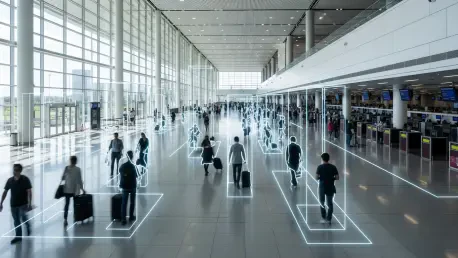

The seamless orchestration of modern air travel increasingly relies on sophisticated technological layers that operate beneath the surface to manage the fluid movement of millions of passengers through complex logistical environments. Rome Fiumicino Airport, managed by Aeroporti di Roma, has emerged as a global frontrunner in this digital evolution by expanding its partnership with Outsight to deploy 3D LiDAR technology at an unprecedented scale. This transition represents a significant shift from the experimental “Runway to the Future” program to a permanent, industrial-grade implementation across the Schengen common-use areas. By integrating advanced spatial intelligence, the facility is moving beyond traditional monitoring toward a comprehensive, real-time understanding of traveler dynamics at the site. This infrastructure provides the essential digital bedrock for high-precision operations, allowing the airport to handle the complexities of international transit with confidence and significantly improved accuracy in spatial data collection.
Evolution of Data Capture: From Pilots to Global Benchmarks
Modern infrastructure management necessitates a move away from legacy sensor systems toward comprehensive technologies that respect privacy while delivering pinpoint accuracy. The decision to implement LiDAR at Rome Fiumicino allows the facility to capture precise depth information in three dimensions without relying on facial recognition or storing sensitive personal data. Unlike camera-based systems that struggle with varying lighting or passenger density, LiDAR remains consistent in low-light environments and crowded corridors alike. This technology generates a digital twin of movement patterns, creating an environment where every interaction is logged as anonymous spatial data points for the management team. This methodology ensures the airport remains fully compliant with strict privacy regulations while obtaining superior visibility into how people navigate common-use areas within the terminal. By leveraging these advanced 3D sensors, the operation has established a high standard for accuracy and technical reliability that simplifies complex logistics across the entire hub.
The scaling of these systems into a facility-wide operation highlights the robustness of the Outsight software architecture. Moving to full-scale deployment across the terminal signifies that technical challenges associated with LiDAR integration have been resolved through the use of Physical AI. This engine ingests massive volumes of raw sensor data and converts them into manageable events that operators can act upon immediately to improve flow. This process effectively eliminates the background noise typical in high-traffic zones, focusing entirely on human movement dynamics. This refined data allows management to visualize bottlenecks before they reach critical levels of congestion, marking a significant departure from the reactive crowd control strategies of the past. The ability to monitor multiple zones simultaneously from a single platform gives the staff the foresight needed to optimize every square foot of terminal space efficiently and effectively. Such a shift in strategy proves that large-scale perception is an essential component for the long-term success of air travel centers.
Optimization and Implementation: The Future of Terminal Logistics
Integration of predictive capabilities empowers staff to optimize resource allocation well ahead of real-time demand. By analyzing the velocity and density of passenger groups, the digital system provides early warnings for potential queue build-up at security checkpoints or departure gates. This approach transforms staff members into proactive coordinators who adjust staffing levels or redirect traffic flow based on real-time visualizations. Such visibility ensures that the passenger experience remains fluid and pleasant, reducing the stress associated with long wait times in busy transit hubs. The implementation also enables data-driven process re-engineering by identifying structural inefficiencies in terminal layouts that contribute to slow-moving crowds or dead zones. Consequently, the operational framework has become significantly more agile, allowing for rapid adjustments that reflect the immediate needs of daily flight schedules and peak travel periods. These advancements facilitate a smoother journey for all travelers while maintaining peak operational efficiency across the airport grounds.
The integration of spatial intelligence at Rome Fiumicino provided clear takeaways for global transportation hubs aiming to modernize their operational workflows. Administrators prioritized the selection of versatile hardware that integrated with advanced AI platforms, ensuring that technical investments remained relevant as software capabilities expanded over time. By focusing on non-intrusive data collection, the project satisfied operational requirements and public privacy expectations, creating a scalable model for diverse logistical environments. Organizations benefited from establishing a culture of innovation that moved quickly from pilot programs to full-scale industrial application without unnecessary delays. It was determined that early collaboration between hardware providers and on-site staff was essential for tailoring technology to the specific needs of the terminal environment. Ultimately, these steps demonstrated that the shift to predictive management relied as much on strategic leadership and clear objectives as it did on sensors and analytics.







