
The release of the GPT-5.6 family marks a transformative moment in the trajectory of artificial intelligence, moving beyond the era of generic, all-purpose systems toward a highly specialized, tiered architecture. By introducing the Sol, Terra, and Luna models, the industry is seeing a deliberate partitioning of cognitive labor—balancing the raw, expensive reasoning power required for cybersecurity with the high-speed, cost-effective demands of daily enterprise automation. This transition is not merely technical but deeply political, as the rollout is being shaped by executive orders and unprecedented coordination with federal agencies. As organizations navigate this new landscape, the focus shifts from simple prompt engineering to the orchestration of complex subagents and the management of real-time safety interventions. Understanding the nuances of these models is essential for any technologist looking to leverage the next generation of frontier AI while remaining compliant with emerging national security protocols.
With the transition from the traditional “mini” and “nano” labels to the new celestial-inspired naming convention, how should enterprise leaders interpret the functional differences between Sol, Terra, and Luna?
The shift to names like Sol, Terra, and Luna is a clear signal that the industry is moving away from judging models based solely on their parameter size and toward a focus on durable capability tiers. For an organization, Sol represents the apex of reasoning, a powerhouse designed for the most grueling tasks like complex security research and extended coding sessions where a single error could be catastrophic. It is priced as a premium instrument at $5.00 per million input tokens and $30.00 per million output tokens, reflecting its role as a specialist rather than a generalist. Terra, by contrast, is the “earth-bound” workhorse, optimized for the high-volume grind of customer support and document analysis at a more accessible price point of $2.50 for inputs and $15.00 for outputs. Luna rounds out the family as the fast, lightweight option for routine drafting and summarization, costing only $1.00 for inputs and $6.00 for outputs, which allows it to be scaled across massive workflows without the heavy financial overhead of its siblings. Even though Luna is the most affordable, it is important to note that it still maintains a “High” risk classification for cyber and biological capabilities, meaning it is far more than just a simple chatbot.
The introduction of “ultra mode” and the use of subagents within the Sol model suggests a fundamental change in how AI handles complex projects. Can you explain the technical significance of allowing a model more time and structure for deliberation?
This new approach, which centers on giving the model more structure during the inference phase, is a departure from the traditional “instant response” style of older generations. By using a max reasoning setting, Sol can engage in extended deliberation, essentially “thinking” through a problem before committing to a final output, which is crucial for high-stakes environments like vulnerability exploitation or advanced genomic research. The “ultra mode” takes this a step further by deploying subagents that can split a massive project into smaller, parallel tasks rather than trying to force everything through a single-agent flow. This architectural shift feels like moving from a solo researcher to a coordinated team of specialists, and the data reflects its success; for instance, Sol achieved a record-high score of 91.91% on TerminalBench 2.1 command-line tasks using this mode. It provides a more tactile, granular level of control for developers who are tired of the limitations of single-agent reasoning and need a system that can handle long-horizon tasks without losing the thread of the original objective.
When we look at the performance benchmarks for GPT-5.6, particularly the record-breaking scores on TerminalBench and Agent’s Last Exam, what do these numbers reveal about the model’s capacity for autonomous professional work?
The benchmark data highlights a significant leap in the model’s ability to operate autonomously within technical environments that were previously too complex for AI to navigate reliably. On the Agent’s Last Exam, Sol became the first model to clear the halfway mark for task completion in “code mode,” reaching a score of 50.9%, which is a remarkable jump compared to the performance of previous generations. This level of competency is mirrored in command-line automation, where even the mid-tier Terra outpaced the prior flagship, GPT-5.5, which had a benchmark of 83.4%. For a professional developer, these numbers aren’t just abstract statistics; they represent a tangible reduction in the “babysitting” time required when delegating complex automation tasks to the model. Furthermore, in cybersecurity evaluations like ExploitBench, Sol matches the performance of its top competitors while generating only about one-third of the output tokens, proving that it is becoming significantly more efficient at finding the shortest path to a solution.
OpenAI has implemented a rigorous safety architecture for these models, including 700,000 GPU hours of red-teaming. How do these real-time safeguards and activation classifiers change the user experience for legitimate security researchers?
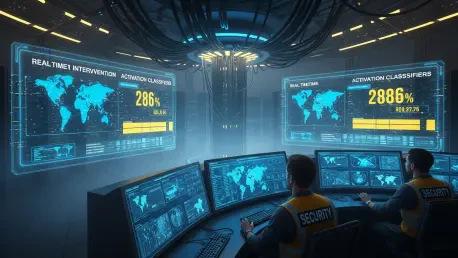
The safety stack for GPT-5.6 is incredibly dense, utilizing a multi-layered approach that includes everything from model-level refusals to live misuse screening and even activation-based monitoring. For the Sol and Terra models, these activation classifiers monitor internal signals during the inference process, and if they detect a risky pattern, the output stream can pause or stop entirely while a larger reasoning system reviews the context. This creates a certain level of “algorithmic friction,” where a researcher might find their legitimate work flagged by a system that has an 81.6% recall rate for cybersecurity risks and a 94.8% recall for biological threats. While these safeguards are designed to prevent the engineering of a functional, full-chain exploit—which the model currently cannot do autonomously—they also mean that false positives are a reality that teams must navigate. It is a sensory experience of “stop-and-go” interactions, where the model might stop mid-sentence to perform a safety check, reminding the user that they are working within a highly regulated and scrutinized digital environment.
Given the unpredictable costs associated with running complex agentic loops, how does the new prompt caching protocol and the partnership with Cerebras address the financial and technical barriers to enterprise-scale AI?
To make these models viable for large-scale production, there had to be a way to stabilize the cost of passing massive context windows back and forth, which is where the revamped prompt caching comes in. Developers can now set explicit cache breakpoints with a guaranteed 30-minute minimum lifetime, paying 1.25 times the standard rate for the initial write but receiving a massive 90% discount on all subsequent reads. This provides a critical financial guardrail for businesses running repeated operations, such as analyzing a massive codebase, by rewarding the reuse of context. Simultaneously, the partnership with Cerebras hardware addresses the “latency wall” by offering processing speeds of up to 750 tokens per second for Sol beginning this July. This combination of economic predictability and raw hardware speed transforms the AI from a slow, expensive experiment into a high-speed engine capable of frontier-grade reasoning in real-time enterprise applications.
The decision to limit the initial release of GPT-5.6 to approximately 20 organizations under the guidance of the U.S. government is a major geopolitical development. What does this suggest about the future of “sovereign gatekeeping” in the AI industry?
This phased release is a direct consequence of the escalating entanglement between AI development and national security, specifically following the executive order issued on June 2, 2026. By coordinating with the White House and federal agencies, OpenAI is navigating a 30-day benchmarking window designed to ensure these models are safe for wide release, particularly in light of recent export controls that impacted competitors like Anthropic. This creates a novel landscape where access to the most powerful tools is no longer just a matter of having the budget, but of being a “trusted partner” within a specific regulatory framework. OpenAI itself has expressed frustration with this trend, stating that government-access processes shouldn’t be the long-term default because they keep essential tools out of the hands of global defenders and developers. It signals a future where “frontier” status is synonymous with “regulated,” and where the release of a new model is as much a diplomatic event as it is a technological one.
With all three models reaching high thresholds on internal capture-the-flag testing—Sol at 96.7%, Terra at 91.84%, and Luna at 85.19%—what is your forecast for how the balance of power between cyber attackers and defenders will shift as these tools become more accessible?
My forecast is that we are entering an era of “automated attrition,” where the speed of defensive patching will finally start to close the gap with the speed of offensive exploitation. While these models are not yet capable of running a complete, autonomous attack campaign without human direction, their ability to automate 96.7% of capture-the-flag tasks suggests that the barrier to entry for high-level vulnerability research is dropping. We will likely see a period of intense volatility as both sides adopt these 750-token-per-second reasoning engines, but the advantage will eventually tilt toward the defenders who can use these models to monitor codebases in real-time. However, this also means that the “High” risk classification will become the new standard for all frontier models, and the regulatory oversight we see today with the U.S. government is only the beginning of a much more permanent system of algorithmic governance. The “arms race” will move from who has the best model to who has the most efficient way to bypass—or enforce—the real-time safety interventions that are now baked into the very core of the silicon.