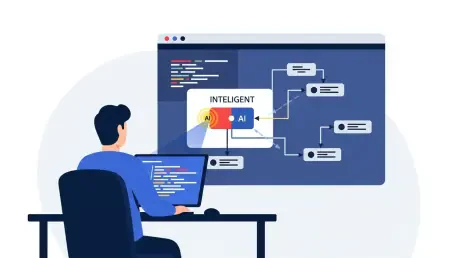

The rapid proliferation of AI-powered development tools has inadvertently created a silent crisis of digital amnesia, where even the most advanced coding assistants begin each task with a clean slate, unaware of past context or established standards. The emergence of stateful intelligence represents a significant advancement in this sector, directly confronting this foundational weakness. This review will explore the evolution from stateless to stateful AI coding assistants, their key features, performance metrics, and the impact they have on development workflows and code quality. The purpose of this review is to provide a thorough understanding of this technology, its current capabilities as exemplified by systems like Qodo 2.1, and its potential future development.
The Evolution from Stateless to Stateful AI
The core limitation of the previous generation of AI coding assistants was their inherently stateless nature. These tools operated within a transactional, short-term context, much like a fleeting conversation. Once a session ended, any established nuance, project-specific standard, or corrective feedback was lost, forcing developers to re-establish context repeatedly. This created what is best described as the “Memento” dilemma, where the AI, like a character with no short-term memory, relied on crude external aids to recall vital information.
This limitation led to inefficient but common workarounds, such as developers meticulously documenting context and standards in external markdown files. While better than nothing, this approach is a fragile and unscalable hack. At an enterprise level, it translates to an unmanageable collection of digital sticky notes that an AI must sift through statistically, hoping to find the right piece of information. The transition to stateful systems is, therefore, not merely an incremental upgrade but a necessary architectural leap to move beyond these constraints and unlock true automation in software development.
Core Technology Qodo 2.1’s Stateful Architecture
The Intelligent Rules System as Organizational Memory
At the heart of Qodo 2.1’s stateful solution is its Intelligent Rules System, which functions as a centralized and dynamic organizational memory. This system is designed to be the single source of truth for a company’s unique coding conventions, architectural patterns, and best practices. Instead of relying on scattered, manually maintained documents, the Rules System creates a living repository of institutional knowledge that is directly accessible to the AI agents.
This architecture fundamentally changes the relationship between the AI and its knowledge base. The system moves beyond the paradigm of an external, passive library of information that the AI must query. Instead, it integrates memory as an intrinsic component of the AI’s operational framework. This tight coupling allows the system to apply fine-tuning and reinforcement learning techniques far more effectively, creating a continuous feedback loop that sharpens the AI’s understanding and application of an organization’s specific standards over time.
Automated Rule Discovery and Maintenance
A key innovation within this architecture is the deployment of proactive agents that build and maintain this organizational memory. The “Rules Discovery Agent” is tasked with the initial heavy lifting, performing deep analysis of existing codebases and historical pull request discussions to automatically identify and codify implicit standards. This process transforms years of human-driven decisions and tribal knowledge into explicit, machine-readable rules, eliminating the tedious and often incomplete task of manual documentation.
Furthermore, the system addresses the problem of “rule decay” through a dedicated “Rules Expert Agent.” This agent continuously monitors the entire set of rules for conflicts, redundancies, and obsolescence. As a codebase evolves and new technologies are adopted, coding standards must adapt. The Rules Expert Agent proactively identifies outdated rules and suggests updates, ensuring the organizational memory remains current, relevant, and internally consistent, thereby preserving its integrity and usefulness.
Integrated Enforcement and Performance Analytics
The true value of a stateful memory lies in its practical application. Qodo’s system integrates its rule set directly into the development workflow, primarily during the code review process. When a developer submits a pull request, the AI agents, armed with the full context of the organizational memory, automatically scan the code for any deviations from established standards. Violations are not just flagged; they are presented with actionable, context-aware suggestions for remediation, turning code review into a real-time coaching opportunity.
Beyond enforcement, the platform provides tangible metrics that demonstrate the system’s impact on engineering quality and efficiency. The analytics dashboard offers insights into rule adoption rates across teams, tracks violation trends over time, and quantifies overall improvements in code consistency and maintainability. This data-driven feedback loop allows organizations to measure the return on their investment in quality standards and make informed decisions about their engineering practices, proving the real-world value of a stateful AI system.
Emerging Trends in AI Driven Development
The industry is currently witnessing a broad and definitive shift away from reactive, stateless tools toward proactive, stateful systems. The initial waves of AI assistants, from simple code completion to conversational bots, successfully demonstrated the potential of large language models. However, their fundamental lack of persistent memory has become a clear ceiling for their utility in complex, collaborative environments. The innovations seen in Qodo are part of a larger trend that recognizes persistent, integrated memory as the next critical frontier.
This evolution frames solutions like Qodo’s as a blueprint for the future of AI-powered development. The prevailing method of storing context in external files is now widely seen as a temporary crutch rather than a long-term solution. The industry imperative is moving toward systems where organizational knowledge is not an afterthought but a core, inseparable component of the AI’s architecture. Consequently, statefulness is poised to become a standard, expected feature, rendering the “hacked” memory solutions of the past obsolete.
Real World Impact and Applications
In enterprise environments, the practical applications of stateful AI are delivering substantial benefits. One of the most immediate impacts is a marked improvement in code consistency across large and distributed teams. By enforcing a single, dynamic set of standards, these systems eliminate the ambiguity and stylistic drift that often plague complex projects, leading to a more maintainable and predictable codebase.
Moreover, stateful AI significantly accelerates the onboarding process for new developers. Instead of relying on lengthy documentation and peer mentoring to absorb a company’s coding culture, new hires can receive instant, contextual feedback from the AI assistant. This not only helps them become productive faster but also ensures their contributions align with established best practices from day one. Customer testimonials from early adopters, such as the HR technology company Hibob, validate these gains, reporting stronger code consistency and a more streamlined onboarding experience for their engineering teams.
Overcoming the Challenges of Subjective Quality
One of the most persistent technical hurdles in AI-driven development has been the deeply subjective nature of code quality. Universal, one-size-fits-all models of what constitutes “good code” inevitably fail because quality is context-specific. A standard that is critical for a high-frequency trading application may be irrelevant for a content management system. Best practices, architectural decisions, and even stylistic preferences vary dramatically between organizations and even between teams within the same company.
Stateful AI directly confronts this challenge by moving away from a universal model and toward a customizable, persistent memory. It allows an AI to learn and adapt to the nuanced and often unwritten rules of a specific development environment. This capability to internalize and enforce subjective quality standards is what allows the AI to generate code that is not just functionally correct but also idiomatically and architecturally aligned with an organization’s specific requirements, a feat that stateless systems simply cannot achieve consistently.
The Future of Software Development
Looking ahead, the integration of persistent memory into AI assistants is set to unlock even more profound transformations in the software development lifecycle. With a stable and evolving knowledge base to draw upon, AI systems will be able to employ more sophisticated reinforcement learning techniques. Feedback from human code reviewers on AI-generated suggestions can be used to continuously refine the internal rule set, creating a virtuous cycle where the AI becomes progressively more aligned with its human counterparts.
In the long term, this technology may fundamentally alter the role of human developers. As AI agents become more autonomous and context-aware, they could take on larger and more complex tasks, such as refactoring entire modules or implementing new features based on high-level specifications while adhering perfectly to established architectural patterns. This would shift the focus of human developers from line-by-line coding toward higher-level system design, strategic decision-making, and creative problem-solving, with the AI serving as a highly capable and context-aware implementation partner.
Final Assessment and Key Takeaways
The analysis of stateful AI coding assistants, particularly as implemented in Qodo 2.1, confirmed that the technology represents a pivotal evolution in software development automation. The limitations of stateless models became a significant bottleneck, and the introduction of a persistent, integrated organizational memory proved to be an effective solution. The ability to automatically discover, maintain, and enforce an organization’s unique coding standards directly addressed the critical challenge of subjective code quality.
This transition from stateless to stateful intelligence has established a new benchmark for AI-powered development tools. The measurable improvements in precision, coupled with the real-world benefits of enhanced code consistency and accelerated developer onboarding, underscored the technology’s immediate value. Ultimately, the move toward stateful systems marked the beginning of a new era defined by highly customized, context-aware, and increasingly autonomous AI partners in the software development process.