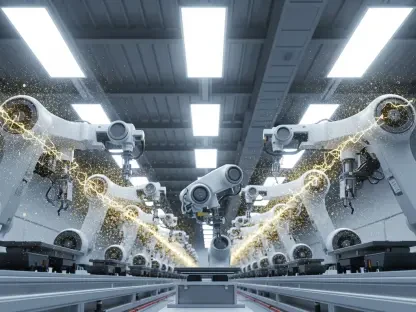

Imagine a world where the tiny chips powering everything from smartphones to supercomputers are designed not in weeks or months, but in mere hours, with pinpoint accuracy that rivals the best human expertise. This isn’t a distant dream—it’s the reality Vinci, a Palo Alto-based tech company, is bringing to the semiconductor industry. Emerging from stealth mode with a bold announcement on December 2, the company has introduced a physics-driven artificial intelligence platform that promises to overhaul electronic design automation (EDA). As the industry wrestles with ever-more intricate designs like 2.5D/3D integrated circuits, Vinci’s approach could be the lifeline engineers need to escape the constraints of outdated tools. The growing complexity of hardware demands faster, smarter solutions, and Vinci seems poised to deliver just that, sparking curiosity about how deep its impact might run.
Technological Innovation
Breaking Barriers with Physics-Driven AI
In the heart of semiconductor design lies a nagging problem: traditional finite element analysis (FEA) tools are painfully slow and often falter when faced with the detailed geometries of modern chips. Vinci tackles this head-on with a platform that sidesteps the cumbersome meshing process entirely, achieving speeds up to 1,000 times faster than legacy systems. This isn’t just about raw speed, though. By marrying physics-based rigor with cutting-edge AI, the technology ensures that every simulation maintains high accuracy, even on full manufacturing-resolution designs. For engineers bogged down by tools that can’t keep pace with innovation, this represents a seismic shift. The ability to iterate designs rapidly without sacrificing precision could redefine workflows, turning what used to be a bottleneck into a competitive edge.
Moreover, Vinci’s system stands apart from other AI-driven tools that often stumble into unreliable outputs or “hallucinations”—fabricated results that can derail projects. Instead, this platform is built on a foundation of dependable physics methodologies, integrated with AI to guarantee trustworthy outcomes. This reliability makes it a go-to choice for handling the intricate layouts of today’s chips, where a single misstep can cost millions. Unlike solutions that promise much but deliver little, Vinci’s hybrid model offers a practical answer to the industry’s call for efficiency. It’s a tool that doesn’t just work in theory but thrives under the real-world pressures of semiconductor manufacturing, setting a new standard for what technology can achieve in this space.
Redefining Speed and Accuracy
The magic of Vinci’s platform isn’t just in its speed—it’s in how it reimagines the balance between velocity and precision. Traditional tools often force engineers to choose: get results fast with rough estimates or wait days for detailed accuracy. Vinci eliminates that trade-off, running thousands of simulations in hours rather than weeks, all while matching or surpassing the fidelity of conventional FEA solvers. This capability is crucial as chips shrink to nanometer scales and sprawl across centimeter-sized dies. For companies racing to bring cutting-edge tech to market, this kind of efficiency can mean the difference between leading the pack or lagging behind.
Beyond pure performance, the platform’s design reflects a deep understanding of engineering needs. By bypassing time-intensive processes and focusing on scalable AI, Vinci slashes compute costs—a critical factor in an industry where budgets for design cycles are often stretched thin. This isn’t merely a tool; it’s a paradigm shift that empowers teams to experiment more freely and innovate without the constant drag of technical limitations. As the semiconductor world pushes toward ever-more complex designs, Vinci’s ability to deliver fast, accurate results could become the cornerstone of next-generation hardware development.
Market Impact and Validation
Proven Results in Real-World Applications
Vinci’s arrival isn’t just talk—it’s backed by hard evidence from the field. Having operated in stealth for over two years, the company has already secured early deployments at three major semiconductor manufacturers, with benchmarks conducted by more than ten others. These validations aren’t mere test runs; they show Vinci’s simulations aligning closely with experimental data, often outperforming traditional solvers in both speed and precision. For an industry where trust in tools is paramount, this level of real-world success speaks volumes. It signals that Vinci isn’t just another tech startup with lofty claims but a serious player ready to tackle the toughest design challenges.
Equally impressive is how Vinci addresses practical concerns that often stall innovation. The platform comes pre-trained and production-ready, meaning there’s no need for customer data to fine-tune it—a significant relief for firms wary of intellectual property risks. Deployable securely behind customer firewalls, it integrates seamlessly into existing workflows without compromising sensitive information. This focus on usability and security shows a keen awareness of the hurdles semiconductor companies face, making Vinci not just a powerful tool but a trusted partner. As more players in the field take notice, the ripple effects of this technology could reshape market dynamics in profound ways.
Shaping Industry Standards
The impact of Vinci’s technology extends beyond individual companies—it’s setting a benchmark for the entire EDA market. With over half of the top 20 semiconductor firms already engaging with the platform, there’s a clear consensus that this isn’t a passing trend but a transformative force. The ability to deliver results in seconds at a fraction of the compute cost addresses a critical bottleneck that has long plagued the industry. This efficiency doesn’t just save time; it frees up resources for bolder experimentation, potentially accelerating the pace of innovation across the board.
Furthermore, the early endorsements from major players suggest that Vinci could redefine what’s expected of design tools. As companies adopt this technology, the pressure will mount on competitors to match its speed and accuracy, potentially sparking a wave of advancements in the sector. This isn’t merely about solving today’s problems; it’s about raising the bar for tomorrow’s solutions. Investors and industry insiders alike see Vinci as a catalyst, one that could push the boundaries of what’s possible in hardware design while addressing longstanding pain points with elegance and precision.
Leadership and Industry Support
Strong Foundations for Growth
Behind Vinci’s promising tech lies a team built for disruption. Founded by Hardik Kabaria, a specialist in computational geometry, and Sarah Osentoski, a seasoned expert in machine learning and autonomous systems, the company brings together a rare blend of academic depth and practical know-how. Their combined expertise ensures that Vinci’s platform isn’t just a theoretical exercise but a production-grade solution ready for the rigors of industry use. Add to that $46 million in funding, with a Series A round led by Xora Innovation and a Seed round by Eclipse, alongside support from Khosla Ventures, and it’s clear that Vinci has the financial muscle to scale its vision.
This strong foundation goes beyond numbers on a balance sheet. The backing of top-tier investors signals a shared belief in Vinci’s potential to not only address current design challenges but also pioneer entirely new approaches to hardware development. Partnerships with firms like Xora and Eclipse further amplify this confidence, suggesting that Vinci’s influence could extend well beyond simulation into broader co-design capabilities. For an industry hungry for fresh ideas, this combination of leadership and support positions Vinci as a formidable force, capable of driving meaningful change in a field ripe for reinvention.
Vision for a Broader Horizon
Looking ahead, Vinci’s ambitions hint at a scope far wider than today’s EDA challenges. Industry partners and investors envision the company expanding into co-design across various physics and hardware domains, potentially reshaping how entire systems are conceptualized. This forward-thinking perspective sets Vinci apart from tools focused solely on narrow simulation tasks, offering a glimpse of a future where design optimization becomes as intuitive as it is powerful. Such a vision could redefine market boundaries, turning Vinci into a linchpin for next-generation innovation.
In reflecting on Vinci’s journey, the strides made through strategic leadership and robust industry support stand out. The groundwork laid by its founders and backers sparked a movement that challenged the status quo, delivering a platform that turned complex design hurdles into streamlined successes. Looking to the next steps, the focus should be on how Vinci can build on this momentum—perhaps by forging deeper collaborations or tackling emerging fields in hardware. With its blend of technology and vision, the company holds the potential to not only meet current needs but also anticipate and shape the demands of tomorrow’s semiconductor landscape.