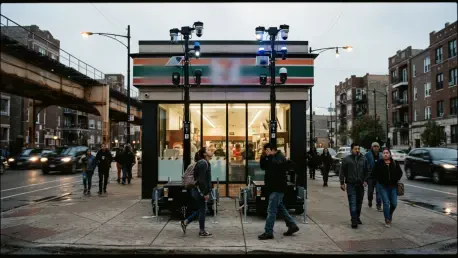

The owner of the surveillance data captured at retail locations typically retains control over the footage, which is often overwritten every thirty days to avoid legal liability. This operational standard has come under intense scrutiny in the Rogers Park neighborhood of Chicago, where a viral incident at a 7-Eleven parking lot highlighted the friction between advanced technology and public expectations of privacy. A local resident, identified online as “Trash god,” found himself the subject of an automated confrontation while waiting for his fiancée to complete a purchase inside the store. The situation, captured in a brief but poignant video, showed a mobile surveillance tower activating a bright light and broadcasting a stern order to cease loitering after the resident had been parked for only a few minutes. This encounter underscores a fundamental challenge for modern retail: the difficulty of programming automated systems to accurately distinguish between a legitimate customer and a security threat without human intervention.
Technical Foundations: Distinguishing LVT from Traditional Systems
While many observers initially identified the hardware as a system from Flock Safety, the specific units deployed at retail locations like the 7-Eleven in Chicago are actually the work of LiveView Technologies. Unlike the automated license plate readers commonly associated with Flock, which are designed primarily for vehicle tracking by law enforcement agencies, these LVT towers are mobile, solar-powered platforms intended for active deterrence. These units are highly sophisticated, featuring high-mast trailers that house multiple pan-tilt-zoom cameras capable of providing a 360-degree view of their surroundings. The core of their utility lies in “edge-AI” video analytics, which allows the hardware to process visual data locally and in real-time rather than sending every frame to a remote server. This localized processing is what enables the system to react instantly to environmental changes, making it a proactive tool for property management rather than just a passive recording device for later review.
The operational intelligence of these towers is built upon the ability to recognize specific “postures” or “behaviors” that are historically correlated with criminal activity. The AI is programmed to trigger a response based on pre-set parameters, such as a loitering timer that tracks how long a person or vehicle remains in a specific zone. Furthermore, the software can identify physical stances associated with catalytic converter theft, such as an individual crouching or crawling beneath a vehicle. When the system detects these patterns, it can autonomously initiate “talk-down” sequences, where pre-recorded or live-operator audio warnings are broadcast through high-decibel speakers. This functionality is intended to notify individuals that they are under active observation, effectively serving as a tireless, robotic security presence. However, as the Chicago incident demonstrated, the lack of nuance in these algorithms can lead to aggressive interactions with patrons who are simply waiting for family members or engaging in typical consumer behavior.
Corporate Defenses: The Privacy Claims of Identity-Blind AI
In defense of the expanding presence of these surveillance towers, LiveView Technologies emphasizes that its systems are designed to be “identity-blind” by focusing on object classification rather than individual identification. The company asserts that the onboard AI is programmed to distinguish between general categories like humans, vehicles, and animals, as well as superficial visual attributes such as the color of a person’s clothing or the make of a car. Crucially, the manufacturer maintains that its systems do not utilize facial recognition, biometric data collection, or any form of audio recording in their standard operating procedures. By avoiding the capture of unique physical identifiers, these technology providers aim to navigate the increasingly complex legal landscape surrounding digital privacy. This design philosophy is intended to provide a robust security solution that mitigates crime through behavioral analysis while theoretically respecting the anonymity of the individuals who frequent the monitored spaces.
The structure of data management further reinforces the corporate strategy of placing the ethical and legal burden of surveillance on the end-user, such as the retail establishment itself. Footage captured by the LVT towers is typically owned and controlled by the client, with data being overwritten every thirty days to minimize the accumulation of sensitive information. Only when a specific “alert event” is triggered by the AI—such as a detected theft or a significant security breach—is the relevant footage uploaded to a secure cloud platform for long-term storage and review. This customer-centric model is designed to insulate the technology provider from direct privacy litigation by making the retailer responsible for how the data is used and shared. However, this decentralization of data ethics raises concerns about the consistency of privacy standards across various retail locations, as different business owners may have varying interpretations of what constitutes an “alert event” worthy of permanent storage.
Legal Frameworks: Navigating the Biometric Privacy Laws of Illinois
The deployment of AI-driven surveillance towers in Chicago is particularly significant due to the rigorous protections established by the Illinois Biometric Information Privacy Act. As one of the most stringent privacy laws in the United States, this act requires private companies to obtain explicit written consent before they can collect, store, or use biometric identifiers, such as facial geometry or fingerprints. Because violations of this law can result in steep financial penalties—reaching up to five thousand dollars per individual occurrence—the legal standing of LVT’s systems depends entirely on their ability to prove that they do not track unique physical characteristics. If the cameras are truly only analyzing “postures” and “objects” without creating digital maps of facial features to identify people, they likely fall outside the current scope of the law. This legal boundary remains a critical point of interest for privacy advocates and retail chains as they expand the use of automated security.
Despite the technical assurances provided by manufacturers, the distinction between “behavioral analysis” and “individual tracking” is becoming increasingly blurred as software capabilities advance. If these systems were to evolve to log facial data to identify “repeat loiterers” across different geographic locations, they would almost certainly trigger significant legal liabilities under current Illinois statutes. Commenters on the viral 7-Eleven video noted that the shift from simple motion detection to complex behavioral monitoring feels like a stepping stone toward more invasive forms of tracking. The legal community is closely monitoring how these AI systems are updated, as any mission creep that incorporates identity-based tracking could result in massive class-action lawsuits for retailers. The ongoing debate in Chicago serves as a national bellwether for how state laws will adapt to technologies that can effectively monitor public behavior without technically identifying the individuals involved.
Societal Impacts: The Emergence of Automated Enforcement Nets
The public reaction to the 7-Eleven incident reveals a profound cultural unease, often framed by critics as a move toward a “lame cyberpunk” reality where the dystopia is characterized by cheap, solar-powered trailers shouting at citizens. This sentiment is amplified by the realization that retail security is transitioning from human-led policing to algorithmic governance, which lacks the social nuance required for effective community engagement. Looking forward, the integration of ground-based sensors with drone technology represents a further escalation in this trend. Starting in 2026 and continuing into the next few years, private security teams are expected to gain the ability to deploy drones automatically in response to alerts triggered by towers like those found in Rogers Park. This creates a multi-tiered surveillance net where a ground sensor detects a “loiterer,” a speaker broadcasts a warning, and if the individual does not comply, a drone is dispatched to shadow them until they leave the property.
The incident in Chicago illustrated a significant shift in the management of public spaces, where the drive for cost-effective security often outweighed the value of a welcoming consumer environment. To address these challenges, several strategic steps were identified by industry experts and privacy advocates. It was suggested that retailers should implement clearer signage and transparency regarding the capabilities of their AI systems to manage customer expectations. Furthermore, the development of more sophisticated AI training models was recommended to better distinguish between harmless activities and genuine threats, reducing the frequency of false alerts. Legislative bodies were also urged to review existing privacy laws to ensure they covered behavioral tracking that effectively bypassed biometric definitions. Ultimately, the successful integration of automated security required a balanced approach that prioritized human dignity alongside asset protection, ensuring that the technology served the community rather than alienating it.