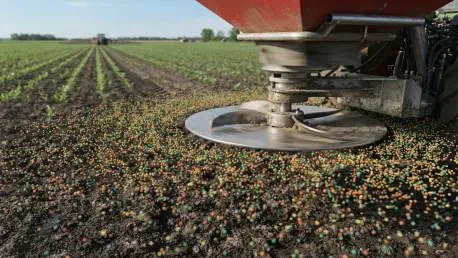

Variable factors such as wind speed and disk rotation velocity can cause significant deviations in how nutrients are distributed across a field during application. This inherent volatility often results in uneven crop growth, financial waste, and environmental strain, making precision in nutrient delivery a primary concern for modern agronomy. To address this challenge, the University of Regina and its collaborators have introduced a groundbreaking computer vision framework designed to revolutionize nutrient application in precision agriculture. The primary objective of this system is to estimate the swath width—the lateral distance over which fertilizer is distributed—directly from video sequences in real-time. By utilizing a hybrid deep learning architecture that combines Convolutional Neural Networks with Transformer encoders, the researchers created a system capable of bypassing the traditional, labor-intensive methods of spreader calibration. This technological advancement addresses a critical bottleneck in modern farming: the inability to monitor and adjust fertilizer distribution patterns dynamically during field operations. Centrifugal spreaders, the most common tools for nutrient application, rely on high-speed rotating disks to fling particles, making their output highly sensitive to external variables. The AI model provides a non-intrusive, vision-based alternative to physical collection trays, allowing for the rapid assessment of spreading performance to ensure spatial uniformity and minimize the risk of environmental degradation from nutrient runoff.
The Challenge: Why Uniformity Matters in Field Operations
In the context of modern precision agriculture, achieving a uniform distribution of nutrients is paramount for both economic viability and ecological stewardship. The swath width is the most influential factor in determining the necessary overlap between adjacent passes of a tractor, yet it remains one of the most difficult variables to manage in real-time. If the width is incorrectly estimated, it leads to either over-application, which increases production costs and causes environmental degradation through nutrient runoff, or under-application, which results in reduced crop yields and poor plant health. The precision required for high-yield farming in 2026 and beyond demands that these estimates be accurate to within centimeters, a feat that is nearly impossible without advanced digital assistance. Current industry standards for measuring this width involve placing numerous collection trays on the ground and manually weighing the contents after a pass. While accurate for a single moment, these offline methods are incredibly time-consuming and cannot account for changing environmental factors, such as sudden gusts of wind or variations in machine performance during a long workday.
The mechanical complexity of centrifugal spreaders further complicates the quest for uniformity, as these machines are subject to a multitude of physical variables that shift constantly. Factors such as the physical characteristics of the fertilizer granules, the height of the spreader above the soil, and the exact rotational velocity of the distribution disks all play a role in where each particle eventually lands. While high-fidelity physics simulations like the Discrete Element Method exist and can model these interactions with high accuracy, they are far too computationally demanding for use on a tractor-mounted computer in real-time. This leaves a significant gap in the market for a system that provides the precision of a laboratory measurement with the speed required for active field monitoring. The University of Regina team sought to bridge this gap by developing a system that uses cameras and artificial intelligence to “see” the fertilizer cloud and instantly translate that visual data into actionable swath width measurements. By providing this immediate feedback, farmers can adjust their speed or spreader settings on the fly, preventing the expensive and damaging errors associated with traditional estimation methods.
Sim2Real Strategies: Overcoming Data Scarcity through Synthetic Modeling
A significant hurdle in developing robust artificial intelligence for agricultural applications is the scarcity of large-scale, labeled datasets that cover the vast array of possible field conditions. Capturing and labeling thousands of videos of fertilizer spreading across various terrains, light levels, and wind conditions is practically impossible and prohibitively expensive. To overcome this logistical nightmare, the researchers adopted a Simulation-to-Real strategy, commonly known as Sim2Real. They developed a physics-informed particle-motion model in Python to generate synthetic training data that mimics the trajectory of fertilizer particles based on core mechanical principles. This approach allowed the team to create a nearly infinite variety of training scenarios without ever having to set foot in a field. By simulating the physical forces of gravity and aerodynamic drag, the model produced video sequences that realistically represented how fertilizer behaves when launched from a centrifugal spreader. This synthetic environment provided the AI with a clean, controlled space to learn the fundamental physics governing particle dispersion before being introduced to the messy realities of a working farm.
The simulation modeled a spreader with two counter-rotating disks and four blades, allowing the researchers to generate video sequences representing a vast array of scenarios. They systematically varied parameters such as disk diameter, rotational speed, and wind velocity to ensure the model could handle any situation a farmer might encounter. To ensure the synthetic data remained grounded in reality, the team applied a specific calibration factor to align their model with more complex simulations that account for particle-to-particle collisions. This careful tuning resulted in a robust dataset of nearly 300 diverse scenarios, providing the AI with a comprehensive understanding of how physical variables influence the spread pattern. The use of synthetic data not only sped up the development process but also ensured that the model was trained on edge cases—such as extreme wind or mechanical failure—that would be dangerous or difficult to capture in real life. This proactive training methodology ensured that the resulting AI framework was prepared for the unpredictable nature of agricultural environments from the first moment of deployment.
Hybrid Intelligence: Combining CNNs and Transformer Encoders
The technical heart of this framework is a hybrid architecture designed to interpret both the spatial and temporal aspects of a fertilizer cloud as it disperses. This dual-layered approach is necessary because a single image cannot convey the motion and velocity required to calculate a final landing position. The process begins with a ResNet-18 CNN backbone, which analyzes individual frames from a video sequence to extract spatial features. This part of the model essentially identifies the density and distribution of the fertilizer particles at a specific moment in time, transforming the visual information into a high-dimensional feature vector. By focusing on these spatial markers, the CNN provides the system with a detailed snapshot of the fertilizer “cloud.” However, understanding the spatial layout is only half the battle; the system also needs to understand how that layout changes over time to predict where the particles will eventually settle on the ground.
To address the temporal evolution of the dispersion, the model employs a Transformer encoder, a type of AI architecture originally designed for natural language processing but adapted here for motion analysis. By processing a sequence of feature vectors from the CNN, the Transformer utilizes attention mechanisms to understand how the particles move relative to one another and the environment over time. This allows the system to relate the visual flow of the fertilizer to a continuous numerical value for swath width, enabling high predictive accuracy that simple image recognition could never achieve. The combination of CNN for spatial awareness and Transformer for temporal understanding creates a “vision” that is more akin to human observation but with the mathematical precision of a computer. This hybrid approach ensures that the model remains accurate even when the motion of the fertilizer is erratic, providing a stable and reliable measurement that serves as the foundation for automated spreader adjustments and precision nutrient management.
Validation Hierarchy: Testing Performance Across Environments
The research highlighted that the perspective of the camera is a deciding factor in the system’s overall reliability and accuracy. The team tested various configurations and determined that a wide field of view proved significantly superior to narrow configurations because it could capture the full trajectory of the particles from the disk to the ground. When the AI could not see the full extent of the spread at high disk speeds, its ability to predict the final landing position was compromised, as it had to guess based on incomplete data. This finding emphasizes that real-world deployment requires a wide-angle lens or a specific high-mounting position on the tractor to ensure the entire spreading pattern remains within the frame. By optimizing the camera’s placement, the researchers ensured that the model had access to the most relevant visual information, which directly translated to a lower margin of error in swath width estimation.
To ensure the model was not merely memorizing synthetic data, the researchers implemented a rigorous validation hierarchy that tested the system against increasingly complex datasets. After successfully testing on held-out synthetic data, they moved to independent simulations that explicitly modeled the collisions between individual particles and the machinery. Despite the significantly increased complexity of these physics models, the AI maintained high accuracy, suggesting that it had successfully learned the underlying physics of particle motion rather than just visual patterns. The final and most crucial test involved laboratory experiments with a real spreader and a stereo camera, where the model was tasked with predicting the swath width of real fertilizer being spread over collection bins. In this test, the model achieved impressive results despite never being trained on real-world images. It relied entirely on the knowledge it gained from simulations, proving that the Sim2Real approach is a viable path for creating agricultural AI that works in the real world.
Future Trajectories: Optimizing Resources in Modern Farming
The transition from simulation to reality was made possible by a sophisticated image pre-processing pipeline that cleaned the raw video data before it reached the AI. Real-world agricultural images are often cluttered with shadows, dust, and mechanical parts of the spreader, which can confuse a model trained on clean, synthetic simulations. To bridge this gap, the researchers applied lens undistortion and photometric adjustments to make the small fertilizer particles stand out against the soil and machinery. This pipeline ensured that the AI only “saw” the relevant particle motion, allowing it to function effectively even when unexpected objects, such as a person or a tool, entered the camera’s frame. Furthermore, the team evaluated the computational latency of the framework and found that it could process video sequences in approximately 1.3 seconds. While this speed is sufficient for monitoring and logging, it represents a baseline that the industry can now work toward optimizing for millisecond-level steering and flow control applications.
The research concluded that a vision-based approach was essential for the next generation of farming, offering a scalable path toward more responsible and data-driven agronomic practices. They verified that the Sim2Real method bypassed the need for massive manual labeling, which had previously stalled progress in this niche area. By focusing on the temporal flow of particles rather than static images, the team achieved a robust level of accuracy that translated from simulated environments to laboratory conditions. Stakeholders were encouraged to look toward modular hardware solutions that could be retrofitted onto existing machinery to implement these insights immediately. Future efforts were directed toward expanding the framework to predict the entire distribution profile and calculate application uniformity. This project ultimately demonstrated that real-time monitoring of fertilizer distribution reduced the reliance on guesswork, providing a practical solution for farmers who aimed to lower costs and reduce their environmental footprint in an increasingly regulated landscape.