


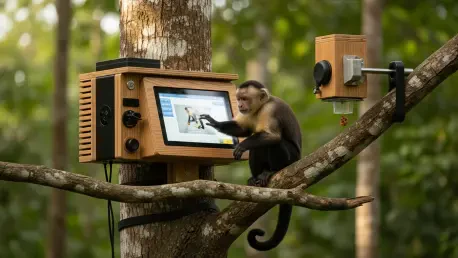

Researchers and engineers have spent the last few years perfecting a method to reconcile the inherent conflict between rigorous laboratory standards and the unpredictable reality of animal field studies. The emergence of CapuchinAI represents a pivotal moment in this endeavor, offering a sophisticated, open-source framework that brings automated cognitive testing into the dense forests where primates naturally reside. Developed through a collaboration between Emory University and the Georgia Institute of Technology, this battery-powered platform utilizes cutting-edge machine learning to monitor and evaluate monkey intelligence without human interference. This approach avoids the ethical and logistical complications of removing animals from their social structures, allowing for a more authentic assessment of how these creatures navigate their worlds. By integrating facial recognition and interactive touchscreens, the system provides a granular view of individual mental performance that was previously impossible to obtain in the wild. This technological bridge ensures that the data collected is both ecologically valid and scientifically precise, paving the way for a deeper understanding of the evolutionary roots of primate cognition.
The Intersection: Laboratory Precision and Ecological Validity
The core motivation behind the development of CapuchinAI stems from the realization that the primate brain did not evolve within the sterile, controlled confines of a modern laboratory. While traditional lab studies offer an unparalleled level of experimental control, they often fail to capture the dynamic ways in which intelligence is utilized to secure food, manage social hierarchies, and evade environmental threats. The “lab-in-the-wild” philosophy addresses this gap by transporting high-fidelity testing equipment directly into the primary habitats of the subjects. This methodology allows scientists to maintain the same rigorous standards found in a research facility while the animals remain embedded in the complex social and physical environments that shaped their evolutionary history. Consequently, the data reflecting traits such as memory or impulse control is far more representative of how these animals actually function in their daily lives, providing insights that are both deeper and more nuanced than those gained from captive populations.
Traditional field studies have historically relied on passive observation, which, while excellent for documenting behavior, often struggles to quantify specific cognitive mechanisms with high levels of accuracy. By introducing a precise measuring tool like CapuchinAI into the forest, researchers can now observe how real-world stressors, such as seasonal food scarcity or shifts in troop leadership, directly impact the mental performance of specific individuals. This shift from general group observations to individual-level metrics allows for a much more detailed analysis of the variation within a population. Understanding why certain individuals excel at problem-solving while others struggle requires a level of consistency that only automated systems can provide. As a result, the scientific community is now better equipped to answer fundamental questions about the adaptive nature of intelligence and how specific cognitive traits contribute to the overall survival and success of a species in a constantly changing natural landscape.
Technical Design: Hardware Resilience and Vision Pipelines
Building a piece of technology capable of surviving the rigors of a tropical rainforest and the curiosity of wild primates required a design that was both durable and cost-effective. The hardware for CapuchinAI consists of a weather-proof wooden enclosure constructed from standard pine planks and treated with specialized deck sealant to resist moisture and decay. Inside this protective shell, a Raspberry Pi microcomputer serves as the central nervous system, managing the operations of a high-definition webcam, an interactive touchscreen interface, and a custom 3D-printed food dispenser. The entire unit is powered by a lightweight, rechargeable battery pack designed to provide approximately eight hours of continuous operation, making it ideal for daily deployment in remote field locations. This focus on using accessible, off-the-shelf components ensures that the platform remains scalable and easy for researchers around the globe to replicate or modify for their own specific study species.
The software driving the system relies on the YOLO computer vision framework, which has been meticulously trained to recognize individual monkeys with a staggering 97 percent accuracy rate. Achieving this level of precision required research teams to invest thousands of hours into labeling images, teaching the AI to distinguish between the subtle facial features of dozens of different animals. This high-performance identification capability is essential for ensuring that every touch on the screen and every reward earned is correctly attributed to the right individual. Without such a robust vision pipeline, data from a crowded forest environment would quickly become muddled and unreliable. The system operates using a dual-script architecture: one script constantly monitors the environment and triggers a recording when a monkey is detected, while a second script manages the cognitive tasks and reward mechanisms. This allows the device to simultaneously collect baseline data on new arrivals while running personalized test sequences for known members of the troop.
Field Deployment: Observations from the Costa Rican Pilot
The initial real-world testing of CapuchinAI took place within the Taboga Forest Reserve in Costa Rica, a region populated by wild white-faced capuchins known for their social complexity and high levels of activity. When the prototype was first introduced, the monkeys were understandably cautious, treating the new object with a mix of suspicion and distant curiosity. However, the social nature of the species quickly turned this hesitation into engagement once a single bold male discovered that interacting with the glowing screen resulted in a tangible banana reward. This breakthrough moment triggered a cascade of interest throughout the troop, as other individuals observed the success of their peer and began to approach the device themselves. This transition from avoidance to active participation demonstrated the potential of the system to integrate into the daily routines of wild animals, turning a piece of human technology into a standard, albeit unusual, part of their foraging landscape.
Throughout the pilot phase, the system captured a diverse array of learning styles and social behaviors that highlighted the individuality of the capuchins. Some monkeys emerged as “fast learners,” quickly grasping the association between the touchscreen tasks and the food rewards, while others were “late adopters” who preferred to watch from the periphery. These observers showcased a form of social learning, carefully studying the mechanics of the game and the movements of their troop-mates before attempting the task themselves. This variation in approach provided a wealth of data on the different strategies used by primates to master new challenges. Furthermore, the monkeys displayed significant innovation, with some individuals finding alternative ways to trigger the sensors, such as using their lips to “kiss” the screen instead of their hands. These spontaneous behaviors proved that wild primates are not just passive participants but are capable of innovative problem-solving when given the opportunity to interact with complex tasks on their own terms.
Social Management: AI Logic and Group Dynamics
A significant challenge in conducting cognitive research with social animals is the inevitable interference of dominant individuals who may attempt to monopolize the testing equipment. In a typical primate troop, a high-ranking monkey might physically exclude subordinates from the device, which would result in a dataset heavily skewed toward the most aggressive or socially powerful members of the group. To mitigate this issue, CapuchinAI incorporates specialized “anti-monopolization” logic within its software, leveraging its facial recognition capabilities to enforce fairness. The system tracks the number of rewards a specific individual has received during a single session, and once a pre-defined limit is reached, it temporarily ceases to offer tasks to that monkey. This encourages the dominant individual to move on to other activities, thereby opening a window for lower-ranking or more timid members of the troop to approach and interact with the machine without fear of immediate retribution.
This automated management of social dynamics ensures that the researchers can gather a representative sample of data across the entire demographic spectrum of the troop. By providing a “level playing field,” the AI allows for the study of cognitive abilities in individuals who might otherwise be hidden by the social hierarchy. This is particularly important for understanding how cognitive traits like memory or patience are distributed throughout a population, rather than just within the alpha tier. Moreover, the system’s ability to recognize individuals means it can maintain a persistent profile for every monkey, resuming their specific progress each time they return to the screen. This level of personalized interaction prevents the data from being diluted by repeated, low-level tasks, as the software can skip ahead to more advanced challenges once a monkey has demonstrated mastery of the basics. This approach transforms the device from a simple dispenser into a sophisticated, individual-oriented tutor that adapts to the specific intellectual trajectory of every user.
Evolution and Metrics: Mapping the Primate Mind
The primary goal of the CapuchinAI platform is to evaluate four essential cognitive domains: learning speed, impulse control, cognitive flexibility, and memory. Each of these metrics provides a different piece of the puzzle when it comes to understanding the evolution of intelligence and its role in natural selection. For example, tests for impulse control measure an individual’s ability to resist an immediate, smaller reward in favor of a delayed, more substantial one, a trait that is highly relevant to survival strategies in the wild. By collecting this data over long periods, scientists can build comprehensive mental profiles for every member of a troop, linking cognitive performance to other life history factors such as health, reproductive success, and social status. This creates a multidimensional map of how intelligence functions as a tool for navigating the complexities of a real-world environment, offering a much more detailed picture of evolutionary success than traditional observation alone.
Because the system is designed to be scalable and relatively low-cost, it offers a blueprint for a global network of “smart” field stations that could study various species in diverse habitats. The ability to automatically adjust task difficulty ensures that the data remains challenging and relevant as the animals learn, preventing the “ceiling effect” often seen in simpler testing setups. As more researchers adopt this open-source technology, the scientific community will be able to compare cognitive data across different species and environments with unprecedented consistency. This could lead to new insights into why certain cognitive traits evolved in some lineages but not others, and how environmental factors like climate or predator density shape the development of the primate mind. Ultimately, the integration of AI into wildlife research provides the tools necessary to move beyond anecdotal observations toward a truly quantitative, individual-based science of animal intelligence that spans the globe.
Advancing Research: Future Directions in Cognitive Ecology
The deployment of the CapuchinAI system established a new standard for non-invasive, high-precision research in the field of primatology and animal behavior. It successfully demonstrated that sophisticated machine learning could be adapted for use in rugged environments, providing a reliable method for identifying individuals and tracking their mental progress over time. This breakthrough moved the discipline closer to the vision of researchers who advocated for seeing primates as distinct individuals with their own personalities and histories. By quantifying the cognitive profiles of wild monkeys, the project offered a way to link social habits directly to mental performance, revealing the intricate minds behind the behaviors observed in the forest canopy. The success of the pilot program in Costa Rica served as a proof of concept for a broader application of these tools across various ecosystems and species, suggesting that the future of wildlife biology would be increasingly digital and data-driven.
The transition toward these automated systems offered a clear path for future conservation efforts and evolutionary studies, as the ability to monitor the cognitive health of wild populations became a vital metric for assessing environmental impact. Moving forward, the scientific community began to explore how these interactive devices could be used to deliver conservation messages or even cognitive enrichment to animals living in fragmented habitats. The open-source nature of the platform meant that the technology remained accessible to researchers in resource-limited areas, democratizing the tools needed to study biodiversity. By prioritizing the autonomy and social integrity of the subjects, the development of such AI frameworks ensured that the study of intelligence remained ethical and grounded in the natural world. This progress represented a significant leap in the collective ability to understand the complex mental lives of the animals with whom humans share the planet, fostering a deeper connection through the lens of shared cognitive challenges.







