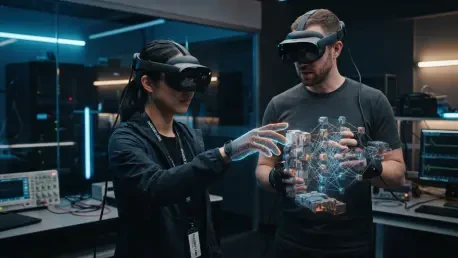

Pairs in a KAIST virtual reality study sorted objects approximately 23% faster when visual roughness cues appeared on both users’ virtual hands. One partner had haptic equipment; the other did not. By changing a hand’s outline, the researchers gave both collaborators access to information that would otherwise be available through touch alone.
How a Hand Outline Communicates Texture
In collaborative VR, sharing a digital environment doesn’t mean everyone has access to the same sensory information. A haptic device lets one person feel roughness through fingertip vibrations; a partner without that hardware has to judge it by sight. Comparing or selecting objects together becomes harder when partners have different evidence to work from.
Researchers at KAIST’s Ubiquitous Virtual Reality Lab (UVR Lab), led by Professor Woontack Woo of the Graduate School of Metaverse, developed a visual encoding technique to close that gap. Changes to the shape and movement of a virtual hand’s outline communicate an object’s roughness.
The technique distinguishes three categories: low, medium, and high. It doesn’t recreate a physical sensation on the user’s skin. Instead, it makes a tactile property readable through a visual signal, giving a collaborator without specialized equipment a basis for judgment.
| Access to feedback | How roughness becomes available |
|---|---|
| Haptic hardware | Vibrations delivered to the fingertips |
| Visual encoding | Changes in a virtual hand’s outline and movement |
| Both forms together | Partners can compare roughness using different sensory channels |
A VR interface can use this approach to share information between users whose hardware differs. Understanding a texture’s category is different from experiencing it through touch. The study focuses on that understanding, without claiming to replace the sensation.
What the Paired Experiment Demonstrated
The work began with two preliminary experiments. The researchers found that users could tell the visual signals apart. Their roughness judgments from those signals also matched judgments made through haptic feedback. That established a basis for testing whether the cues could support joint work.
The collaborative experiment then brought together 48 participants in 24 pairs. Within each pair, one person used haptic hardware while their partner worked without it. Their shared task was to arrange virtual objects by roughness.
With cues visible on both partners’ hand representations, completion time was approximately 23% lower than in the condition without visual cues. Sorting accuracy remained high. This suggests that comparable information can help partners coordinate, even when they receive it through different sensory channels.
Where the cues appeared also shaped the experience. People lacking haptic equipment reported more confidence in their judgments and felt they contributed more when the signals appeared on their own virtual hands. The researchers found that whose hand carried the information influenced collaboration, alongside the way roughness was represented.
For interface designers, that adds a useful deployment question. Making a signal visible somewhere in the environment may be insufficient; its relationship to the user’s own actions and representation can shape how useful it feels.
Where the Technique Could Fit, and What Remains Limited
The researchers identify VR learning, training, and remote teamwork as possible applications. These are settings where equipment differences could affect a shared task. A visual representation of roughness could let participants discuss the same property without requiring everyone to have a tactile device.
The evidence remains specific to the tested setup. Participants sorted objects using three roughness categories, and the reported speed improvement came from displaying cues on both virtual hands. Those findings don’t establish that visual encoding can reproduce detailed textures or improve every collaborative activity.
Teams considering a similar interface should keep several distinctions clear:
- Information versus sensation: A visible category supports a judgment, but does not supply physical touch.
- Cue placement: Signals on a user’s own hand affected reported confidence and contribution.
- Task fit: The demonstrated benefit concerns collaborative roughness sorting; other uses would need evaluation.
AI sits within the lab’s broader research direction rather than the described mechanism. Woo said the team plans to combine XR and AI in future virtual-convergence work aimed at sharing knowledge and experiences across distance and time. The roughness technique itself is described as visual encoding, not an AI-driven system.
Recognition and the Next Design Question
KAIST reported the award on October 29: the work received a Best Paper Award at IEEE International Symposium on Mixed and Augmented Reality (ISMAR 2026). The recognition follows the lab’s 2024 award for MR remote collaboration and two 2025 awards covering spatial sharing and visual-tactile experiences.
Woo credited government-backed research and talent development, KAIST infrastructure, and interdisciplinary work by younger researchers. The research was supported by the Virtual Convergence Graduate School Support Program, funded by the Ministry of Science and ICT (MSIT) and administered by the Institute for Information & Communications Technology Planning & Evaluation (IITP).
For people making decisions together in VR, the technique offers a way to make equipment differences less disruptive. Developers considering shared training and collaboration environments have a concrete interface option to evaluate here: turn sensory information a user cannot otherwise access into visible cues. They can then test where to place those cues and whether the cues improve the intended task.