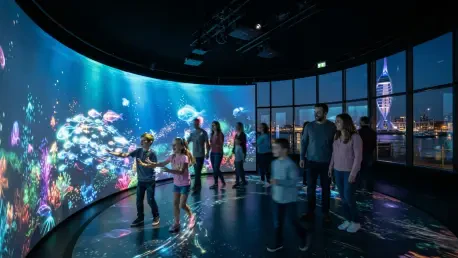

Projectors equipped with multi-laser drive engines and failover circuitry provide the reliability needed for continuous all-day operation in retail hubs. The installation at Gunwharf Quays represents a fundamental shift in how developers approach the integration of high-end media in bustling outdoor retail environments. By partnering with Holovis and Panasonic, Landsec transformed a standard shopping center into a magnet for shared human experiences, moving away from the isolating nature of individual headsets that have dominated the digital landscape recently. This move focused on collective engagement where friends and families could step into the ApolloDomes and experience a unified narrative journey together. The goal of this strategic deployment was not merely to display impressive hardware but to facilitate place-making that fosters long-term emotional loyalty. By extending dwell time and creating a destination for communal memories, the project supported the broader economic ecosystem including nearby dining and retail stores, proving that physical spaces must offer something distinctly communal to remain relevant in a digital world.
The Philosophy: Collective Shared Reality
The core philosophy behind the ApolloDomes project was a deliberate rejection of isolating technology that often severs the social link between participants. In an era where digital trends frequently prioritize solitary immersion through Virtual Reality headsets, the Gunwharf Quays installation utilized Shared Reality to ensure that every visitor witnessed the exact same visual and auditory events simultaneously. This synchronized approach allowed for immediate social interaction, where the laughter and reactions of one person could ripple through the group, enhancing the collective impact of the story. By filling the entire field of vision within a large-scale geodesic structure, the installation achieved a degree of presence that was previously restricted to high-end theme parks or specialized cultural centers. This shift from private to public immersion highlights a growing demand for technology that acts as a bridge for connection rather than a barrier between users and their surroundings.
To maintain interest among local residents and repeat shoppers, the narrative content within the dome was designed to be both seasonal and dynamic. The creative teams at Holovis developed a library of productions that allowed the attraction to remain culturally relevant throughout the year, ranging from festive winter narratives to atmospheric Halloween-themed shows. This rotational strategy ensured that the installation did not become a static monument but rather an evolving platform for storytelling that rewarded returning guests with new visual surprises. By aligning the digital content with the rhythm of the shopping seasons from 2026 onwards, the organizers successfully proved that a semi-permanent physical structure could sustain high engagement levels over extended periods. This variety in storytelling transformed the dome into a reliable anchor for the retail center, proving that the synergy between a physical venue and versatile digital content is essential for maintaining a sense of novelty and excitement in public spaces.
Technical Execution: Advanced Projection Systems
Achieving a seamless 360-degree environment inside a geodesic structure required an extraordinary level of engineering and hardware performance. To meet these rigorous demands, the technical team deployed six Panasonic PT-RZ24K projectors, selected specifically for their ability to deliver 20,000 lumens of brightness using advanced 3-Chip DLP laser technology. This high light output was crucial for maintaining the vibrancy and clarity of the images against the significant ambient light levels found in a busy public harbor and retail district. Without such high-intensity projection, the immersive effect would have been washed out, breaking the illusion and reducing the emotional impact on the audience. These units provided the necessary color accuracy and contrast ratios to bring complex digital worlds to life, ensuring that every detail was visible from any angle within the dome. This choice of hardware underscores the necessity of professional-grade equipment when moving immersive experiences out of controlled darkrooms and into the public eye.
The visual integrity of the dome relied on sophisticated geometry correction and edge blending to create a singular, continuous world without visible seams or distortion. Because the interior projection surface was a curved geodesic dome, the images from each of the six projectors had to be digitally warped and aligned with millimeter precision to prevent the immersion from being ruined by overlapping lines or misaligned pixels. Furthermore, the creative content itself was engineered with specific textures and movements that worked in harmony with the hardware to naturally disguise transition points. This deep synergy between software and hardware meant that the underlying technology became invisible to the viewer, allowing them to remain fully present in the narrative. By treating the projection surface as a unified canvas rather than a collection of separate screens, the technical team successfully bridged the gap between traditional media and true environmental immersion, setting a high standard for future public-facing digital installations.
Operational Reliability: Excellence in Public Spaces
Operational reliability was a non-negotiable requirement for the Gunwharf Quays installation, as it was expected to run all day, every day, without interruption. The inclusion of the multi-laser drive engine meant that even in the unlikely event of a laser diode failure, the system would continue to function with a virtually unnoticeable loss in brightness. This failover circuitry is critical for high-traffic environments where any technical downtime can lead to immediate guest dissatisfaction and a loss of potential revenue for the surrounding commercial ecosystem. By prioritizing redundancy at the hardware level, the project ensured that the show could go on regardless of minor component issues, maintaining the center’s reputation as a top-tier destination. This focus on reliability allowed the property management team to focus on the guest experience rather than troubleshooting technical errors, demonstrating that industrial-grade hardware is the backbone of successful semi-permanent public attractions.
Long-term maintenance and the total cost of ownership were also central considerations during the planning phases of the ApolloDomes. The Panasonic projectors featured hermetically sealed optical blocks and advanced liquid-cooling systems, which provided up to 20,000 hours of maintenance-free operation. This robust design was essential for a public installation exposed to varying environmental factors, such as dust and humidity, which could typically degrade the performance of less durable projection units. By eliminating the need for frequent filter changes and manual internal cleaning, the technical teams minimized intrusive on-site maintenance that would have required closing the attraction to the public. This level of durability makes the deployment of such high-end technology economically viable for property developers, as the reduction in labor and parts over the lifecycle of the project offsets the initial investment. The choice of such reliable systems highlights a shift toward using enterprise-grade tech as a sustainable solution for permanent retail placemaking.
Atmospheric Grounding: The Power of Spatialized Audio
While the massive visual scale of the dome was the primary draw for many visitors, the atmospheric grounding provided by the spatialized audio system was equally important to the experience. Holovis collaborated with KV2 Audio to engineer a 3D soundstage that meticulously tracked the movement of visual elements across the dome’s interior. This setup utilized high-frequency CS6 tops to deliver crystal-clear narrative voiceovers and sharp sound effects, alongside powerful ESD 1.15 subwoofers that provided the low-end physical impact necessary for dramatic sequences. By creating a sonic environment that moved in perfect sync with the projection, the creators ensured that the sound felt as if it were coming from within the virtual world rather than from external speakers. This tactile audio experience added a layer of depth that transformed a visual spectacle into a multi-sensory reality, grounding the digital characters and environments in a way that resonated physically with every person inside the dome.
The audio design philosophy mirrored the visual strategy by prioritizing technological invisibility, ensuring that speakers were placed as unobtrusively as possible to avoid breaking the immersion. By using ESD 6 surround units, the technical team was able to envelop the audience in a seamless audio field without cluttering the floor space or distracting from the visual narrative. This spatialized sound played a critical role in guiding the audience’s attention toward specific areas of the dome, using directional cues to lead the eye through the 360-degree story. By bridging the gap between the physical environment and the digital screen, the audio system enhanced the overall sense of presence, making the virtual world feel tangible. This integration of high-fidelity sound and sophisticated projection proves that immersion is a holistic endeavor, where every sensory input must be carefully calibrated to support the overarching narrative and maintain the audience’s suspension of disbelief.
Strategic Impact: The Experience Economy and Future Retail
The success of the Gunwharf Quays project serves as a definitive case study for the modern experience economy, where physical destinations must provide unique value to compete with the convenience of e-commerce. As consumers increasingly seek experiences over mere transactions, retail centers are evolving into entertainment hubs that blend technology, storytelling, and human performance. The inclusion of live actors within the dome further bridged the divide between the digital and the physical, adding a layer of spontaneity and human warmth that pure digital displays cannot replicate. This attraction-led strategy repositioned Gunwharf Quays as a primary destination rather than a secondary stop for shoppers, attracting a wider demographic of families and groups. By integrating high-end theater with industrial-grade technology, the project demonstrated how physical spaces can use shared immersion to reclaim their role as vital community hubs, offering a compelling reason for the public to engage with brick-and-mortar locations.
In conclusion, the collaboration established a new benchmark for how immersive technology was successfully integrated into the fabric of daily public life. Developers moved beyond passive digital signage and embraced active, shared narratives that fostered genuine human connection in a commercial setting. The technical reliability of the projection systems allowed for a consistent performance schedule that maintained high visitor confidence throughout the installation’s duration. Moving forward, property owners should consider investing in modular, high-impact installations that can be updated with fresh content to ensure long-term sustainability and continued foot traffic. By prioritizing shared reality over individual isolation, the industry took a major step toward creating inclusive environments where technology served to bring people together. The project proved that when professional-grade hardware and creative engineering were aligned, physical retail spaces effectively transitioned into vibrant centers of communal entertainment and shared history.