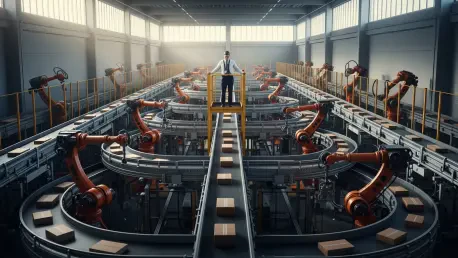

The traditional economic doctrine that technological advancement serves as a rising tide lifting all boats has come under intense scrutiny as corporate strategies increasingly favor cost-cutting over genuine innovation. While the promise of the digital age suggested a world where machines would handle drudgery and humans would flourish in higher-value roles, the empirical reality of the modern American workplace reveals a more calculated and less optimistic trajectory. Instead of deploying automation solely to maximize output and industrial efficiency, many prominent firms have utilized technology as a strategic tool for wage suppression. By specifically targeting workers who earn wage premiums—salaries that are higher than average for their specific qualifications and experience—companies are prioritizing the reduction of labor costs over the actual optimization of production processes. This shift represents a fundamental departure from earlier eras of industrialization where technology was used to expand capacity rather than to simply capture a larger share of the existing economic pie from the workforce.
Economic Disruption: Evaluating the Impact of Automated Systems
Exhaustive research conducted by economists at prominent institutions like MIT and Yale has provided a granular look at how these shifts have reshaped the American economic landscape over the last few decades. By analyzing extensive data across five hundred demographic groups and nearly fifty industrial sectors, researchers identified a direct link between the adoption of specific automation technologies and the erosion of worker pay. The study reveals that the technology being deployed is not always inherently superior to the human labor it replaces in terms of raw efficiency. Rather, these systems are often chosen because they allow firms to bypass the collective bargaining power and specialized experience of middle-tier employees. This strategy effectively redistributes income from workers to shareholders without necessarily improving underlying services. Such a pattern suggests that the primary driver of technological adoption is the systematic transfer of wealth rather than the pursuit of excellence or the expansion of industrial frontiers.
Middle-Tier Risks: Identifying the Targeted Demographic of Labor Displacement
The statistical impact of this trend is quite significant, accounting for a massive portion of the growth in income inequality seen in the United States during the modern era of computing. While automation was once expected to assist the workforce by removing dangerous or repetitive tasks, the current model specifically targets individuals in the seventieth to ninety-fifth percentiles of their respective salary ranges. This selective displacement means that the most successful and experienced non-college-educated workers often bear the brunt of technological change, as their hard-earned pay raises and seniority make them the primary targets for replacement by automated systems. Consequently, the incentive for workers to invest in specialized vocational skills is diminished when they perceive that higher earnings merely increase the likelihood of their roles being automated. This dynamic creates a precarious labor market where experience is viewed as a liability rather than an asset, leading to a workforce that is increasingly disillusioned with the promise of technology.
The Productivity Puzzle: Examining the Roots of Stagnant Growth
This intense focus on wage control helps explain the persistent productivity puzzle, a phenomenon where massive investments in computing and software patents fail to result in meaningful economic growth. When companies prioritize profit margins through cost reduction over actual output expansion, they often settle for what economists describe as mediocre automation. This occurs when a business replaces a highly skilled human professional with a machine that is technically less efficient or versatile but significantly cheaper in terms of monthly overhead and long-term liabilities. Because the primary goal of the executive board is to lower the total wage bill rather than to expand the scale of the business, the overall economy suffers from sluggish growth despite the external appearance of high-tech advancement. This misallocation of capital into labor-replacing tech instead of labor-augmenting tech stunts the growth of the Gross Domestic Product, as the efficiencies gained are purely financial for the firm and do not translate into broader social utility.
Corporate Financials: Consequences of Short-Term Prioritization
This trend represents a modern manifestation of the Solow Paradox, where the influence of technology is visible everywhere except in the actual productivity statistics that measure national economic health. In sectors like customer service or administrative logistics, automated systems often provide a slower experience for the consumer and handle fewer inquiries per hour than the human representatives they replaced. However, because these systems eliminate a dozen salaries and remove the need for benefits or retirement contributions, they are viewed as an unmitigated financial success in the short term. This type of bad automation essentially cannibalizes the potential benefits of innovation, offsetting the vast majority of productivity gains that new technology should theoretically provide to society. When the metric of success is exclusively tied to the reduction of human costs, the incentive to develop tools that actually make humans better at their jobs disappears, leading to a stagnant corporate culture that values spreadsheet optimization over real-world performance.
Social Stratification: Assessing the Erosion of Middle-Class Stability
The long-term consequence of these management choices is a deepening divide between capital and labor, particularly for those who have built their careers on vocational expertise rather than university degrees. For much of the twentieth century, technical skills and seniority allowed workers to maintain a stable lifestyle, but today those paths are being systematically erased by software designed to lower the floor for global wages. This shift is not an inevitable consequence of scientific progress, but a result of specific corporate strategies that view labor as a cost to be minimized rather than an asset to be empowered. To reverse this trajectory, there must be a deliberate move toward calibrated innovation that complements human ability rather than seeking to erase it from the production cycle. Economists argue that the path forward requires a more nuanced assessment of how technology can expand output and create new, high-value tasks for human workers. By incentivizing technology that rewards both innovation and the people who contribute to it, the economy can finally move past this era.
Future Pathways: Developing Strategies for Human-Centric Innovation
Reclaiming the lost productivity gains of the previous decades depended on choosing technologies that built value rather than those that simply redistributed it among a small group of stakeholders. Policymakers and industry leaders began to recognize that sustainable growth required a workforce that was integrated into the technological ecosystem rather than being alienated by it. Tax structures were adjusted to favor investments in human-centric tools, ensuring that the financial incentives for automation aligned with broader societal goals of full employment and rising wages. Firms that prioritized the creation of new tasks and roles for their employees found that they achieved higher rates of actual efficiency and customer satisfaction than those that focused solely on headcount reduction. This shift in perspective allowed for a resurgence of middle-class stability as the benefits of machine learning and robotics were harnessed to augment human creativity. Ultimately, the transition toward a more equitable economy was achieved by redefining the purpose of innovation as a tool for collective prosperity.