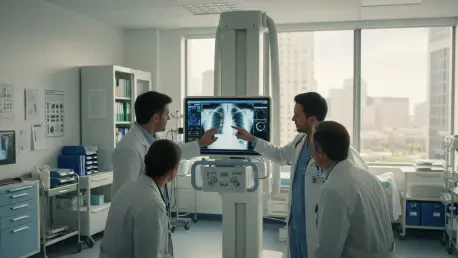

Imagine a world where a routine chest X-ray could do more than just check for lung issues—it could also reveal a silent threat lurking in your bones, one that often goes undetected until it’s too late. Osteoporosis, a condition that weakens bones and increases fracture risk, affects millions globally, yet diagnosis often comes only after a painful break. Now, a groundbreaking advancement from researchers at a leading South Korean hospital has harnessed artificial intelligence (AI) to spot signs of this debilitating disease using everyday chest X-ray images. This isn’t just a step forward; it’s a potential game-changer in early detection. By turning a common diagnostic tool into a dual-purpose screening method, this innovation promises to catch osteoporosis before it strikes, offering hope for timely intervention. The implications are vast, reshaping how healthcare providers approach bone health and paving the way for proactive care on a scale previously unimagined.
Pioneering Research in Bone Health Detection
The journey to this remarkable discovery began with an extensive study involving over 14,500 women who had both chest X-rays and traditional bone density tests at a prominent South Korean medical center. Researchers explored the capabilities of four AI foundation models, split between those trained on general imagery and others focused on medical scans. Through rigorous testing methods like linear validation and low-rank adaptation, the AI was taught to analyze specific features in chest X-rays, such as the spine and ribs, to classify bone density into categories like normal, osteopenia, or osteoporosis. What emerged was striking: one model, originally trained on general images, outperformed expectations with an accuracy rate that placed it at the forefront of predictive technology. Published in a respected journal, these findings highlight how AI can transform a standard imaging tool into a powerful diagnostic ally, potentially saving countless individuals from the consequences of undetected bone loss.
Moreover, this research didn’t just stop at accuracy. The team tackled a deeper challenge—ensuring the AI’s decisions could be understood by medical professionals. By developing a system that highlights specific areas in the X-ray images influencing the AI’s assessment, they’ve addressed the often-criticized “black box” nature of such technologies. This explainability feature ensures that doctors aren’t left guessing about how a conclusion was reached, focusing instead on clinically relevant structures. As the study’s lead researchers emphasized, high performance alone isn’t enough in healthcare settings; trust is paramount. This transparency fosters confidence among practitioners, bridging the gap between cutting-edge tech and real-world application. The result is a tool that not only detects osteoporosis risk with precision but also aligns with the practical needs of medical staff, marking a significant milestone in integrating AI into routine diagnostics.
Transforming Healthcare with Opportunistic Screening
Looking beyond the research itself, the implications of this AI-driven approach are nothing short of revolutionary. Traditional bone density testing requires specialized equipment and appointments, often inaccessible to many until symptoms become severe. In contrast, chest X-rays are among the most commonly performed imaging tests worldwide, conducted for a range of reasons from pneumonia checks to pre-surgical evaluations. Embedding osteoporosis screening into these routine procedures could dramatically increase early detection rates without additional burden on patients or healthcare systems. This opportunistic screening model means that a single scan could alert doctors to bone health issues long before a fracture occurs, enabling interventions like lifestyle changes or medication to halt disease progression. It’s a shift that could redefine preventive care, particularly for aging populations at higher risk.
Furthermore, this innovation doesn’t stand alone in the global landscape. Across the world, similar strides are being made to leverage AI for bone health. In South Korea, a medical tech company has gained approval for software that diagnoses osteoporosis from chest X-rays, while in Taiwan, another firm has introduced an AI tool for bone density analysis in Indonesia. Even in Singapore, advancements are underway to detect related conditions in real-time using AI. These parallel efforts underscore a growing consensus: integrating AI into everyday medical imaging isn’t just feasible—it’s the future. This collective push amplifies the potential for widespread adoption, ensuring that tools like the one developed in South Korea don’t remain isolated successes but become part of a broader movement to enhance diagnostic efficiency. The shared vision is clear—better patient outcomes through technology that’s both accessible and actionable.
Building Trust for a Healthier Tomorrow
Reflecting on the strides made, it’s evident that this South Korean study set a new benchmark by blending high accuracy with transparency in AI assessments. The emphasis on explainability tackled past hesitations about automated diagnoses, proving that technology could align with clinical trust. Looking back, the rigorous validation of multiple models established a robust foundation for future refinements. What stood out was how the research prioritized real-world applicability, ensuring that healthcare providers had tools they could rely on.
Moving forward, the focus should shift to scaling these innovations for global impact. Governments and health organizations must collaborate to integrate such AI tools into standard protocols, especially in underserved regions where specialized tests are scarce. Investment in training for medical staff will also be crucial to maximize adoption. Ultimately, the path ahead involves continuous improvement of these systems, ensuring they adapt to diverse populations and evolving medical needs. This isn’t just about detecting a disease—it’s about building a future where prevention is as routine as a simple scan.