
The current landscape of mixed reality is often dominated by consumer-ready headsets that prioritize portability and immersion, yet Canon’s recent demonstration at the Augmented World Expo challenges this trend with a surprising return to bulky, high-cost specialized hardware. This decision marks a significant departure from the trajectory of competitors like Meta or Apple, who have spent the last few years slimming down their devices to make them more accessible to a broader audience. Canon, however, is leaning into a different philosophy, one where the hardware is tailored strictly for industrial environments and public installations. By showcasing two distinct paths—a handheld prototype and the established MREAL X1—the company is making a bold bet that the professional sector values specific ergonomic utility over the sleek, all-in-one designs currently flooding the market. Whether this gamble pays off depends heavily on how enterprises perceive the trade-off between specialized build quality and the sheer technical specifications offered by much cheaper rivals.
Exploring Specialized Hardware Form Factors
The Handheld Prototype: Solutions for Public Spaces
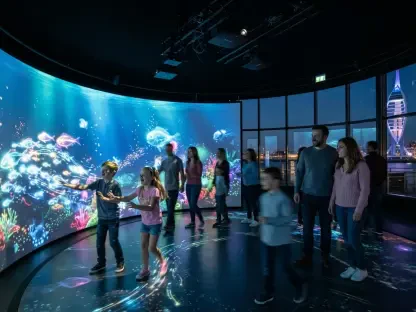
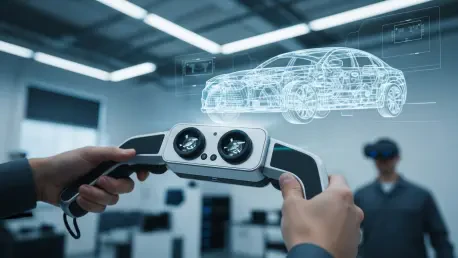
The introduction of the handheld mixed reality module represents a pivot toward a frictionless user experience in high-traffic environments like museums or showrooms. By removing the traditional head strap and onboard battery, Canon has created a device that functions more like a digital magnifying glass or a high-tech periscope than a wearable computer. This “walk-up-and-use” approach addresses a major pain point for public exhibits: the logistical nightmare of fitting headsets onto various head shapes and the persistent hygiene concerns that come with shared facial interfaces. Instead of a long calibration process, a visitor simply picks up the device by its handle and looks through the lenses. This design facilitates a faster turnover of users, making it an attractive option for curators who want to integrate digital overlays into their physical exhibits without the bottleneck of complex wearable tech. It creates a bridge between the physical and digital worlds that feels less like a personal computer and more like a shared optical instrument.
Despite the cleverness of the handheld form factor, the underlying technology appears to be trailing behind the current state of the art in spatial computing. The field of view is limited to approximately 50 degrees, which feels significantly restrictive when compared to the expansive displays found in modern wearable devices. Furthermore, the prototype lacks sophisticated internal processing and positional tracking, relying instead on external markers to orient itself within a room. In a world where inside-out tracking has become the standard for even budget-friendly devices, the requirement for physical stickers or QR codes to anchor 3D models feels somewhat antiquated. For a device intended to operate in the mid-2020s, these specifications might not provide the level of immersion that modern audiences, increasingly accustomed to high-fidelity augmented reality on their smartphones and tablets, have come to expect. The focus on physical convenience may have come at the direct expense of the visual experience.
Build Quality: Physical Design of the MREAL X1
While the handheld unit targets the general public, the MREAL X1 is built specifically for the rigorous demands of enterprise and industrial workflows. The headset features an open-periphery design, which is a deliberate choice intended to keep the user’s natural peripheral vision unobstructed. This is particularly valuable in factory or construction settings where maintaining situational awareness is a matter of safety. However, the actual construction of the headset leaves much to be desired when considering its premium price point. The side blinders are made from a thin, somewhat flimsy plastic that does not instill the same sense of durability found in other professional-grade equipment. The halo-style strap, while adjustable, tends to feel unstable during rapid head movements, which can be a significant drawback for engineers or designers who need to move around a prototype or look at a large-scale industrial machine from various angles.
The physical experience is further complicated by a connectivity architecture that feels remarkably dated compared to the streamlined solutions of today. Instead of the wireless or single-cable connections that have become the industry standard, the MREAL X1 utilizes a bulky intermediary connection box. This box acts as a bridge between the headset and a high-powered laptop, requiring a tangle of cables that can easily become a tripping hazard or a nuisance in a dynamic workspace. This multi-component setup is reminiscent of the early experimental virtual reality rigs from years ago, and it stands in stark contrast to the elegant, self-contained systems now available to professional users. For a piece of hardware that costs more than a mid-sized sedan, the expectation for a more integrated and ruggedized design is naturally high. The current iteration seems to struggle with finding the right balance between professional functionality and the refined manufacturing standards of a modern flagship device.
Performance Metrics and Market Value
Visual Fidelity: Resolution and Tracking Stability
When evaluating the visual output of the MREAL X1, the device provides a per-eye resolution of 1920×2160, which delivers a clear and usable image for most professional visualization tasks. This level of clarity is sufficient for inspecting digital 3D models or overlaying CAD data onto physical parts, but it does not quite reach the “retina” quality levels that competitors are now achieving. The relatively narrow 60-degree field of view creates a distinct “tunnel vision” effect, which can be jarring for users trying to understand the spatial relationship between large-scale digital objects and the physical room. More concerning than the resolution, however, is the actual performance of the tracking system during intensive use. Professional testers have noted instances of jitter and lag when moving the head quickly, along with a noticeable motion blur that can lead to eye strain or even motion sickness over long sessions. These technical hiccups are difficult to overlook in a professional context where precision is paramount.
A core part of the tracking problem stems from Canon’s continued reliance on marker-based systems rather than moving toward a more flexible SLAM-based approach. While using physical markers can provide high precision in a controlled environment, it limits the user’s freedom to move throughout a space that hasn’t been specifically prepared. This dependency on external environment anchors makes the MREAL X1 feel less like a futuristic tool and more like a legacy system that has been updated with newer screens but kept the same old brains. In contrast, most modern mixed reality platforms use sophisticated sensor arrays to map a room in real-time without the need for any external help. By sticking with a system that requires physical setup and maintenance of markers, Canon is asking its customers to put in more manual labor for a tracking experience that is often less fluid than what they could get from a device costing a fraction of the price at a local retail store.
The Value Gap: Competitive Market Analysis
The most significant hurdle for Canon is the massive price gap between its offerings and the rest of the mixed reality market. At a price point of approximately $20,000, the MREAL X1 is positioned as an ultra-high-end tool, yet it faces stiff competition from companies that offer superior specifications for the same or less money. For instance, the Varjo XR-4 provides nearly double the resolution and a much wider field of view, while also incorporating advanced eye-tracking and autofocus features that Canon lacks. Even in the consumer sector, devices like the Meta Quest 3 offer more stable tracking and a more polished software ecosystem. While Canon might argue that its value lies in its specialized support and enterprise-grade services, the raw hardware performance is increasingly difficult to justify when compared to these alternatives. The market has shifted rapidly, and the baseline for what constitutes “high-end” mixed reality has been raised significantly in the last couple of years.
Ultimately, the future of Canon’s mixed reality division depends on whether it can bridge the gap between its unique ergonomic designs and the high-performance optical standards required by modern industry. The company clearly has a deep understanding of niche needs, such as the museum handheld or the open-periphery industrial headset, but these innovations are being hampered by hardware that feels a generation behind. To remain a serious contender, Canon must invest heavily in improving its tracking stability, expanding its field of view, and simplifying its cable management. If the company fails to modernize the internal technology of these devices, it risks being marginalized as a provider of expensive, niche curiosities rather than essential tools for the modern enterprise. The prestige of the Canon brand is a powerful asset, but it cannot forever compensate for a technical specification sheet that no longer leads the pack in a highly competitive and fast-moving technological arena.
The demonstration at the expo clarified that Canon’s strategy leaned heavily on serving very specific user niches rather than chasing broad market appeal. It was observed that while the handheld prototype solved unique logistical problems for public venues, the overall technical execution remained anchored in older methodologies. Decision-makers in the industrial sector recognized that the open-periphery design offered safety benefits, yet they also questioned whether the high cost matched the actual performance delivered by the MREAL X1. Moving forward, the most effective path for the company involved a total overhaul of the tracking sensors and a shift toward more durable, premium materials that justified the five-figure investment. It became clear that successful adoption required the integration of modern spatial mapping features to replace the aging marker-based systems. By aligning its legendary optical expertise with contemporary processing power, the brand had the opportunity to reclaim its position as a leader. The focus shifted toward creating a more cohesive ecosystem where hardware reliability was matched by a seamless, modern user interface.