
The pharmaceutical industry is currently facing a massive bottleneck due to the manual labor required to manufacture complex cell and gene therapies. This challenge has historically kept life-saving treatments prohibitively expensive and difficult to distribute on a global scale. However, the landscape of biotechnology changed significantly following a massive seventy-five million dollar Series B funding round for Multiply Labs Inc., led by the prominent medical researcher Patrick Soon-Shiong and supported by industry giants such as AstraZeneca and Teradyne. This influx of capital signals a decisive move away from outdated manual methods toward sophisticated automation. By utilizing advanced robotics to handle the most delicate parts of drug production, the industry is finally addressing the high-touch requirements that have stalled the growth of personalized medicine for years. This shift is not merely about speed; it represents a fundamental reimagining of how the world produces curative treatments for rare and chronic conditions.
The Engineering: Modular Design of Robotics Clusters
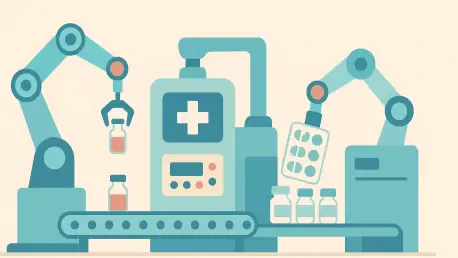
The core innovation driving this transformation involves the deployment of modular robotics clusters, which function as self-contained environments designed to replicate the controlled conditions of a high-tech laboratory. These enclosures house specialized manufacturing equipment and monitoring hardware, all connected through a sophisticated digital nervous system that tracks every variable in real-time. Central to the operation of these clusters are robotic arms sourced from Universal Robotics, which are mounted on an intricate rail and elevator system to provide a full range of motion within the workspace. Unlike traditional fixed automation, these robots can navigate between various processing stations, ensuring that materials are moved with surgical precision. This level of mobility allows for a high degree of flexibility in the manufacturing floor layout, enabling facilities to scale up by simply adding more modular units as demand increases, rather than rebuilding entire production lines from scratch.
To achieve the high standard of care required for personalized medicine, these robotic systems have been integrated with advanced tactile sensors that provide the sensitivity necessary for handling fragile glass vials and delicate biological samples. These sensors allow the robotic arms to perform intricate tasks such as stirring, mixing, and transferring medical ingredients with a level of consistency that human technicians struggle to maintain over long shifts. By mimicking the exact mechanical pressure and rotational movements of a human hand, the technology ensures that the biological integrity of the therapy is preserved throughout the process. This automation of the wet lab workflow reduces the risk of contamination and human error, which are the primary causes of batch failure in cell therapy production. As these systems become more prevalent, the focus shifts from basic mechanical movement to the fine-tuned manipulation of biological materials, setting a new benchmark for precision manufacturing.
The Implementation: Regulatory Mimicry and Market Scalability
One of the most significant barriers to innovation in drug manufacturing is the strict regulatory environment, where any change to a validated process often triggers an exhaustive and costly re-approval cycle. Multiply Labs has addressed this hurdle through a strategy of mechanical mimicry, designing its robotic systems to replicate the exact movements and workflows of human scientists. By ensuring that the robot interacts with the same tools and follows the same sequence of operations as a human would, the company allows drugmakers to implement automation without fundamentally altering the registered manufacturing process. This clever engineering workaround permits pharmaceutical companies to bypass the years of clinical trials usually required for process changes, facilitating a faster transition to automated production. This approach preserves the legal status of the production method while drastically increasing efficiency, proving that the fastest way to innovate in a regulated industry is to respect the existing rules while upgrading the execution.
The successful deployment of these automated systems established a clear roadmap for biopharmaceutical companies aiming to modernize their infrastructure between 2026 and 2030. Leaders in the field moved quickly to integrate these robotic clusters into their existing facilities, ensuring that the transition to personalized medicine was supported by a robust manufacturing backbone. This shift required a rethinking of the workforce, as technicians transitioned into roles focused on supervising automated systems and analyzing the massive data generated by the production process. The industry eventually reached a point where the cost-prohibitive nature of gene therapy was a thing of the past, as the efficiency gains from robotics made high-quality care accessible to a broader patient population. Moving forward, the focus turned toward optimizing software layers to ensure that hardware remained as adaptable as the science it served. This era of automation provided the tools to turn personalized medicine into a global standard of care.