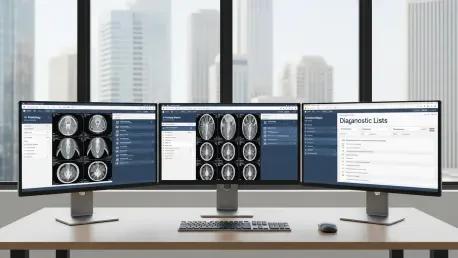

The traditional healthcare landscape is witnessing a seismic shift as diagnostic imaging centers evolve from mere service providers into high-tech software giants driven by artificial intelligence. RadNet is currently spearheading this transformation, moving decisively away from its historical identity as a fixed-location imaging operator to become a dominant force in medical software development. This strategic evolution is centered around its subsidiary, DeepHealth, and the comprehensive rollout of the DeepHealth OS, which serves as an integrated platform designed to unify and modernize the fragmented radiology workflow. By prioritizing these sophisticated high-tech solutions, the organization is positioning itself at the vanguard of a digital healthcare revolution that transcends the limitations of physical facilities. This pivot allows the company to capture the burgeoning market for automated diagnostic tools, effectively transitioning from a capital-heavy business model to one defined by digital innovation and scalable software ecosystems.
Establishing a Regulatory and Financial Foundation
Regulatory Milestones: Accelerating Market Entry
Recent regulatory achievements have acted as a powerful catalyst for this organizational transition, particularly through the successful FDA clearance of advanced tools within the DeepHealth breast-imaging suite. These updates empower clinicians to identify potential cardiovascular risks during routine mammograms, effectively turning a standard screening into a multi-purpose diagnostic event. By automating the retrieval of complex patient histories and integrating them directly into the physician’s view, the software significantly reduces the manual administrative workload that often plagues specialists. This series of approvals across various medical domains represents a crucial foundation for the company’s commercial expansion into the global digital health market. The ability to secure these clearances demonstrates a rigorous commitment to clinical validity, providing the necessary credibility to persuade healthcare systems that AI-driven tools are ready for widespread adoption in high-stakes environments.
The implications of these regulatory successes extend far beyond mere compliance, as they foster a deeper sense of trust between technology developers and the medical community. When the FDA validates an algorithm’s ability to detect subtle abnormalities, it provides a safety net that encourages radiologists to incorporate these tools into their daily practice. This momentum is essential for scaling the DeepHealth OS globally, where regulatory frameworks vary but the demand for precision remains constant. Furthermore, the integration of cardiovascular risk assessment into mammography exemplifies a broader trend toward holistic patient care enabled by deep learning. Instead of viewing diagnostic tests in isolation, the software synthesizes data points to provide a more comprehensive health profile. As more modules receive approval, the platform becomes an indispensable asset for providers looking to improve patient outcomes while maintaining high standards of clinical accuracy across diverse populations.
The Financial Engine: Shifting to SaaS Models
While physical imaging centers continue to generate a substantial portion of total revenue, the digital health segment is rapidly emerging as the primary engine for sustainable long-term growth. The high-margin software-as-a-service model offers a far more predictable and scalable income stream compared to the capital-heavy requirements of maintaining and staffing physical medical clinics. By consolidating its diverse portfolio of specialized AI firms under the unified DeepHealth brand, the organization is constructing a cohesive software offering that appeals to both institutional investors and large-scale healthcare providers. This financial restructuring reflects a broader industry trend where value is increasingly derived from intellectual property and data insights rather than physical assets alone. The transition to a recurring revenue model allows for greater reinvestment into research and development, ensuring that the technology remains competitive in a rapidly evolving market defined by constant innovation.
Strategic consolidation of these specialized technologies has created a robust financial architecture that supports aggressive expansion into international markets. The shift toward a digital-first strategy enables the company to bypass many of the traditional barriers to entry associated with opening physical locations in foreign territories. Instead, the organization can deploy its cloud-based DeepHealth OS to existing hospitals and clinics worldwide, drastically reducing overhead while maximizing reach. Investors have responded positively to this pivot, recognizing that software-centric businesses typically command higher valuations due to their inherent scalability and lower marginal costs. As the digital segment continues to outpace the growth of the traditional imaging business, the company is effectively future-proofing its operations against economic fluctuations. This financial stability provides the necessary runway to refine the AI algorithms further, ensuring they deliver measurable economic value to customers through increased efficiency and throughput.
Operational Strategy and Clinical Implementation
Dual-Track Deployment: Bridging Clinics and Software
The company utilizes a unique dual-track strategy by treating its extensive network of owned imaging centers as a real-world testing ground for its burgeoning technology. This approach allows for the continuous, iterative refinement of the DeepHealth OS in a controlled environment before the software is ever marketed to external hospital customers or health systems. By observing how radiologists interact with the AI tools in daily clinical practice, developers can identify bottlenecks and usability issues that might not be apparent in a laboratory setting. This internal feedback loop ensures that when the platform is finally deployed to third-party clients, it has already been battle-tested against the rigors of high-volume medical imaging. Such a strategy significantly de-risks the product rollout, providing a level of operational maturity that many standalone software competitors simply cannot match without their own dedicated clinical infrastructure.
Collaborative ventures with large-scale healthcare providers further demonstrate the potential of the platform to function as a comprehensive operating system for modern radiology departments. These partnerships serve as high-profile case studies, showcasing the ability of the DeepHealth OS to integrate seamlessly with various existing electronic health records and picture archiving systems. As the platform gains traction within external networks, it creates a powerful network effect where the increasing volume of data leads to better-trained algorithms and more accurate diagnostic insights. This expansion strategy effectively positions the company not just as a software vendor, but as a strategic partner capable of transforming how hospitals manage their entire imaging workflow. By bridging the gap between clinical operations and software development, the organization ensures that its technological innovations remain grounded in the practical realities of modern medicine.
Workflow Automation: Solving the Radiologist Shortage
The integration of artificial intelligence is a direct response to a growing crisis in the healthcare sector, where an aging population’s demand for scans is outpacing the supply of qualified radiologists. DeepHealth’s tools address this fundamental imbalance by automating time-consuming tasks such as lesion measurements and the prioritization of urgent cases within the daily workflow. By handling the more repetitive aspects of image analysis, the software allows physicians to focus their expertise on complex interpretations and patient consultations. This shift is critical for preventing burnout among medical professionals who are increasingly overwhelmed by the sheer volume of diagnostic data they must process each day. The automation of preliminary report sections further streamlines the administrative process, enabling faster turnaround times for results without sacrificing the quality of care provided to the patient.
Beyond simple efficiency gains, these automated tools offer a level of consistency and precision that can be difficult to maintain during long, high-stress shifts. For example, AI algorithms can perform pixel-level analysis to detect minute changes in tissue density that might be overlooked by a fatigued human eye. This capability is particularly valuable in early cancer detection, where every millimeter of accuracy can significantly impact the effectiveness of subsequent treatment plans. By functioning as a digital co-pilot, the DeepHealth OS enhances the overall capacity of the medical workforce, allowing departments to process more patients while maintaining a high standard of diagnostic rigor. As healthcare systems look for ways to do more with fewer resources, the implementation of such sophisticated automation becomes a necessity rather than a luxury. This focus on operational efficiency ensures that the technology provides a clear return on investment for health systems.
Navigating the Challenges of Modern Medical AI
Clinical Realities: Safety versus Real-World Performance
Despite the immense promise of these technologies, there remains a vital distinction between obtaining regulatory clearance and proving long-term clinical success across varied environments. While FDA approvals confirm that a tool meets specific safety and functionality standards, the real-world performance of AI often depends on how it interacts with diverse patient populations. Factors such as variations in imaging hardware, technician protocols, and patient demographics can all influence the accuracy of an algorithm outside of a controlled testing environment. It is therefore essential to view these tools primarily as decision-support aids that assist a clinician’s judgment rather than replacing it entirely. Maintaining a human-in-the-loop approach ensures that the final diagnostic decision remains with a qualified professional who can account for the nuances and clinical context that an algorithm might miss.
Navigating the transition from clinical trials to daily practice requires a commitment to ongoing monitoring and validation of the software’s performance. As the AI is exposed to a broader range of clinical scenarios, developers must be prepared to update and recalibrate their models to ensure they remain accurate and unbiased. This is particularly important as the industry moves toward more complex diagnostic tasks involving multi-modal data integration. Proving that an AI tool can consistently deliver better outcomes than traditional methods is a long-term process that involves rigorous peer-reviewed research and longitudinal studies. For RadNet and DeepHealth, the challenge lies in maintaining this clinical excellence while scaling their operations to meet global demand. Success will depend on their ability to transparently share performance data and collaborate with the broader medical community to establish best practices for the responsible use of artificial intelligence.
Market Competitive Risks: Sustaining a Global Edge
The competitive landscape for medical AI is becoming increasingly crowded as major equipment manufacturers begin to embed similar features directly into their imaging hardware. These original equipment manufacturers often have longstanding relationships with hospital systems, making it difficult for third-party software providers to gain a foothold. To remain competitive, RadNet must emphasize the platform-independent nature of the DeepHealth OS, highlighting its ability to function across different brands of scanners and legacy IT systems. This flexibility is a significant selling point for large hospital networks that operate a heterogeneous mix of equipment. Additionally, the industry must overcome significant hurdles such as complex IT integration, uncertain insurance reimbursement models, and ongoing concerns regarding data privacy. Navigating these obstacles requires a sophisticated understanding of both the technical and regulatory aspects of the global healthcare market.
The organization successfully demonstrated a path forward by integrating artificial intelligence into the core of its operational strategy, effectively bridging the gap between traditional imaging and digital health. By prioritizing high-margin software models and securing critical regulatory clearances, the company established a robust foundation for global expansion through the mid-term of 2026 and beyond. Future success hinged on the ability to prove that platform-independent software could deliver measurable economic and clinical value while maintaining the highest standards of data security. Stakeholders must now focus on expanding interoperability with diverse hospital systems and refining AI algorithms to ensure they remain unbiased across all patient demographics. As the market matured, the emphasis shifted from mere technological capability to the seamless integration of these tools into the broader continuum of patient care. This strategic evolution ensured that the company remained a leader in the digital healthcare revolution.