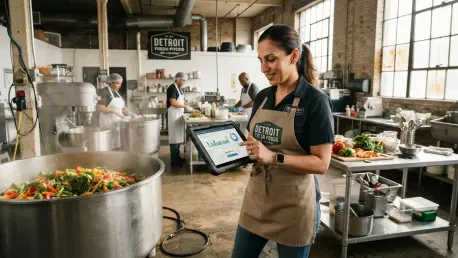

At McClure’s Pickles, tracing ingredients once took 30 to 45 minutes; after an AI integration, the same task took less than two minutes. Bob McClure, the co-owner of McClure’s Pickles in Detroit, says the change came from connecting large language models to the company’s existing business system. For a food producer testing its recall procedures, that’s a practical shift: staff can retrieve information faster when they need to establish where a batch came from and where it went.
A Recall Workflow Shows What Useful Integration Looks Like
Each year, McClure’s Pickles produces more than 3 million jars, with products that include cucumbers, onions, and peppers. The company already used industrial robots for labeling, packing, and stacking. With AI applied to food-safety records, automation took on another task: finding and presenting the information needed to manage an operational risk.
Previously, employees entered ingredient-origin details manually into a database. McClure connected professional versions of large language models, or LLMs, to the firm’s enterprise resource management program. He says the resulting system can trace ingredients through to the finished jar and display shipment destinations, remaining warehouse quantities, and pH readings on an online dashboard.
The value comes from the connection to business records. A standalone chat interface would leave employees responsible for gathering the information before asking questions about it. Here, the integration brings the relevant data into a workflow the company already needs to run.
McClure also built applications for equipment monitoring, supplier accounts-payable drafts, and label checks. Those uses extend the same approach across production and administration, though each has a different consequence if something goes wrong. A draft payment record can be reviewed before use; food-safety information calls for particular care.
His experience also shows why implementation isn’t effortless. McClure says instructions sometimes need several revisions, and bugs still require attention. A former actor without coding training, he uses ordinary language to build with the models and says he can do this work without hiring a technician or licensing separate software for each task.
Those are his reported advantages, rather than a universal cost promise. He notes that he now needs people to oversee the AI. For a business adopting it, time saved on one task can mean new work checking, maintaining, and managing the application.
Owners Are Moving From Assistance to Business Planning
Marie Hunter, owner and president of KRG Oil Company, began with a comparatively contained use case: managing email. She developed an agent with a colleague and named it Billi Jean. Its remit later expanded to financial analysis and growth planning shaped around her goals for the family-owned fuel distribution business near Atlanta.
When Hunter considered adding solar panels to storage tanks to supply power to pumps, along with other modifications, she asked the agent to examine the economics. She expected an assessment of customized tanks for a limited group of customers. Instead, she says it proposed a broader offering built around upgraded tanks and supporting services.
That proposal illustrates a different role for AI in a small company. The owner brings a commercial question; the application helps explore how the idea might become a product. Hunter’s account describes a planning output, not an established new revenue line, so the next business decision remains hers.
Across these cases, the starting point determines what implementation requires:
| Business use | How AI enters the work | Reported result or proposed value |
|---|---|---|
| Recall tracing at McClure’s Pickles | LLMs connected to business records | Ingredient tracing in less than two minutes |
| Expansion planning at KRG Oil Company | An owner-directed agent examines a proposed tank upgrade | A proposal for a wider product and service offering |
| Surplus-material matching at Enso | AI connects available materials with potential buyers | A route toward revenue from materials that cost money to dispose of |
Hunter has also asked her agent to gather M&A information and explore preparations for a possible exit from KRG Oil Company. She is considering giving more attention to her entrepreneurial coaching business. In that setting, the tool supports a decision about the owner’s future as well as the company’s direction; it doesn’t establish what a buyer would ultimately pay.
Enso Makes Matching the Core of a New Venture
Naomi Stone, the owner and CEO of an environmental engineering consulting firm in Hermosa Beach, California, has taken another adoption route. Rather than adding an assistant to an existing process, she has built a new company, Enso, around an AI-enabled matching function.
Stone says companies pay to dispose of surplus materials that other businesses could use. Enso seeks to connect those holders with buyers, covering industrial byproducts as well as packaging, equipment, and manufacturing scrap. Coal ash, which can be used to strengthen building materials, is one example she identifies.
For this business, the matching task is central to the service. Stone says AI can find combinations her team hadn’t considered and operate at a pace and scale that would be difficult for Enso to achieve alone. The intended customer benefit is straightforward: material treated as a disposal expense could instead generate income.
A suggested match still needs to become a workable transaction. The practical adoption question is whether the proposed buyer can use the available material and whether the arrangement makes commercial sense. Stone’s account establishes the opportunity, but supplies no revenue figures or completed-transaction totals.
Together, these businesses suggest a useful implementation path for owners evaluating similar applications:
- Choose a specific decision or task. Ingredient tracing, tank-upgrade economics, and material matching each give the application a defined purpose.
- Provide the relevant business context. McClure connected operational records; Hunter supplied her company goals and questions.
- Revise and check the output. McClure’s experience with instructions and bugs shows why initial results need testing.
- Separate a proposal from a realized outcome. A growth plan or buyer match creates a next step, not proof of commercial success.
Adoption Figures Put the Cases in Perspective
More than 85% of respondents used AI in some capacity, a Goldman Sachs 10,000 Small Businesses report, The AI Economy is a Small Business Economy, found. Use for financial analysis and planning reached 42%, more than twice the rate reported in 2024. More than half used it to investigate or develop projects and products.
Those figures describe a particular group. For the 2026 Alumni Survey, Babson College contacted 14,967 alumni and received responses from 2,473. The survey ran from August 10–24, 2026. Its findings show how program graduates are adopting AI; they don’t measure adoption across all small businesses.
The wider economic context explains the interest in helping owners move beyond experimentation. The US Small Business Administration’s Office of Advocacy attributes 43.5% of US economic output and 61% of net new job creation to small businesses. Successful implementation in these firms could therefore have relevance well beyond individual time savings.
The Goldman Sachs Small Business AI Institute is intended to help entrepreneurs adopt and integrate the technology, says Asahi Pompey, global head of the Office of Corporate Engagement and chair of the Urban Investment Group. She frames the task as turning existing experimentation into durable business results. The owners described here have been pursuing their applications independently.
These examples show why that transition matters now. Small-business owners already put AI to work in recall procedures, commercial planning, and new matching services. From there, each application needs reliable information and someone responsible for its output. Owners also need to assess it against a business result they can check.