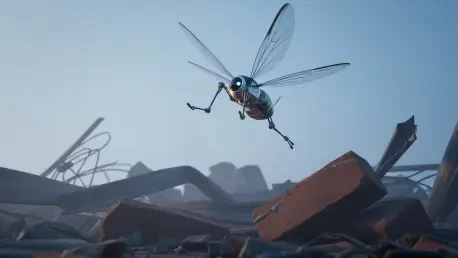

Imagine a world where tiny robots, no larger than a paperclip, dart through the rubble of a collapsed building, searching for survivors with the agility of a bumblebee. This isn’t a distant dream but a reality crafted by engineers at MIT, who have pioneered a groundbreaking aerial microrobot. This technology, blending bioinspired design with cutting-edge artificial intelligence, promises to transform disaster response and beyond. The following review dives deep into the nuances of this innovation, exploring its design, performance, and the potential it holds for reshaping industries constrained by the limitations of traditional robotics.
The Dawn of Insect-Like Robotics
Aerial microrobots have emerged as a solution to challenges that larger drones and robots simply cannot tackle. In environments where space is tight or conditions are hazardous, such as post-earthquake debris or confined industrial zones, the need for nimble, micro-scale devices becomes apparent. MIT’s latest creation stands out by mimicking the flight capabilities of insects, a feat long considered unattainable due to constraints in speed, control, and computational power at such a small scale. This development marks a pivotal shift, positioning these robots as vital tools in scenarios where precision and accessibility are paramount.
The significance of this technology extends beyond mere size. It represents a convergence of disciplines—biology, engineering, and computer science—working in harmony to solve real-world problems. By drawing inspiration from nature, particularly the rapid wing-flapping of insects, this microrobot challenges the status quo of aerial robotics. Its ability to navigate complex spaces with near-biological finesse offers a glimpse into a future where micro-scale devices could become as commonplace as their larger counterparts in critical missions.
Unveiling the Technology: Design and Performance
Bioinspired Hardware: Wings and Muscles
At the heart of this microrobot lies an ingenious design that mirrors the natural world. The robot features larger flapping wings, powered by soft, squishy artificial muscles, which enable high-speed wing motion akin to that of a bumblebee. This hardware innovation allows for remarkable agility, letting the tiny device weave through obstacles with an ease that traditional rigid structures could never match. The artificial muscles, in particular, provide a flexibility that enhances both speed and maneuverability, setting a new standard for micro-scale flight systems.
Beyond the wings, the integration of these soft components addresses a long-standing issue in robotics: durability versus performance. Unlike stiff materials that may crack under stress, the pliable nature of the artificial muscles ensures the robot can withstand minor collisions while maintaining its flight capabilities. This balance of resilience and efficiency underscores the brilliance of bio-mimicry, proving that solutions from nature can often outshine purely synthetic approaches in addressing engineering challenges.
AI-Powered Control: The Brain Behind the Flight
Complementing the hardware is a sophisticated two-step AI control system that acts as the robot’s brain. The first step involves a model-predictive controller that meticulously plans trajectories for complex maneuvers, ensuring optimal paths even in unpredictable settings. The second, a deep-learning-based policy, executes these plans in real time, adapting to disturbances like sudden gusts of wind. This dual approach achieves a harmony between strategic foresight and instantaneous reaction, a critical factor in the robot’s near-insect-like precision.
What’s truly impressive is how this system maintains stability during aggressive flight behaviors. Whether performing consecutive somersaults or executing rapid turns, the microrobot stays within mere centimeters of its intended path. This level of control, previously unimaginable at such a small scale, highlights the power of computational advancements in robotics. Moreover, it sets a precedent for future micro-scale devices, demonstrating that AI can bridge the gap between hardware limitations and ambitious performance goals.
Performance Metrics: A Leap Forward
The numbers speak volumes about the capabilities of this tiny marvel. Compared to earlier iterations, the microrobot boasts a staggering 447% increase in speed and a 255% boost in acceleration, bringing its performance tantalizingly close to that of natural insects. In practical terms, it can complete feats like 10 consecutive somersaults in just 11 seconds, all while adhering to its trajectory with minimal deviation. Such metrics are not just academic milestones; they translate to real-world reliability in high-stakes environments.
This performance isn’t merely about speed or acrobatics. It reflects a robustness that allows the robot to operate under challenging conditions, such as wind disturbances exceeding 1 meter per second. The ability to maintain control amidst external forces ensures that the technology is not confined to controlled lab settings but can eventually thrive in unpredictable outdoor scenarios. This durability, paired with precision, makes a compelling case for its practical deployment in urgent missions.
Applications: From Disaster Zones to Daily Life
One of the most immediate and impactful uses for this technology lies in search and rescue operations. In disaster-stricken areas, where larger drones struggle to navigate through tight spaces or hazardous rubble, this microrobot can slip into crevices to locate survivors. Its small size and agility enable it to access areas that are otherwise unreachable, potentially saving lives when every second counts. This capability alone positions it as a game-changer in emergency response strategies.
Looking beyond crises, the potential applications are vast and varied. Environmental monitoring could benefit from deploying these robots to track wildlife or assess pollution levels in hard-to-reach locations. Agricultural surveillance might also see a revolution, with microrobots inspecting crops for pests or disease at a granular level. These diverse use cases illustrate how a technology initially designed for urgent needs can ripple out to enhance everyday operations across multiple sectors.
Challenges on the Horizon
Despite its groundbreaking achievements, the journey toward widespread adoption is not without hurdles. A significant technical challenge is transitioning from external control systems to onboard processing. Currently, much of the robot’s computational power relies on offboard setups, limiting its autonomy in real-world settings. Overcoming this barrier, while preserving the precision of its maneuvers, remains a critical area of focus for ongoing development.
Additionally, durability under variable conditions poses a concern. While the robot performs admirably in controlled tests, real-world environments introduce factors like extreme temperatures or unpredictable debris that could test its limits. Integrating sensors and cameras for full autonomy adds another layer of complexity, as does navigating regulatory landscapes that govern the use of such devices. These obstacles, though daunting, are part of the natural evolution of any transformative technology and are being actively addressed by research teams.
Reflecting on a Milestone in Robotics
Looking back, the strides made by MIT in developing this aerial microrobot stood as a testament to the power of interdisciplinary innovation. The fusion of bioinspired hardware with AI-driven control carved a path that few could have predicted, delivering performance metrics that redefined what micro-scale robots could achieve. Each somersault, each precise turn through turbulent air, marked a victory over longstanding barriers in robotics.
Moving forward, the focus must shift to actionable advancements—integrating onboard systems for true autonomy and ensuring resilience in diverse environments. Collaboration across sectors will be key, as will investment in testing these robots in real-world simulations from 2025 onward. The potential to coordinate swarms of these devices for complex tasks, from disaster response to industrial inspections, offers an exciting frontier. As solutions to current limitations emerge, this technology promises not just to assist but to inspire, redefining the boundaries of what tiny machines can accomplish.