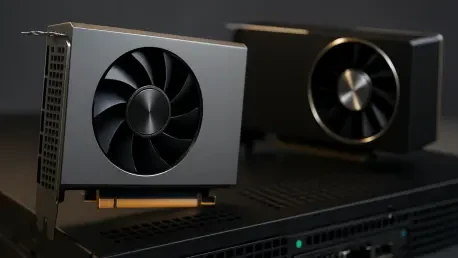

The sudden escalation in computational requirements for generative artificial intelligence has pushed data center operators into a frantic search for hardware that balances raw power with logistical feasibility. While the industry has long been defined by a single dominant player, the arrival of the AMD Instinct MI350P represents a calculated disruption aimed squarely at the high-performance PCIe market currently occupied by Nvidia’s ##00 NVL. This new accelerator is not merely a reactionary update; it is a specialized instrument designed to fit into the standard server infrastructures that enterprises have already spent billions to establish. By prioritizing the PCIe form factor, AMD is specifically addressing the massive middle ground of the market that craves Blackwell-level performance but lacks the specialized, proprietary liquid-cooled chassis or SXM-based systems typically required for such densities. This strategic positioning provides a pragmatic pathway for organizations to scale their operations without the friction of total architectural overhauls.
The Architectural Foundation
Next-Gen Silicon: Smart Manufacturing and CDNA4
At the center of the MI350P is the CDNA4 architecture, which represents the most advanced iteration of AMD’s data-center-focused GPU logic designed for the rigorous demands of 2026. The manufacturing process for this silicon employs a sophisticated hybrid approach, utilizing a combination of TSMC’s 3nm and 6nm FinFET process technologies. This multi-node strategy is a masterclass in modern semiconductor engineering, allowing the company to concentrate high-density logic for complex compute tasks on the leading-edge nodes while using more mature, cost-effective nodes for supporting I/O and power management components. By decoupling these elements, the architecture achieves a superior balance of thermal efficiency and raw transistor density. This design philosophy ensures that the silicon can maintain high clock speeds without the exponential heat generation that typically plagues single-die monolithic designs, making it ideal for high-density rack deployments.
The architectural layout of the CDNA4 engine is specifically tuned to handle the sparse matrix operations that define modern neural network training and inference. Unlike consumer-grade hardware, every square millimeter of the MI350P silicon is dedicated to accelerating tensor mathematics and high-speed data movement. This focus is reflected in the integration of specialized instructions that allow for faster execution of transformer-based models, which are the backbone of current large language model breakthroughs. By refining the way individual compute units communicate across the chiplet fabric, the architecture minimizes internal latency, ensuring that the processing cores are never starved for work. This efficiency is critical for maintaining the high utilization rates required to justify the massive capital expenditure associated with modern AI clusters. The result is a hardware foundation that is not just faster in theory, but more resilient under the sustained, heavy loads typical of enterprise AI workloads.
Optimized Cache: Breakthroughs in Throughput Management
To support the massive logic density of the CDNA4 architecture, AMD has integrated 128 Compute Units (CUs), a configuration that leads the industry for a standard PCIe-based accelerator. While this represents a more focused compute density compared to the flagship MI355X models, it is precisely calibrated to maximize the performance of a dual-slot card. To ensure these CUs perform at their peak, the design includes a massive 128MB last-level cache. This local memory pool is vital for overcoming the “memory wall” effect, a common bottleneck where high-speed processors sit idle while waiting for data to arrive from the main memory stacks. By keeping larger chunks of the working dataset directly on the silicon, the MI350P drastically reduces the need for energy-expensive off-chip data fetches. This results in a smoother execution flow for complex tensor operations, allowing the card to maintain near-peak performance even during the most demanding cycles.
The cache architecture also plays a pivotal role in minimizing the total cost of ownership by significantly improving energy efficiency per operation. Every time data moves from the HBM3E stacks to the compute units, energy is consumed; by caching that data locally, the MI350P reduces the total power draw required for repetitive tasks like iterative model refining or high-volume inference. Furthermore, the intelligent management system within the cache hierarchy predicts data access patterns, pre-loading essential information before the compute units even request it. This proactive data management is what separates enterprise-grade accelerators from standard hardware, providing the predictable low-latency performance that real-time AI applications require. In the context of a modern data center, where every microsecond and every watt counts, this optimized throughput management provides a tangible competitive advantage for businesses running massive, data-intensive workloads.
Dominating Through Memory and Performance
Unmatched Bandwidth: The HBM3E Advantage
The most defining characteristic of the MI350P is undoubtedly its sophisticated memory subsystem, which features 144GB of HBM3E memory. This technology utilizes vertical stacking of memory dies to achieve a level of density and speed that traditional GDDR solutions simply cannot match. The 144GB capacity is a strategic choice, specifically tailored to the memory-hungry nature of Large Language Models (LLMs) that dominate the current technological landscape. These models often require hundreds of gigabytes of VRAM to store model parameters and KV caches during high-speed inference sessions. By providing such a large local memory pool on a single PCIe card, AMD allows developers to host larger, more sophisticated models without the performance penalties associated with splitting the model across multiple cards or server nodes. This simplifies the software stack and improves the overall reliability of the AI infrastructure.
Beyond the raw capacity, the MI350P delivers an industry-leading 4TB/s of memory bandwidth, a figure that is often more critical for AI performance than the teraflops of the processor itself. In the world of AI inference, the speed at which data can be moved into the compute units is the ultimate gatekeeper of performance. With 4TB/s, the MI350P ensures that its 128 compute units are constantly saturated with data, preventing the idle cycles that often plague less balanced systems. This massive bandwidth allows for the simultaneous processing of billions of parameters, enabling the card to handle complex tasks like real-time video analysis or high-concurrency chatbot interactions with ease. By eliminating the memory bottleneck, AMD has created a product that can truly capitalize on its architectural strengths, providing a level of responsiveness that is essential for the next generation of interactive, autonomous, and generative AI services.
Performance Benchmarks: Breakthroughs in Precision
When compared directly against the Nvidia ##00 NVL, the MI350P demonstrates a significant leap in theoretical compute performance, particularly in the standard formats used for modern AI. The card delivers approximately 40% faster performance in FP16 and FP8 formats, which are the industry benchmarks for training and inference, respectively. This performance gap is not merely a marginal gain; it represents a substantial shift in the price-to-performance ratio for data center operators. Additionally, the MI350P shows a 20% improvement in FP64 tasks, which are essential for high-performance computing (HPC) and complex scientific simulations. This versatility ensures that the card is not a one-trick pony, but a robust tool capable of supporting a wide range of academic and industrial research projects alongside its primary AI duties. This multi-faceted performance makes it an attractive investment for hybrid data centers.
A major breakthrough in the MI350P is its native support for ultra-low-precision formats, specifically MXFP6 and MXFP4. By utilizing the MXFP4 format, the accelerator can reach peak theoretical performance levels between 2,299 and 4,600 TFLOPs. This capability is critical for the emerging trend of model quantization, where the precision of mathematical operations is reduced to save memory and increase speed without significantly impacting the accuracy of the final output. The ability to run these highly compressed models at such extreme speeds allows for unprecedented throughput in inference tasks. This positions the MI350P as the fastest AI accelerator currently available in a standard PCIe form factor, especially given the current lack of a direct Blackwell-based PCIe competitor with equivalent memory specifications. For organizations looking to maximize their inference capacity per rack, these precision breakthroughs offer a clear path toward industry-leading efficiency and speed.
Infrastructure and Ecosystem Deployment
Power Management: Flexibility and Scalability
One of the most persistent hurdles in modern data center management is the balancing act between high-performance hardware and the limitations of existing power and cooling infrastructure. AMD has addressed this challenge by designing the MI350P with a highly flexible 600W power envelope that can be tuned down to 450W depending on the specific needs of the environment. This tunability is a strategic masterstroke, as it allows the card to be deployed in older server racks or power-constrained facilities that cannot support the massive power draws of high-end SXM modules. By offering this range of configurations, the MI350P becomes a versatile solution that can be tailored to the specific thermal and electrical capabilities of any data center, ensuring that performance is never sacrificed due to local infrastructure constraints. This adaptability is key for rapid enterprise deployment.
The physical design of the MI350P also reflects a deep understanding of data center logistics, featuring a 10.5-inch, dual-slot, fanless configuration. This passive cooling approach is a standard requirement for high-density environments, as it allows the card to leverage the high-pressure airflow generated by the server chassis fans rather than relying on small, failure-prone internal fans. Furthermore, the MI350P supports massive scalability, allowing up to eight cards to be interconnected within a single server chassis. This multi-GPU scaling provides a linear increase in performance, enabling a single 4U server to provide the compute power once reserved for entire racks of equipment. This level of density and scalability is essential for handling the massive concurrent requests of a global user base or for hosting the exceptionally large models required for cutting-edge research. It represents a significant step forward in making high-end AI compute accessible.
Use Cases: Optimization for RAG and Inference
As the AI industry shifts its primary focus from the initial training of models to the day-to-day reality of inference, the MI350P is perfectly positioned to handle the most demanding production workloads. It is specifically optimized for Retrieval-Augmented Generation (RAG) pipelines, a method that is becoming the standard for enterprise AI. In a RAG setup, an LLM retrieves real-time information from an external database to provide more accurate, contextually relevant answers. This process is incredibly data-intensive, requiring both high-speed memory and rapid data movement—the two areas where the MI350P excels. By providing the bandwidth and capacity needed to manage these complex retrieval tasks, the card allows businesses to deploy AI agents that are more reliable and knowledgeable than those running on less capable hardware. This optimization directly translates to better user experiences and more accurate AI outputs.
Despite the hardware’s clear superiority in several key metrics, the ultimate success of the MI350P will depend on its ability to compete with the entrenched CUDA software ecosystem. To this end, AMD has made massive strides with its ROCm (Radeon Open Compute) software stack, an open-source alternative that provides the drivers and libraries necessary for AI development. The maturation of ROCm is critical, as it ensures that popular frameworks like PyTorch and TensorFlow can run seamlessly on AMD hardware without requiring extensive code changes from developers. By fostering an open and accessible software environment, AMD is lowering the barrier to entry for teams that have traditionally been locked into the Nvidia ecosystem. The goal is to provide a “plug-and-play” experience where the hardware’s raw power can be immediately harnessed by existing AI pipelines. This commitment to software parity is what will ultimately determine the MI350P’s long-term impact on the competitive landscape.
Strategic Implementation and Future Directions
Comprehensive Hardware Assessment
The introduction of the MI350P represented a fundamental shift in how organizations approached the procurement of AI hardware during the previous development cycle. By delivering a product that surpassed existing benchmarks in the PCIe category, AMD provided a necessary alternative to the supply-chain-constrained options of the past. The industry quickly recognized that the massive 144GB HBM3E memory pool was not just a luxury, but a necessity for the larger models that became the standard for enterprise deployment. Many technical leaders found that the ability to run larger inference batches on a single card significantly reduced the complexity of their distributed computing stacks. This realization led to a widespread re-evaluation of data center strategies, with many opting for the flexibility of the MI350P’s power-tunable design to maximize their existing rack space.
The market’s adoption of the MI350P also highlighted the growing importance of precision-flexibility in modern AI operations. As organizations looked for ways to reduce operational costs, the card’s native support for MXFP4 became a vital tool for maintaining high throughput without the energy costs of higher-precision mathematics. This shift was supported by the rapid maturation of the ROCm ecosystem, which proved that an open-source approach could indeed compete with proprietary standards when backed by superior hardware. The historical performance of this accelerator proved that the market was hungry for competition and that the dominance of a single vendor was not an inevitability. By focusing on the practical needs of the data center, the MI350P solidified its place as a cornerstone of the modern AI hardware landscape, offering a blueprint for future high-performance accelerator designs.
Actionable Strategies for Integration
For technical decision-makers looking to capitalize on this hardware, the first step involved a detailed audit of existing server thermal profiles to determine the optimal power configuration for the MI350P. By testing the card at both the 600W and 450W settings, organizations were able to find the “sweet spot” that maximized performance while staying within the cooling limits of their current facilities. Furthermore, the implementation of RAG-based workflows became much more feasible, as the high memory bandwidth allowed for the rapid retrieval and processing of external data sources. Organizations were encouraged to migrate their inference workloads to these cards to free up more expensive, specialized training clusters for long-term research and development. This tiered approach to hardware utilization resulted in a more efficient use of resources across the entire enterprise.
Looking ahead, the successful deployment of the MI350P required a commitment to the ROCm software stack and a willingness to participate in the broader open-source AI community. Developers who took the time to optimize their models for the CDNA4 architecture found that the performance gains far outweighed the initial effort of moving away from proprietary libraries. The actionable takeaway for any enterprise in 2026 was to prioritize hardware that offered both massive memory headroom and infrastructure flexibility. As models continue to grow in size and complexity, the lessons learned from the MI350P deployment served as a guide for building scalable, resilient AI platforms. By embracing these advancements, organizations were able to move beyond experimental AI and into a phase of reliable, high-speed production that drove real business value across every sector of the economy.