
The rapid integration of Large Language Models into the core infrastructure of modern enterprise systems has fundamentally changed how organizations interact with their proprietary data repositories. While the initial wave of adoption relied heavily on basic Retrieval-Augmented Generation to ground AI responses in factual evidence, the limitations of this approach are becoming increasingly evident in complex operational environments. As of 2026, the industry is witnessing a decisive shift from simple vector-based retrieval toward more sophisticated, graph-enhanced architectures that can navigate the intricate web of relationships inherent in corporate knowledge. This transition is driven by the realization that semantic similarity alone cannot replicate the nuanced logical reasoning required for high-stakes decision-making. By integrating graph databases into the retrieval pipeline, developers are finally able to bridge the gap between statistical probability and deterministic structural truth, ensuring that AI systems provide answers that are not only relevant but also contextually accurate across multiple layers of interconnected information.
The Structural Blind Spots of Vector Search
The most significant drawback of relying solely on vector search is the inherent loss of data topology that occurs during the embedding process. When information is chunked and converted into high-dimensional vectors, the explicit connections—such as corporate hierarchies, project ownership, or technical dependencies—are effectively flattened into a sea of numerical coordinates. Vector databases are undeniably excellent at capturing the general semantic meaning of a specific text segment, but they are fundamentally blind to the structural “skeleton” that defines how different pieces of information relate to one another in the real world. This mathematical abstraction treats every piece of data as an island, relying on proximity in a latent space rather than the concrete logical links that human experts use to navigate complex documentation. Consequently, when a query requires understanding the specific relationship between two distant entities, the vector-only approach often misses the mark because it lacks a map of the underlying terrain.
This lack of structural awareness frequently leads to a total breakdown in multi-hop reasoning, which is essential for answering complex business questions. For instance, in a global supply chain scenario, a vector-only system might successfully identify a news report about a factory disruption because the terms are semantically relevant to a user’s query about “risk.” However, it often fails to connect that specific factory to a downstream client or a particular product line unless those entities are explicitly mentioned within the same narrow text segment. This structural gap forces the model to either hallucinate a plausible but incorrect connection or admit defeat, even when the necessary data exists elsewhere in the broader database. By failing to “traverse” the relationships between data points, standard retrieval systems remain trapped in a surface-level understanding of the content, unable to synthesize insights that require moving through multiple logical steps or layers of organizational data.
Building the Hybrid Retrieval Framework
To overcome these hurdles, a hybrid architecture is necessary, beginning with a strict enforcement of data structure during the initial ingestion phase. Instead of treating documents as a collection of isolated fragments to be indexed, the system must employ sophisticated Named Entity Recognition and relationship extraction to identify nodes and edges as information is processed. By capturing these entities and their specific interactions from the start, the system preserves the essential “connective tissue” of the information, ensuring that the meta-structure is never lost. This proactive approach transforms the ingestion pipeline from a simple storage mechanism into a knowledge-graph construction engine. When a new contract or technical manual is added to the system, it is not just embedded for similarity; it is mapped into a growing web of facts where every participant, date, and requirement is linked to its broader context, providing a far more resilient foundation for the generative model to build upon during the inference stage.
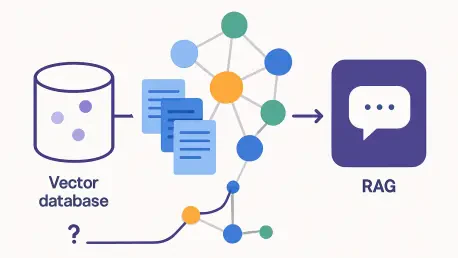
The storage strategy in this advanced model utilizes a dual-capability approach, often pairing a high-performance graph database like Neo4j with vector embeddings stored as node properties. This setup enables a powerful two-step retrieval process that combines the best of both worlds: a vector scan first identifies the most relevant entry points in the graph based on the user’s semantic intent, and then a graph traversal gathers the surrounding context by following defined relationships. This methodology provides the Large Language Model with a structured payload that explicitly maps out how entities relate to one another, leading to more grounded and verifiable responses. Instead of receiving a random assortment of text chunks, the model receives a coherent “sub-graph” of relevant facts. This explicit mapping effectively eliminates the ambiguity that often plagues vector-only systems, as the model no longer has to guess how different pieces of information fit together; the structure is provided directly in the prompt.
Navigating Production Hurdles and Use Cases
Implementing these sophisticated systems in a production environment introduces a unique set of technical challenges, primarily centered around balancing system latency with the need for data integrity. Graph traversals are inherently more computationally demanding than simple vector lookups, which can lead to increased response times that may impact the user experience. To maintain the high performance required for enterprise applications, organizations are increasingly turning to strategies like semantic caching, where the results of common graph queries are stored and served when a new query is semantically similar to a previous one. This layer of optimization allows the system to provide the depth of a graph search without the associated time penalty for every single interaction. Furthermore, because graph data is highly interdependent, any change in one part of the network can have cascading effects, necessitating the use of advanced synchronization pipelines to ensure the digital twin remains accurate.
Deciding when to transition to a graph-enhanced model involves a careful evaluation of the specific domain’s complexity and the necessity for explainable reasoning paths. In scenarios where the data is naturally flat or the primary requirement is ultra-low latency, a traditional vector-only RAG remains the more efficient and cost-effective choice. However, for highly regulated industries like finance, healthcare, or legal services—where answers must be derived from complex, multi-step relationships—Graph-Enhanced RAG provides the structural truth necessary to build reliable applications. As organizations move toward 2027 and 2028, the ability to provide an “audit trail” of how an AI arrived at a specific conclusion will become a mandatory requirement. By anchoring the generative process in a deterministic graph, developers can offer a level of transparency and precision that was previously unattainable, transforming AI from a helpful assistant into a rigorous tool for complex enterprise-scale business intelligence.
Strategic Implementation and Future Considerations
The decision to implement a graph-enhanced retrieval system should be viewed as a long-term investment in the reliability and scalability of an organization’s AI capabilities. To begin this transition, engineering teams must prioritize the cleanup and standardization of their existing data, as the quality of the knowledge graph is directly proportional to the clarity of the underlying entities and relationships. A practical first step involves identifying the “high-value” relationships that drive the most critical business queries and focusing extraction efforts there rather than attempting to map an entire enterprise at once. This iterative approach allows for the gradual refinement of the graph schema, ensuring that the system evolves in alignment with actual user needs. Moreover, as vector databases and graph databases continue to converge into unified multi-model platforms, the technical friction of maintaining separate systems is expected to decrease, making this advanced architecture accessible to a broader range of mid-market companies.
Looking ahead, the integration of graph structures into the RAG pipeline was a fundamental shift in how developers approached the problem of AI reliability. By moving away from the “black box” nature of pure vector embeddings, organizations successfully created systems that are more resilient to the hallucinations that plagued earlier iterations of the technology. The primary takeaway for architects today is that the most effective AI systems are those that treat data not just as a collection of words, but as a living network of interconnected facts. This structural grounding has proven essential for moving AI from experimental pilots into mission-critical production environments where accuracy is non-negotiable. As the technology continues to mature, those who have mastered the art of hybrid retrieval will find themselves at a significant advantage, possessing the tools to unlock deep insights from their data that simple search methods could never hope to uncover.