


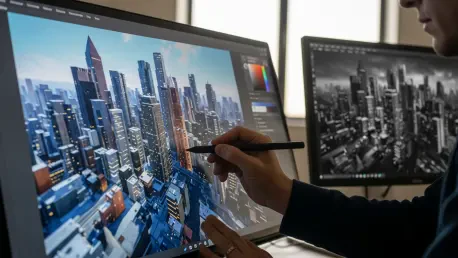

The transition from laborious manual concept art to near-instantaneous high-fidelity rendering represents one of the most significant technological leaps in the history of interactive entertainment. The current gaming landscape demands a level of visual complexity that traditional manual pipelines often struggle to maintain without ballooning budgets or extending development cycles by several years. Unlike the early text-to-image models that often produced unpredictable or structurally incoherent results, image-to-image AI offers a refined method for translating human intent into actionable assets. This technology functions as a collaborative bridge, allowing artists to feed their own rough sketches or blocked-out 3D scenes into a model that adds texture, lighting, and detail while strictly adhering to the original composition. By maintaining the spatial logic of the source material, developers avoid the common pitfalls of purely generative systems, ensuring that every piece of art remains functional within the context of the game’s mechanics. The result is a more fluid and responsive creative environment where the distance between a raw concept and a polished visual benchmark is measured in minutes rather than weeks.
Accelerating the Creative Pipeline
From Rough Ideation to Style Selection: Conceptual Prototyping
In the early stages of pre-production, the traditional workflow involves a grueling cycle of pencil sketches, digital paintings, and multiple rounds of feedback before a character or environment is approved. Image-to-image AI dramatically alters this timeline by serving as an instantaneous rendering assistant that interprets low-fidelity inputs with surprising accuracy. A concept artist can produce a gestural drawing of a protagonist, and the software will immediately provide a version with realistic clothing folds, skin textures, and cinematic lighting. This capability allows creative directors to see a vision realized almost immediately, facilitating faster decision-making and reducing the need for dozens of intermediate drafts. Because the AI respects the silhouette and pose of the original sketch, the fundamental artistic intent remains intact, preventing the loss of character essence that often occurs when outsourcing tasks or using more chaotic generative methods. This rapid feedback loop encourages a more experimental atmosphere where teams can explore unconventional designs without the fear of wasting significant billable hours on a discarded idea.
From Rough Ideation to Style Selection: Aesthetic Iteration
Beyond simply polishing individual assets, these tools provide a sophisticated sandbox for exploring the overarching visual identity of a project through look-development. Developers can take a single environment mockup and subject it to a variety of stylistic filters, instantly comparing how the scene would look in a high-contrast noir aesthetic versus a vibrant, painterly watercolor style. This iterative power is particularly useful for establishing consistent art bibles early in the development cycle, as it allows teams to stress-test their ideas across different genres or moods without manual redrawing. By automating the visual exploration phase, studios can confidently commit to a specific direction early on, knowing exactly how their world will translate into the final product. This systematic approach to style selection reduces the risk of costly pivots later in production, ensuring that the visual narrative remains cohesive and compelling for the intended audience. Moreover, it empowers art directors to maintain tighter control over the visual consistency of large projects, as the AI can be fine-tuned to replicate a specific, proprietary house style across thousands of unique assets.
Scaling Production and Asset Variety
Generating Environmental Variations and Detailed Props: World Diversity
Creating vast, open-world environments requires a massive volume of unique assets and terrain variations to keep players engaged and prevent the world from feeling repetitive. Image-to-image AI enables developers to take a single, well-designed landscape and generate hundreds of variations that account for different weather systems, seasons, or times of day. For instance, a basic forest scene can be transformed into a winter tundra or a post-apocalyptic wasteland while maintaining the exact placement of trees, rocks, and hills. This spatial consistency is vital for gameplay, as it ensures that the player’s navigation paths and line-of-sight mechanics remain unchanged despite the visual overhaul. By leveraging AI to handle these environmental permutations, technical artists can focus on the architectural logic and level design, leaving the time-consuming tasks of seasonal re-skinning to the automated systems that excel at such large-scale visual transformations. This approach not only saves time but also allows for more dynamic world states where the environment can evolve in response to player actions or narrative milestones.
Generating Environmental Variations and Detailed Props: Asset Fidelity
At the micro-level, the demand for high-quality props and textures often creates a significant bottleneck in the production line, especially for titles striving for high-fidelity realism. Artists now utilize image-to-image models to generate high-resolution textures from basic patterns or even photographs of real-world materials, ensuring that every surface in the game world feels authentic. This process allows for the rapid creation of diverse prop libraries, where a single base model of a wooden crate can be turned into dozens of unique versions with different wear patterns, labels, or fungal growth. This variety is essential for maintaining player immersion, as it prevents the repetitive cloned asset effect that frequently plagues large-scale projects with limited art budgets. By streamlining the production of background elements and minor decorative objects, AI allows the core art team to dedicate their skills to hero assets and central story elements that define the player’s emotional experience. Consequently, the overall density of the world increases, providing players with a richer and more believable sensory environment.
Evolving Industry Strategy and Workflows
Empowering Small Studios and Professional Collaboration: Creative Parity
The democratization of high-end visual tools through image-to-image AI has profoundly impacted the strategic landscape for independent developers and smaller creative teams. Historically, the gap in visual polish between triple-A titles and indie projects was dictated by the sheer number of artists a studio could afford to employ. Now, a small team can produce a level of graphical fidelity that rivals much larger competitors by using AI to handle the heavy lifting of asset rendering and texture mapping. This shift allows independent creators to compete on a global scale, focusing their limited resources on innovative gameplay mechanics and deep storytelling rather than manual labor. Furthermore, these tools simplify the marketing process by allowing developers to quickly convert internal grey-box prototypes into high-quality promotional screenshots. This ability to generate professional-grade marketing materials early in the development cycle helps small studios secure funding and build community engagement long before the final game is ready for commercial release.
Empowering Small Studios and Professional Collaboration: Human-Centric Design
A fundamental shift in the professional hierarchy is occurring as artists transition from manual creators to creative directors of their own AI-assisted workflows. The most successful implementations of image-to-image technology involve a symbiotic relationship where the human artist provides the conceptual base layer and the final artistic polish. This ensures that the output is not just a random generation but a deliberate piece of art that reflects a specific creative vision and narrative purpose. By delegating the repetitive and technically demanding aspects of rendering to the AI, professionals are free to spend more time on high-level world-building and character development. This new workflow emphasizes the importance of human taste and directorial oversight, as the artist must still curate, adjust, and refine the AI’s output to meet professional standards. Ultimately, this collaboration results in a more efficient production cycle that prioritizes creative intent over manual execution, redefining what it means to be a digital artist in an era where speed and quality are no longer mutually exclusive.
Strategic Integration and Future Standards
The integration of image-to-image AI established a new standard for efficiency and creative flexibility that redefined the fundamental economics of the gaming industry. Studios that successfully adopted these tools focused on building internal pipelines that prioritized artist-led control over fully autonomous generation, ensuring that visual quality never came at the expense of creative soul. Strategic investments shifted toward training staff in AI orchestration and prompt engineering, acknowledging that the industry belonged to those who could effectively manage the bridge between human intuition and machine speed. As these systems became more sophisticated, the focus moved toward developing ethical frameworks for data usage and intellectual property, ensuring a sustainable ecosystem for creators. Looking ahead, the industry explored real-time image-to-image applications, promising a new era of dynamic visuals that respond instantly to player choices. The successful pioneers in this space proved that technology serves best when it acts as an amplifier for human imagination, paving the way for experiences that were once deemed impossible.







