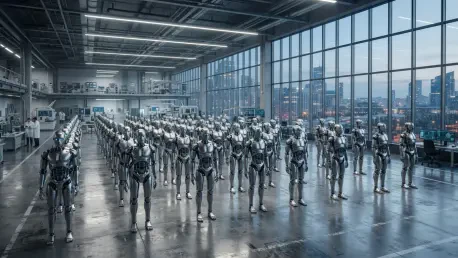

Engineers at the new AI Humanoid Data Factory are using remote human guidance to record the intricate full-body coordination required for robots to perform household chores. This facility, established by the Korea Institute of Machinery and Materials in partnership with the Electronics and Telecommunications Research Institute, represents a pivotal shift in how machines learn. Rather than relying on programmed logic or digital simulations, these robots acquire skills through direct human imitation. The site acts as a repository for physical AI data, capturing every micro-adjustment of robotic limbs as they interact with physical objects. By documenting these fluid motions, South Korea is building a foundational library of movement that allows machines to navigate the unpredictability of human environments. This initiative is designed to solve the challenge of environmental adaptation, moving beyond rigid automation toward versatile humanoid agents that can assist in homes starting from this year.
Bridging Digital Intelligence and Physical Execution
The Mechanics of Behavioral Data Acquisition
Within the factory, a fleet of twelve advanced humanoid robots serves as the primary data generators for this ambitious project. These machines are linked to human operators who use specialized haptic suits and visual feedback systems to perform a variety of complex tasks. From the delicate folding of laundry to the precise manipulation of vehicle controls in a simulated cockpit, every torque value and joint angle is meticulously logged in real-time. This high-fidelity recording process ensures that the AI models are trained on movements that possess the nuance and efficiency of a human professional. By capturing the subtle corrections a human makes when an object slips or when weight shifts unexpectedly, the factory provides a level of detail that traditional computer-generated data cannot replicate. This corpus of demonstration data is the key to training neural networks that can eventually replicate these behaviors autonomously without any ongoing human input or physical guidance.
Processing and Refining Foundation Models
The subsequent phase of the workflow focuses on the transformation of this raw behavioral data into scalable artificial intelligence models. Once a task is successfully recorded through teleoperation, the data undergoes rigorous cleaning and labeling to highlight critical decision-making moments. Engineers utilize these datasets to build reinforcement learning environments where the robots can practice their newly acquired skills in a virtual space before returning to the physical floor. This iterative training loop—moving from human demonstration to digital refinement and finally back to robotic hardware—ensures that the AI becomes increasingly resilient to environmental noise. The facility is equipped with dedicated server clusters that process terabytes of motion data daily, enabling the rapid evolution of foundation models specifically designed for bipedal movement. This comprehensive approach ensures that robots do not just mimic movements but actually understand the physics and spatial constraints of the tasks they are performing.
Strategic Autonomy and the Expansion of Domestic Infrastructure
Strengthening National Sovereignty in Robotics
A central driver behind this technological hub is the pursuit of technological sovereignty within the global robotics landscape. By establishing an independent domestic infrastructure, South Korea is actively reducing its reliance on foreign proprietary AI models and international datasets that may not align with regional needs. This project serves as a cornerstone of the broader K-Moonshot AI Humanoid Mission, a government-backed initiative supported by the Ministry of Science and ICT. The mission’s primary output is the KAIROS platform, a standardized Korean humanoid architecture designed for high-precision object manipulation and sophisticated motion imitation. By centralizing data production within the AI Humanoid Data Factory, the nation is creating a closed-loop ecosystem where hardware and software can evolve in tandem. This integrated development model ensures that domestic manufacturers have access to the high-quality task data necessary to compete with global tech giants in the burgeoning market for autonomous general-purpose robots.
Scaling Solutions: Future Industry Integration
The establishment of this factory marked a decisive moment for the domestic robotics industry, as it moved from theoretical research into large-scale practical application. In the past months, the facility successfully demonstrated that humanoid robots could learn to manage complex warehouse logistics and domestic chores through human-in-the-loop training. Moving forward, the Korea Institute of Machinery and Materials has planned to open the site to private academic and industrial partners starting in late 2027. To maximize the impact of this resource, stakeholders should begin standardizing their communication protocols and data formats to ensure seamless integration with the KAIROS platform. Industry leaders must also focus on developing ethics and safety frameworks that govern the interaction between these highly capable humanoid agents and human users. By fostering a collaborative environment, South Korea is positioning itself to lead the global transition toward a future where robotic assistants are a ubiquitous presence in society.