
By lowering the barrier to entry for complex visual tasks, generative software enables the realization of projects that were previously economically unfeasible. As of 2026, the initial waves of technological anxiety that characterized the early adoption of generative artificial intelligence have begun to stabilize into a more nuanced understanding of these tools as professional assets. While the rapid ascent of platforms like Midjourney, ChatGPT, and Sora once fueled fears of a total displacement of human artists, the current landscape reveals a different reality where human ingenuity remains the primary driver of high-quality output. The shift in perspective focuses on the idea that these technologies do not replace the artist but rather function as a sophisticated set of digital ingredients that require expert curation and direction. This evolution mirrors previous shifts in the creative industry, where the introduction of new methodologies initially sparked concern but ultimately expanded the boundaries of what was possible for a single creator to achieve. By examining the current integration of these systems, it becomes clear that the essence of creativity is not being automated, but is instead being liberated from the mechanical burdens that have historically limited the scope of artistic expression.
The Algorithmic Roots of Creative Software
The transition from manual labor to digital efficiency has been a steady march across the professional landscape, reinforcing the idea that technological shifts represent a continuity of progress rather than a sudden rupture from tradition. In the decades leading up to 2026, the design industry underwent several major transformations, such as the move from manual letterpress typesetting to digital layout programs like Adobe InDesign. These shifts significantly reduced the physical drudgery associated with the craft, yet they never managed to eliminate the necessity for a human mind to make the thousands of nuanced decisions required to produce a finished, meaningful piece of communication. Every major advancement in tool-making has served to extend the reach of the imagination, allowing creators to focus more on conceptual depth and less on the repetitive physical tasks that once defined their workdays. The core finding of this historical context is that while tools can automate the mechanical execution of a task, the artistic vision remains a distinctly human contribution that software cannot independently replicate.
Contrary to the perception that generative AI is an entirely alien or emergent form of intelligence, it is more accurately viewed as a sophisticated extension of existing image-processing engineering that has been in development for years. Software like Photoshop has always been a mathematical marvel, utilizing complex algorithms to perform calculations for filters, layers, and color corrections that would be impossible for a human to compute manually. The introduction of automated “Actions” and scripts in previous iterations of design software served as early precursors to the prompts used in modern generative systems. By recognizing that today’s AI-driven outputs are essentially advanced evolutions of earlier mathematical processing, the technology can be demystified and viewed as a familiar partner in the creative process. This perspective allows professionals to approach generative tools not as a threat to their expertise, but as a high-speed way to synthesize existing visual languages into new and compelling forms, maintaining the artist’s role as the final arbiter of aesthetic value and technical quality.
The Human-Sourced Nature of Artificial Intelligence
The term “artificial” is frequently misunderstood in the context of modern technology, as it literally refers to something that is produced by human hands and minds rather than occurring naturally. Generative models are purely human products, built upon massive datasets that represent the collective output of species-wide creativity accumulated over millennia. Every line of prose, every melodic sequence, and every digital painting used to train these systems was originally a product of human labor, meaning that the output of an AI is essentially a high-speed synthesis of a shared cultural heritage. This perspective reframes the act of using generative tools as a form of global collaboration, where the software acts as a conduit for the vast library of human knowledge. Because these models rely on human-generated data to function, they remain tethered to the history and nuances of human emotion and cultural context, ensuring that the “ingredients” used in the creative process are inherently rooted in our own experiences and artistic traditions.
This collaborative nature is effectively illustrated through the metaphor of a simple pencil, which requires a vast, global network of contributors to manufacture, from the timber harvesters to the graphite miners. Just as a graphic designer has always relied on fonts, paper stocks, and software they did not personally create, they now rely on AI-generated assets to expand their library of materials. Utilizing these generative tools allows for a deeper level of personal expression, as creators are no longer limited to the constraints of generic stock imagery or existing assets. Instead, they can now generate custom-made elements that fit a specific vision with a degree of precision that was previously impossible without significant time and financial investment. This democratization of high-quality asset creation empowers individuals to act as directors of their own visual worlds, using the collective output of human history to craft unique narratives that reflect their individual perspectives and creative goals.
Orchestrating the Creative Workflow
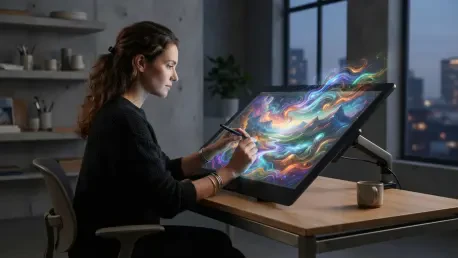
The practical application of generative tools in a professional setting reveals a “human-in-the-loop” workflow that demands constant oversight, curation, and critical thinking. A professional designer starting a project in 2026 does not simply press a button and receive a finished product; instead, the process begins with a unique conceptual theme that guides the entire production. This initial stage requires the human agent to spend significant time refining prompts and adjusting parameters to generate a “seed” image that aligns with a specific aesthetic goal. This iterative process often involves sifting through hundreds or even thousands of variations, discarding the vast majority of them, and identifying the rare few that possess the necessary artistic quality and brand alignment. The AI provides the raw material, but the human provides the discernment, ensuring that the final output is not just a random generation but a deliberate piece of design that serves a specific functional and emotional purpose.
Beyond the initial generation of images, these tools are increasingly used to solve complex, real-world design problems that were once prohibitively time-consuming. For instance, designers frequently use AI to unify disparate assets, such as matching the lighting and style of various headshots into a cohesive visual format, or generating original theme music that perfectly matches the tempo of a video project. While the software performs the heavy lifting of the technical execution, the human agent remains the director, responsible for the high-level ideation and the final stamp of approval. The designer’s agency is not lost in this transition; it is simply redirected toward higher-level conceptual and aesthetic choices that define the overall impact of the work. This shift allows professionals to operate at a faster pace and explore a wider range of creative possibilities, effectively turning the generative system into a high-powered extension of their own technical skills and stylistic sensibilities.
Economic Realities and the Future of Labor
Historical trends suggest that when technology increases the efficiency of a specific task, it does not necessarily destroy the total volume of work available in that industry; instead, it fundamentally changes the nature of the labor. A comparison can be drawn to the agricultural sector, where advanced machinery and automated combines have drastically reduced the number of people required to harvest a single acre of land, yet the industry continues to evolve and demand new forms of specialized expertise. In the creative fields, AI is likely to lower the barrier to entry for complex projects, making it possible for small teams or individual creators to produce high-end content that once required the resources of a large studio. This democratization of production could lead to an explosion of new media, as creators who were previously sidelined by high costs are now able to bring their visions to life, such as independent authors turning their novels into high-quality films or interactive experiences.
As the industry moves further into this generative era, the total output of human culture is expected to expand significantly rather than contract. The availability of these tools means that work is not a finite resource to be divided up, but rather an expanding field of possibilities where new needs and desires for creative content will emerge. By reducing the cost of production, AI enables a wider variety of organizations and individuals to engage in sophisticated visual communication, which in turn creates a greater demand for professionals who can navigate these tools effectively. The future of labor in the creative sector will likely favor those who can combine traditional design principles with a mastery of generative systems, using the increased efficiency to tackle more ambitious projects. Ultimately, the story of technological advancement in the arts remains one of human empowerment, demonstrating that as long as there are new ideas to be explored, there will be a continued need for the human mind to guide the machines.
Defining the Future of Professional Artistry
Professionals who successfully navigated the transition into a generative-first workflow discovered that the most impactful work came from a deep integration of traditional craft and algorithmic speed. Those who embraced these systems as a new set of brushes and pigments were able to transcend the limitations of their previous technical constraints, producing work that was more ambitious and stylistically diverse than ever before. This period of change demonstrated that the value of an artist was never tied to the mechanical difficulty of a task, but to the unique perspective and critical judgment they brought to the creative process. The industry realized that the human spirit remained the essential ingredient that turned a technically perfect image into a piece of art that could resonate with an audience on an emotional and cultural level.
The evolution of generative software ultimately provided a roadmap for a more sustainable and expansive creative future. Practical strategies emerged for practitioners to maintain their relevance by focusing on high-level strategy, narrative development, and complex problem-solving—areas where human intuition remained superior to algorithmic prediction. Educational frameworks were adjusted to prioritize the teaching of curation and conceptual thinking alongside technical proficiency, ensuring that the next generation of creators was prepared to act as directors of AI systems rather than just operators of software. By treating generative tools as an extension of the human drive to create, the professional community ensured that the future of art remained as vibrant and human-centric as its past, proving that technology served to elevate the creator rather than replace the soul of the work.