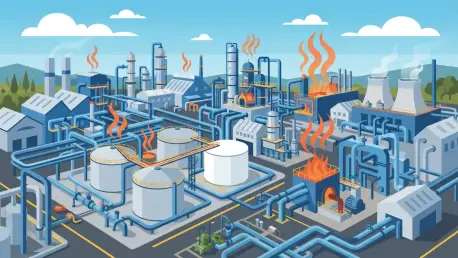

The combinatorial mathematics of catalyst development are so complex that selecting just three elements from the common pool creates over fifty thousand possible material combinations for testing. This sheer volume of potential configurations has long stymied the development of efficient Oxidative Coupling of Methane (OCM) processes, which seek to convert natural gas directly into ethylene. Ethylene stands as the backbone of the global chemical economy, essentially serving as the fundamental raw material for everything from food packaging to automotive parts. Currently, the industry relies on steam cracking, a method that is both energy-intensive and carbon-heavy. As the world shifts toward more sustainable feedstock options, the ability to utilize methane—the primary component of natural gas—represents a massive opportunity. However, the technical difficulty of managing high-temperature reactions while preventing the over-oxidation of methane into waste gases like carbon dioxide remains a persistent and high-stakes engineering puzzle.
The Evolution of Catalyst Discovery and Data Analysis
The historical quest for a high-performance OCM catalyst began in the mid-1980s, centering on the use of rare earth oxides and the development of the benchmark manganese-sodium tungsten system. For several decades, progress was characterized by a slow and deliberate trial-and-error approach, where researchers manually synthesized and tested a limited number of material variations. This changed with the arrival of advanced data processing techniques that emerged in the early 2000s and reached a tipping point over the last few years. By 2026, the application of machine learning has become standard practice, moving beyond simple data logging to active predictive modeling. Algorithms like the random forest method have drastically reduced the experimental workload by identifying patterns in catalyst performance that would be invisible to the human eye. This transition from intuition-based research to a data-centric paradigm has allowed the industry to revisit old material classes with a fresh perspective.
Modern machine learning frameworks have organized OCM catalysts into four major categories: rare earth oxides, alkali and alkaline earth metals, transition metal complexes, and perovskite structures. By meticulously analyzing these groups, researchers have uncovered specific operational windows where each class performs optimally. For instance, while the manganese-sodium tungsten system excels at temperatures between 750 and 800 degrees Celsius, alkali-based catalysts are often more effective at slightly lower ranges. Beyond simple temperature targets, AI has helped identify five critical physical descriptors—ionization energies, electron affinity, Pauling electronegativity, density, and basicity—that govern catalyst efficiency. These descriptors act as a digital fingerprint, allowing for the computational screening of thousands of theoretical binary metal combinations. This level of predictive accuracy ensures that laboratory resources are focused only on the most promising candidates, such as platinum-titanium or nickel-niobium.
Deep Learning and the Search for Low-Temperature Solutions
Deep learning takes these capabilities to a higher level by processing massive datasets that integrate high-throughput experimental results with decades of published academic findings. These neural networks are designed to validate historical performance limits while ensuring that every new model strictly adheres to the fundamental laws of mass conservation. This sophisticated modeling is particularly valuable in 2026 for identifying overlooked correlations between catalyst structure and selectivity. By employing Gaussian mixture models and frequent itemset mining, researchers can now detect subtle interactions between elements that were previously dismissed as noise. This approach has led to the discovery of highly active catalysts that function at significantly lower temperatures, which is a key requirement for reducing the operational costs of industrial chemical plants. Such breakthroughs indicate that the marriage of big data and chemical physics is finally beginning to untangle the complexities of methane activation.
The discovery of active low-temperature catalysts like aluminum-yttrium oxide and silver-yttrium oxide serves as a testament to the predictive power of modern AI. These formulations were initially identified through computer-aided design before their performance was confirmed in laboratory settings. Furthermore, the focus has shifted toward understanding the role of catalyst basicity in driving reaction selectivity. By using specific chemical properties as model inputs, scientists have successfully synthesized complex barium-indium-rubidium systems supported on lanthanum oxide. These advanced materials have demonstrated the ability to outperform traditional manganese-tungsten benchmarks at high temperatures, offering a more robust alternative for industrial use. This iterative process of prediction, synthesis, and validation has accelerated the development cycle, moving the industry closer to a world where catalyst performance can be fine-tuned for specific reactor conditions without years of costly and repetitive experimentation.
Overcoming the Synthesis Bottleneck with Robotics
The design speed provided by artificial intelligence must be matched by a physical production phase of equal velocity, a task that has proven impossible for human chemists to handle alone. Selecting just a few elements from the 68 commonly used in OCM research results in tens of thousands of possible combinations, and when accounting for varying concentrations and preparation methods, the number of required experiments reaches into the millions. Manual synthesis is far too slow to explore this vast chemical space, typically yielding only a handful of samples per day. In response, robotic synthesis platforms have emerged to solve this bottleneck, enabling the fabrication and testing of thousands of catalysts in a fraction of the time. These automated systems are not merely faster; they provide a level of consistency and precision in material preparation that human researchers cannot replicate. This robotic revolution is essential for turning the massive output of AI models into tangible, testable chemical systems.
Modern robotic platforms utilize advanced techniques such as high-efficiency inkjet printing to fabricate over two thousand formulated catalysts in a single week. These systems translate digital catalyst data directly into physical synthesis parameters, ensuring that the exact chemical composition predicted by the AI is realized in the laboratory. Additionally, automated X-ray diffraction and characterization tools allow for the simultaneous analysis of multiple samples, providing immediate feedback on structural properties. This seamless integration of digital design and automated manufacturing ensures that the most promising theoretical materials are rapidly moved from a computer model to a physical testing environment. By 2026, these high-throughput workflows have drastically shortened the innovation cycle, allowing for the rapid optimization of catalyst coatings and support structures. This capability is vital for identifying the specific structural configurations that can withstand the harsh conditions of a commercial-scale methane coupling reactor.
Shifting Paradigms to Bypass Kinetic Constraints
Despite the speed of robotic synthesis and the precision of artificial intelligence, a definitive breakthrough still requires a fundamental shift in how the OCM reaction is understood. Most current research remains trapped by the traditional heterogeneous-homogeneous mechanism, where the catalyst surface merely activates methane to generate methyl radicals. Once these radicals are released into the gas phase, they couple to form ethylene, but the catalyst loses all control over the process. Because this coupling occurs in the open gas space, the reaction is inevitably subject to the kinetic constraints that have kept C2 yields below the 30 percent threshold for decades. To break through this yield barrier, the chemical industry must move beyond simply generating more radicals and instead focus on controlling how those radicals interact. This realization has sparked a new wave of research into reaction engineering that seeks to bridge the gap between material science and the fundamental physics of gas-phase collisions.
The future of ethylene production lies in developing catalysts that act as surface-coupling agents, capturing and joining radicals directly on the material surface before they escape into the gas phase. By moving the reaction from the uncontrolled gas space to the highly specific environment of the catalyst surface, researchers can bypass the thermodynamic limits that have stalled the industry. Some recent experimental systems have already demonstrated this potential, acting as active sites that convert gas-phase species into C2 products with higher selectivity than was previously thought possible. This paradigm shift requires a deep understanding of surface chemistry and radical stability, areas where AI is now providing critical insights. By tailoring the surface architecture of the catalyst to facilitate coupling, it becomes possible to suppress the formation of unwanted carbon oxides. This strategic focus on surface-mediated reactions represents the most viable path toward achieving the yields necessary for a new era of gas-based chemical manufacturing.
Strategic Implementation: Navigating the Industrial Transition
The integration of machine learning and robotic synthesis provided the necessary infrastructure to explore the vast chemical space of OCM catalysts with unprecedented speed and accuracy. These technologies successfully identified critical physical descriptors and optimized traditional material systems, proving that data-driven discovery could outperform traditional experimental methods. However, the journey toward a commercially viable ethylene process required more than just faster testing; it demanded a fundamental change in reaction mechanics. Future development should prioritize the design of reactors that complement surface-coupling catalysts, ensuring that laboratory breakthroughs are scalable to industrial volumes. Stakeholders must now invest in hybrid systems that combine real-time AI monitoring with automated chemical feedback loops to maintain peak performance. From 2026 to 2028, the industry will likely see the first generation of AI-optimized OCM plants that finally bypass the long-standing 30 percent yield barrier, securing a more sustainable future for global production.