


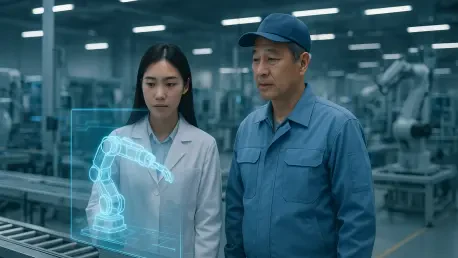

The rapid retirement of South Korea’s second baby boom generation is creating a systemic labor vacuum that threatens the survival of regional small and medium-sized manufacturing enterprises. This demographic shift has accelerated a process often referred to as the industrial hollowing out, where decades of accumulated manual expertise and institutional knowledge are disappearing overnight. In response, a strategic movement has emerged to pivot from theoretical research toward the practical application of Physical AI. By leveraging the technical potential of local university students, the manufacturing sector aims to modernize operations that have historically relied on aging workforces and outdated mechanical processes. This transformation involves the deployment of advanced sensors, robotics, and digital twins designed to ensure the long-term viability of the nation’s industrial core. As traditional recruitment fails to fill the gaps, academic institutions are becoming the essential providers of technical expertise, bridging the distance between legacy manufacturing and the digital future.
The Partnership Model: Transforming Factories Through Academic Collaboration
The collaboration between Chungbuk National University and Chang Myung CST highlights how academic partnerships can resolve specific operational bottlenecks in small-scale manufacturing. Chang Myung CST, a producer of electronic control gear, faced a significant hurdle when its database of thousands of technical drawings became unmanageable, directly slowing down production cycles. Without the capital required to engage high-level AI consultants or expensive software firms, the company engaged an undergraduate research team led by Associate Professor Kim Tae-kyung. These students successfully engineered a customized AI tool that autonomously organized the drawing database, showcasing that regional universities can provide tailored, cost-effective solutions. This case serves as a blueprint for other SMEs, proving that high-level technical modernization does not always require massive capital investment. Instead, the strategic application of local talent can unlock efficiencies that were previously out of reach for companies struggling with disorganized data and legacy management practices.
Despite these localized successes, a significant implementation gap remains within the broader South Korean manufacturing landscape, highlighting the urgency of systematic intervention. While the discourse surrounding Smart Factory initiatives is prevalent, recent statistics indicate that only about 19.5% of small-to-mid-sized manufacturers have actually installed such systems. Even more concerning is the depth of this integration; the vast majority of these installations operate only at a basic level, and a negligible 0.1% have successfully integrated AI into their live production lines. This disparity suggests that the Fourth Industrial Revolution is currently a reality for only a tiny fraction of the industrial base, leaving most small factories vulnerable to obsolescence. Without direct intervention from academic talent to guide the integration of smart systems, most manufacturers will remain unable to transition from manual labor to automated intelligence. The current challenge lies in scaling the university-led model to reach the thousands of firms still operating on the fringes of the modern tech landscape.
Regional Hubs: The Role of Knowledge Exchange and Physical AI
Regional flagship universities are increasingly viewed as the most practical vehicles for modernizing local industrial clusters due to their geographical and social proximity. Because these institutions are situated near manufacturing hubs, students can engage in hands-on problem-solving that offers immediate, tangible value to nearby firms. This proximity creates a virtuous cycle where students acquire essential real-world experience while companies gain access to a reliable pipeline of talent that is already familiar with their specific needs. These collaborations are being structured as employment-linked programs, which significantly reduce the hiring risks and costs for SMEs that often find it impossible to compete with massive conglomerates for top-tier tech talent. By embedding students within the factory environment, universities are helping to demystify complex technologies, making AI adoption seem like a natural evolution rather than an intimidating overhaul. This localized approach ensures that technical solutions are specifically calibrated to the unique constraints of regional industrial sites.
The national industrial focus has shifted toward the concept of Physical AI, which seeks to integrate software intelligence directly with mechanical factory hardware. Rather than treating artificial intelligence as a mere data-processing tool for office environments, this initiative aims to make it a tangible reality on the shop floor through robots and sensor networks. Recent advancements, such as the KAIROS test bed at KAIST, demonstrate a push to make high-level AI accessible for everyday manufacturing operations across diverse sectors. This approach ensures that technology serves the physical requirements of the factory, helping to replace the manual labor lost to an aging workforce while increasing overall precision. By focusing on the intersection of hardware and software, researchers are developing systems that can adapt to the unpredictable variables of a physical production line. This integration is crucial for maintaining the competitive edge of South Korean manufacturing, as it allows for the automation of complex tasks that previously required years of human training and physical dexterity.
Strategic Implementation: Avoiding the Technology Trap Through Standardization
A significant risk in the current rush toward rapid modernization is the potential for a technology trap, where fragmented systems actually decrease overall factory productivity. Experts have warned that if different stages of production utilize disparate, unintegrated software, the resulting management overhead can become more burdensome than the original manual labor processes. To avoid this pitfall, there is a growing demand for a standardized, integrated AI operating system that functions similarly to a smartphone OS. Such a platform would allow smaller manufacturers to utilize a plug-and-play approach, incorporating various digital tools without needing to build custom technical infrastructure from the ground up. Standardization is the key to preventing a chaotic patchwork of technologies that complicates rather than simplifies the manufacturing workflow. By providing a unified framework, the industry can ensure that data flows seamlessly across different departments, allowing AI to optimize the entire lifecycle of a product rather than just isolated components of the assembly line.
The transition toward a sustainable industrial model was finalized when South Korea adopted a structured policy framework that institutionalized industry-academia partnerships. These successes moved beyond the voluntary efforts of individual professors and became part of a government-led initiative that provided clear incentives for regional universities to prioritize factory-floor interventions. By closing the last mile of technology implementation through student researchers, the nation successfully addressed the youth employment crisis while simultaneously filling the industrial labor gap. Policymakers established standardized protocols that allowed SMEs to integrate AI tools with minimal friction, effectively shielding the manufacturing sector from the demographic pressures that had once threatened its core survival. This strategic alignment of educational resources and industrial needs proved to be a decisive factor in maintaining global competitiveness. The project succeeded in transforming small-scale factories into high-tech hubs, ensuring that the retirement of the older generation did not result in a loss of economic momentum or national technical capability.







