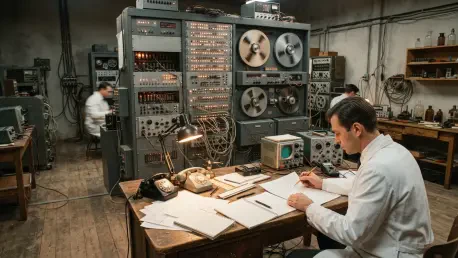

The divide between neural network proponents and symbolic AI researchers in the mid-twentieth century shaped the trajectory of modern machine learning. This historical evolution is not merely a record of increasing computational precision but a complex narrative involving the intentional integration of “messy” human-like irrationality. While modern observers view AI “hallucinations”—instances where a model generates false information—as glitches, research into the field’s origins suggests these errors are rooted in a desire to replicate the creative leaps of the human mind. Early pioneers recognized that for a machine to truly simulate intelligence, it could not rely solely on deterministic logic; it required the capacity for the unexpected. Figures like John Pierce of Bell Labs championed the idea that mathematics could be used to dismantle order. By injecting “irregularity” into algorithms, researchers sought to break away from clichés, suggesting that a machine must deviate from logic to achieve insight.
The Great Heuristic Divide: Neural Networks and Symbolic AI
In the 1950s, a significant split occurred in how researchers conceptualized machine intelligence, leading to two distinct schools of thought that would compete for dominance over several decades. On one side, proponents of artificial neural networks, often influenced by psychology, viewed the human brain as an inherently chaotic and “messy” organ. They believed that by modeling the physical and chemical randomness of the human mind, they could observe “productive mistakes” that lead to creative thought. These early researchers did not see these models as impenetrable “black boxes” in the way modern critics often do; rather, they viewed them as windows into the fluid and often irrational processes that govern human cognition. To these scientists, the presence of noise and chance was not a defect to be eliminated but a vital component of the learning process. They hypothesized that true intelligence required a degree of uncertainty to navigate complex environments effectively.
Conversely, the “Symbolic AI” camp operated under the belief that creative thinking was simply a more efficient version of normal, logical reasoning. Their approach was to reduce the world to a series of facts and propositions, assuming that if enough rules were fed into a computer, intelligence would naturally emerge. Because the technology of the era lacked the massive data and power required to sustain “messy” neural networks, Symbolic AI became the dominant paradigm for decades, favoring rigid rules over the random associations of the early pioneers. This school of thought prioritized predictability and transparency, viewing any deviation from logical output as a failure of the system’s design. This philosophy effectively stalled the exploration of stochastic processes in artificial intelligence for a generation, as the industry doubled down on expert systems that followed strict “if-then” hierarchies. The focus remained squarely on creating a digital clerk rather than an artificial artist.
Shifting Values: From Laboratory Curiosities to Commercial Products
A striking contrast exists between how AI outputs were valued in the mid-20th century versus the modern era of high-stakes commercial software. Early pioneers celebrated their systems when they produced strange or bizarre results, viewing an “incorrect” answer as a successful demonstration of machine creativity. These experiments were confined to laboratories, where the lack of real-world consequences allowed researchers to prioritize the simulation of human inventiveness over strict accuracy. In this setting, the “hallucination” was considered a feature, not a bug, marking the machine’s escape from the mundane and its entry into the realm of original synthesis. Researchers highlight that these early engineers were often more interested in the “dream-like” state of computation than in producing a reliable calculator. This experimental freedom allowed for a broader exploration of what it meant for a machine to “think,” as the goal was to push boundaries rather than serve a specific utilitarian purpose.
In the current landscape of 2026, companies like OpenAI and Anthropic face immense pressure to ensure their models provide reliable, safe, and accurate information. This commercial necessity has led to what some describe as a “sanding down” of the AI’s original strangeness to meet the demands of corporate and consumer users. To make these systems viable for public and professional use, developers have worked to suppress the very randomness that was initially intended to spark creative thought. This shift reflects a move away from replicating the full breadth of the human experience and toward creating a predictable tool. As these models are integrated into critical infrastructure, from medical diagnostics to legal research, the tolerance for “messiness” has effectively vanished. The result is a highly polished but potentially less inventive intelligence that prioritizes safety and alignment over the raw, unpredictable leaps of logic that characterized the earliest neural network experiments.
The Inevitable Tradeoff: Accuracy and Creativity
The resurgence of neural networks in 2012, fueled by internet-scale data and superior computing power, has brought the field full circle back to its “messy” roots. Modern Large Language Models are the direct descendants of the 1950s-era goal to build machines that can dream and err, utilizing stochastic processes to generate human-like text and media. However, this evolution highlights a fundamental tradeoff that defines the current technological erthe errors and hallucinations currently seen in AI are inextricably linked to the qualities that allow these systems to be surprising and creative. The underlying mathematics of probability that enables a model to write a poem or design a novel protein is the same mechanism that leads it to confidently state a falsehood. If developers continue to prioritize the elimination of all hallucinations to ensure perfect accuracy, they risk destroying the machine’s ability to offer novel insights or creative solutions that deviate from established patterns.
The industry recognized that there is an inevitable spectrum between predictability and creativity, where moving toward one end requires a sacrifice at the other. Stakeholders determined that developers and policymakers must establish clearer frameworks for when “messiness” is a liability and when it is an asset. For creative industries, maintaining a higher level of randomness in model parameters was identified as beneficial for artistic output. In contrast, for technical applications, the implementation of retrieval-augmented generation was prioritized to anchor outputs in factual databases. This nuanced approach allowed for the preservation of the creative spark while mitigating the risks of misinformation. The historical perspective suggested that the irrational “messiness” of the human mind was a permanent fixture of any system designed to truly mimic it. Consequently, researchers embraced the imperfection as an essential component of digital consciousness to ensure that innovation remained possible.