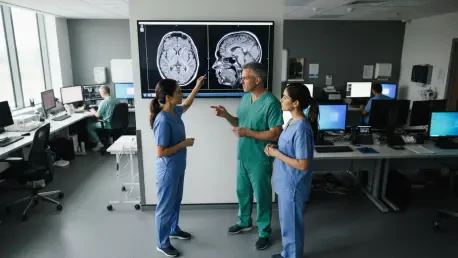

While human neuroimaging analysis remains the clinical standard, deep learning architectures are increasingly capable of identifying large vessel occlusions with higher consistency across diverse hospital settings. Researcher Yan Pan explores this in a systematic review for The Egyptian Journal of Neurology, Psychiatry and Neurosurgery. As of 2026, the transition of artificial intelligence from a theoretical concept to a functional clinical tool in acute ischemic stroke management has fundamentally altered the survival statistics for thousands of patients. Stroke remains a primary global driver of mortality and long-term impairment, making the efficiency of the initial medical response a critical determinant of patient outcomes. By integrating machine learning into the emergency workflow, hospital systems are effectively shortening the bridge between symptom onset and surgical intervention. This shift represents a significant evolution in how neural emergencies are handled on a daily basis.
Enhancing Diagnostic Speed and Accuracy
Modern stroke care relies heavily on the “golden hour,” the critical period immediately following the onset of symptoms where medical intervention is most effective. Within this window, AI-driven models assist clinicians in rapidly distinguishing between salvageable brain tissue and irreversibly damaged areas. These tools have revolutionized automated neuroimaging by performing complex anatomical tasks like the Alberta Stroke Program Early CT Score with high precision. By providing consistent results that match or exceed human interpretation, these systems ensure that every patient receives a standardized evaluation regardless of the radiologist’s experience level. This level of accuracy is fundamental in determining the best course of action during the high-pressure initial stages of a stroke. The speed at which these algorithms process CT and MRI scans allows the neurology team to focus on treatment rather than measurement, effectively reducing the time it takes to clear a patient for life-saving surgery.
Beyond basic scoring, AI platforms are now essential for the instantaneous detection of large vessel occlusions, which are major blockages in the primary arteries of the brain. By flagging these occlusions the moment a scan is performed, the technology notifies the entire endovascular team simultaneously, bypassing traditional manual communication hurdles. This systematic reduction in “door-to-puncture” time is critical because every minute saved in the triage phase translates to millions of preserved neurons and significantly better recovery prospects. The consensus among the synthesized evidence suggests that AI acts as a vital technical catalyst, eliminating human-induced variability and ensuring that urgent assessments are both accurate and swift. As hospitals adopt these cloud-based detection systems, the gap between arrival and mechanical thrombectomy continues to shrink. This technological intervention has become a baseline requirement for modern comprehensive stroke centers seeking to optimize their acute response workflows and patient survival rates.
Supporting Long-Term Patient Outcomes
The application of artificial intelligence extends well beyond the emergency department to cover the entire longitudinal continuum of stroke care. Algorithmic systems are currently analyzing massive datasets to help physicians predict which patients will respond best to specific long-term treatments or secondary prevention strategies. By evaluating historical data alongside real-time clinical inputs, these models provide a data-driven foundation for personalized medicine that was previously unattainable through manual observation alone. This shift toward “intelligent” care allows for a more nuanced understanding of how individual vascular health profiles interact with therapeutic agents. For instance, predictive analytics can now suggest the likelihood of hemorrhagic transformation, allowing doctors to adjust anticoagulation protocols with much higher confidence. This proactive approach helps in mitigating secondary risks while maximizing the primary recovery potential. The integration of such foresight into the post-acute phase ensures that the high-quality care initiated in the trauma bay continues throughout the stay.
Furthermore, AI is increasingly being used to project patient prognoses and tailor long-term rehabilitation strategies to the specific neuroanatomical damage observed during the acute phase. By comparing a patient’s recovery trajectory against thousands of similar cases in a centralized database, algorithms can suggest physical therapy intensities and cognitive exercises that are most likely to yield functional improvements. This ensures that recovery is managed with the same precision as the initial life-saving intervention. The transition toward data-driven rehabilitation allows clinical teams to set more realistic goals and identify potential setbacks before they occur. This longitudinal utility demonstrates that AI is not just a triage tool but a comprehensive management partner. In the current landscape of 2026, the inclusion of algorithmic insights into the discharge planning process has become a standard method for improving the quality of life for survivors. By refining the recovery path, these systems help patients return to independent living more quickly, reducing the economic burden of disability.
Addressing Technical and Ethical Barriers
Despite the clear clinical benefits, several technical hurdles remain that prevent the universal adoption of AI across all medical facilities. A primary concern is the lack of data standardization across different hospital imaging systems, manufacturers, and hardware generations. AI models that perform perfectly in one facility may struggle when deployed in another due to variations in image resolution or software processing, a problem known as poor model generalization. To overcome these obstacles, the medical community is calling for large-scale, multicenter trials to prove that AI-assisted decisions consistently lead to better long-term functional recovery in real-world settings. Researchers emphasize that technical verification in a controlled environment is no longer enough to justify wide-scale implementation. Future advancements must prioritize the creation of robust algorithms that can adapt to the “noise” of diverse clinical environments. Establishing international standards for neuroimaging data will be a crucial step in ensuring that AI tools remain reliable across various health networks.
The systematic review concluded that the most effective implementations occurred when AI was treated as a complementary technology. Hospitals that successfully adopted these frameworks reported a significant decrease in diagnostic errors and a marked improvement in functional outcomes at follow-up. These findings suggested that the focus for future development should remain on enhancing the explainability of deep learning models to satisfy regulatory and ethical standards. Practitioners were encouraged to adopt a hybrid decision-making model, utilizing AI for preliminary triage while reserving complex ethical choices for human panels. The research highlighted that while technical and regulatory challenges persisted, the operational benefits of AI in stroke care were undeniable. By moving toward a standardized global data exchange, the medical community laid the groundwork for a more equitable distribution of advanced stroke care, ensuring precision was accessible to all. Actionable steps for health systems now include investing in modular software that allows for continuous algorithmic updates.