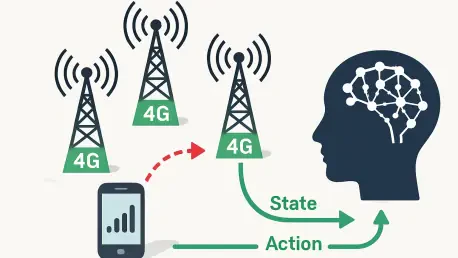

Integrating expert engineering insights via the Analytic Hierarchy Process ensures that automated handover decisions prioritize reliability and user experience over simple signal strength. As mobile networks transition toward increasingly complex, high-density architectures, traditional methods for managing these transitions have become insufficient for maintaining consistent service quality. Modern telecommunications face a persistent technical hurdle in managing the seamless transition of user equipment between base stations, a process known as a handover. Recent research focusing on the Niger Delta region of Nigeria utilized data from 910 LTE base stations to explore how Deep Reinforcement Learning can replace rigid, “one-size-fits-all” parameters established by global standards. By implementing the Proximal Policy Optimization algorithm, researchers have developed an autonomous system capable of real-time adaptation. This approach balances connection reliability, data throughput, and signaling overhead in a way that static rules simply cannot match. The study used historical data from over 900 eNodeBs to calibrate a simulation environment that reflects the real-world complexities of varying topographies and user mobility profiles. Moving beyond the legacy frameworks of the early 2020s, this technology aims to provide a robust solution for the hyper-connected era where every millisecond of connection stability counts for both industrial and consumer applications. By leveraging autonomous agents that learn from environmental interaction, the industry is moving closer to a truly self-organizing network capable of resolving interference patterns that human operators might never identify manually.
Evolution of Handover Standards in Complex Networks
In a heterogeneous cellular environment, the network fabric consists of macro, micro, pico, and femto cells operating with different power levels and frequency bands. This architectural diversity creates a multilayered web of overlapping coverage footprints and intricate interference patterns. A subscriber moving through this complex environment, whether walking through a city center or traveling in a high-speed vehicle, must be handed off from one tower to another without perceiving a drop in service quality. The industry-standard 3GPP A3 algorithm currently relies on fixed parameters: the hysteresis margin and the time-to-trigger interval. These settings determine the conditions under which a device decides to switch its connection to a neighboring cell. If these parameters are set too conservatively, a device may stay connected to a weakening signal for too long, leading to a dropped call or a significant reduction in data speeds. Conversely, if the settings are too aggressive, the device may transition too early, risking a connection failure before the new link is fully established. This binary optimization problem has historically required extensive manual tuning by field engineers, an approach that is becoming increasingly unsustainable as network density continues to rise across urban and industrial zones.
The consequences of improper handover management are particularly evident in the phenomenon known as a ping-pong handover. This occurs when a mobile device bounces rapidly between two adjacent towers because the signal thresholds are set too low. Ping-ponging is highly undesirable for network operators because it consumes massive amounts of control signaling bandwidth and increases the computational load on the core network. Each unnecessary transition introduces a risk of connection failure and degrades the battery life of the user’s device. Traditional algorithms struggle to differentiate between a legitimate need for a handover and a temporary signal fluctuation caused by physical obstacles or atmospheric conditions. As we move through 2026, the demand for high-bandwidth applications like augmented reality and real-time remote operation requires a more sophisticated approach. Relying on static, human-designed heuristics is no longer sufficient for managing the thousands of handovers that occur every second in a modern metropolitan area. This necessity has pushed the telecommunications sector toward exploring machine learning frameworks that can treat the handover process as a dynamic, sequential decision-making problem rather than a set of fixed rules.
Architecting Autonomous Solutions With Reinforcement Learning
To overcome the inherent limitations of manual parameter tuning, researchers have proposed a Deep Reinforcement Learning framework that treats the handover process as a sequential Markov Decision Process. This formulation allows an automated agent to learn an optimal decision-making policy through continuous trial-and-error interactions within a simulated environment. The core of this architecture is the Proximal Policy Optimization algorithm, which was specifically chosen for its operational stability. Unlike older reinforcement learning methods that could undergo drastic, unpredictable changes in behavior during training, the Proximal Policy Optimization approach ensures that policy updates are incremental and controlled. This stability is crucial in the volatile radio environments of 4G and 5G networks, where signal fluctuations are constant and unpredictable. The agent operates within a streamlined tri-choice action space: it can choose to maintain the current connection, hand over to the neighbor with the strongest signal, or select the least-loaded neighbor to ensure resource availability. This simplified decision matrix ensures that the system remains computationally efficient, allowing it to make real-time decisions in the millisecond timeframes required by high-speed mobile hardware.
The intelligence of the agent is derived from a 27-dimensional state vector that provides a comprehensive snapshot of the network’s current state at any given moment. This vector includes critical radio metrics such as signal power and quality from the serving cell and multiple neighbors, as well as network load data like physical resource block occupancy. Furthermore, the model incorporates user-specific data such as estimated mobility speed and contextual embeddings that describe the physical environment, whether urban, rural, or industrial. This multifaceted input ensures that decisions are not based solely on signal strength, which is often a misleading indicator of connection quality. Instead, the agent can recognize whether a neighboring cell actually has the capacity to handle a new user, thereby preventing “resource-blind” handovers that lead to immediate congestion and subsequent service degradation. By integrating environmental context, the system can anticipate the likely trajectory of a signal and make preemptive adjustments. This holistic view of the network state allows the autonomous agent to perform far more nuanced optimization than traditional algorithms, which typically only look at one or two signal metrics in isolation.
Optimizing Outcomes Through Expert Engineering Guidance
A critical innovation in this research is the use of a multi-KPI reward function, which prevents the myopic behavior often seen in earlier machine learning attempts. Previous models often succeeded in optimizing for a single metric, such as signal strength, while inadvertently causing failures in other areas like signaling overhead or call drop rates. To avoid this, the researchers blended five distinct key performance indicators into a single reward signal: Handover Success Rate, Channel Quality Index, User Throughput, Call Drop Rate, and Ping-Pong Rate. To determine the relative importance of each metric, they employed the Analytic Hierarchy Process to incorporate the insights of experienced telecommunications engineers. This expert calibration ensured that the reward function prioritized network reliability and regulatory compliance while maintaining a high-quality user experience. The resulting weights provided the agent with a balanced set of goals, teaching it that avoiding a dropped call is just as important as maximizing data speeds. This methodology bridges the gap between pure data-driven learning and the practical wisdom accumulated by industry professionals over decades of network operation, resulting in a more reliable and commercially viable AI model.
When tested against real-world data from the diverse topographies of the Niger Delta, the model showed remarkable improvements over existing methods. The Handover Success Rate reached an average of 97.3%, which represents a significant lead over the standard 3GPP fixed-parameter methods. Furthermore, the Call Drop Rate was reduced to 1.8%, bringing it below the strict regulatory ceilings that govern mobile service providers in the region. The system also successfully cut wasteful ping-pong transitions by over 34%, proving that the balanced reward function effectively discouraged unnecessary signaling. These improvements were consistent across various mobility profiles, from slow-moving pedestrians to vehicles traveling at high speeds. By maintaining high spectral efficiency and resource utilization, the model demonstrated that connection stability does not have to come at the expense of overall network throughput. The ability to meet and exceed regulatory standards while improving the user experience suggests that AI-driven handover management is ready for broader adoption. This level of performance indicates a shift where the network itself becomes an intelligent entity, capable of self-correction and optimization without constant human intervention.
Navigating Real-World Constraints and Implementation Barriers
To prove the necessity of the complex reward function, researchers conducted ablation studies where specific penalties were removed from the training process. When the penalty for ping-ponging was removed, the rate of oscillatory transitions nearly doubled, confirming that the agent would naturally choose the strongest signal at every moment regardless of the signaling cost. Similarly, when the call drop penalty was removed, the network performance failed to meet the necessary regulatory standards, as the agent prioritized throughput over connection stability. These results confirmed that a balanced, multi-dimensional approach is essential for realistic network management in the field. Comparisons with other machine learning models, such as the Double Deep Q-Network, further validated that sophisticated policy-gradient methods are superior for solving the multi-objective problems inherent in mobile connectivity. One of the most compelling findings was the agent’s ability to develop emergent strategies based on geography. In dense urban areas, the system automatically prioritized load-aware handovers to prevent cell congestion, while in rural areas, it shifted toward signal-strength triggers to maximize coverage in sparsely populated zones.
The research confirmed that a deep reinforcement learning framework, guided by expert insights and a multi-dimensional reward system, can significantly outperform traditional handover mechanisms. From an operational standpoint, the system proved to be highly efficient; while initial training took several hours on a standard workstation, the trained “actor” network could generate a handover decision in less than 0.8 milliseconds. This speed is well within the 100-millisecond window required by existing LTE hardware, making the model viable for immediate deployment on edge computing resources. However, the study also acknowledged that moving from a software simulator to a live production network involves several real-world complexities that remain to be fully addressed. Future considerations must include the inherent signaling latency between physical towers and the specific physical layer retransmissions that occur in the field. To mitigate these risks, the findings recommended the implementation of safety fallbacks where traditional algorithms take over if the AI makes an unpredictable decision. These steps provided a robust roadmap for the development of more reliable and autonomous cellular infrastructure across diverse geographical regions, marking a significant milestone in the evolution of mobile network management.