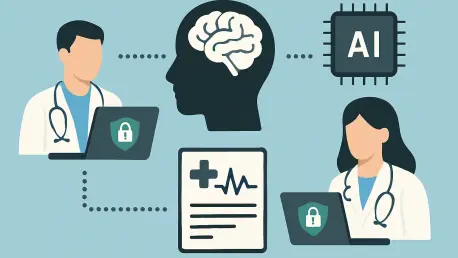

The implementation of secure multi-party computation allows multiple healthcare providers to analyze genomic data evaluations without exposing individual genetic markers. This breakthrough arrives at a critical juncture where the demand for high-fidelity artificial intelligence intersects with increasingly stringent global privacy regulations. Traditional methods of centralizing patient records into massive data lakes often created single points of failure, making them attractive targets for sophisticated cyberattacks and raising significant ethical concerns regarding patient consent. By contrast, current frameworks developed from 2026 to 2028 prioritize a decentralized approach where data remains within the secure confines of the originating institution. This paradigm shift effectively resolves the long-standing friction between the necessity for large-scale training sets and the absolute requirement for confidentiality. As medical centers adopt these distributed protocols, the focus has moved from data collection to the intelligent aggregation of localized insights.
Decentralized Architecture and Local Machine Learning
The core mechanism driving this transformation is the distribution of the training process directly into local clinical environments. Instead of migrating raw patient files to a cloud-based server, the global machine learning model is dispatched to individual facilities, such as community hospitals or specialized clinics. Once deployed, the model learns from the local data on-site, refining its parameters based on specific patient demographics and clinical nuances unique to that location. Only the resulting mathematical updates, which represent the learned patterns rather than the raw data points, are transmitted back to a central orchestrator. This aggregation process combines the gradients from numerous participants to update the master model, which is then redistributed for further refinement. This iterative cycle allows for the creation of robust algorithms that benefit from a vast collective intelligence while maintaining a strict data-at-rest policy that reduces the risk of massive breaches.
Beyond medical imaging and standard diagnostics, this decentralized strategy has proven particularly effective in the study of rare diseases and structured electronic health records. In instances where a single institution might only see a handful of patients with a specific condition, the ability to train on a global cohort without moving sensitive files is revolutionary. By utilizing federated architectures, researchers have successfully developed predictive models for rare genetic disorders that previously lacked the necessary sample sizes for traditional training methods. Furthermore, the integration of wearable sensor data into these federated frameworks has allowed for continuous health monitoring without compromising personal privacy. These systems process biometric signals locally on the device, contributing to a global understanding of disease progression while ensuring that the intimate details of a patient’s life remain protected. This specialized focus ensures that the medical AI landscape remains inclusive, covering diverse populations.
Privacy Preservation: The Path Toward Global Adoption
Despite the clear advantages, the implementation of these decentralized systems introduces unique technical challenges that require sophisticated engineering solutions. One of the primary hurdles is the significant communication overhead involved in synchronizing distributed models across disparate networks with varying bandwidth capabilities. Ensuring that updates from a remote rural clinic are integrated as efficiently as those from a major metropolitan university hospital requires advanced optimization algorithms. To further bolster security, developers have increasingly turned to advanced cryptographic safeguards. Differential privacy has emerged as a standard technique, where carefully calibrated statistical noise is added to the model updates to prevent any potential reverse-engineering of the training data. By managing epsilon and delta parameters, institutions can precisely control the trade-off between the model’s accuracy and the level of privacy protection offered to individual patients, ensuring compliance with HIPAA.
The transition toward these privacy-first architectures reached a turning point as institutions integrated federated learning with large language models and global governance standards. Researchers established secure protocols that allowed clinicians to leverage the power of generative AI for drafting reports while keeping underlying doctor-patient notes strictly localized. Strategic partnerships between technology firms and healthcare regulators formalized the standards for model verification, ensuring that every decentralized update met rigorous safety criteria. Organizations prioritized the development of interoperable frameworks that allowed different platforms to communicate seamlessly, breaking down the silos that previously hindered progress. These efforts culminated in a global research environment where data privacy was no longer a barrier to innovation but rather its primary foundation. By moving away from centralized vulnerability and toward a resilient, distributed future, the medical community secured a path that honored patient sanctity.