
Shrinking lead times, rising SKU counts, and exacting brand standards have forced label converters to modernize the shop floor while protecting margins, and AI is increasingly the lever that makes speed, flexibility, and quality coexist without breaking the production model. Across the segment, 85% of U.S. print providers now call AI critical to competitiveness, yet 42% remain unsure where to start, signaling an industry stuck between urgency and uncertainty. The fastest way forward has been pragmatic: target specific, high‑value workflows in today’s digital and hybrid environments, measure results in hours and errors saved, and then expand. That path has resonated because AI is already embedded in many RIPs, DFE controllers, and scheduling tools. Recognizing that hidden head start shifts the conversation from “whether” to “how,” and it reframes adoption as tuning what is present, not ripping out what already works.
Where AI Is Already Delivering on the Shop Floor
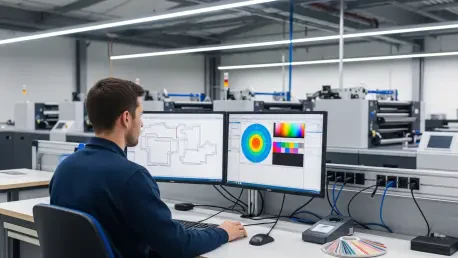
On-press results have arrived first in prepress, where machine learning now automates file normalization, bleed and dieline checks, step‑and‑repeat imposition, and ICC‑driven color targeting with spectral verification. Operators who once nudged curves and trapping by hand now rely on engines that learn from historical approvals and substrate profiles, allowing fast‑twitch changes across SKUs without inviting drift. Scheduling has followed suit. Capacity‑aware planners factor due dates, setup sequences, substrate changes, and curing constraints to route jobs across flexo, digital, and hybrid assets, shrinking idle minutes. Real‑time RIP pipelines sustain variable data printing without throttling throughput, so versioned artwork and serializations do not become bottlenecks.
Quality and reliability gains have come from AI‑driven visual inspection and predictive maintenance, though only 10% of converters report active exploration of these advanced tools, leaving a clear performance gap. High‑speed cameras paired with defect classifiers catch hickeys, voids, color shifts, and registration creep early, while vibration, temperature, and amperage signatures forecast bearing or pump failures days in advance. Instead of firefighting, maintenance windows align to production slack, preventing reprints and scrap that quietly erode margin. These systems have not demanded monolithic change; many ride existing frameworks like JDF/JMF handshakes and press vendor APIs. The common thread is targeted intelligence that trims setup, curbs waste, and stabilizes color under real‑world substrate variability.
Turning Production Data Into Business Insight
Moving beyond discrete tasks, data unified across press controllers, finishing lines, and ERP/MIS has exposed patterns that used to hide in silos. Order cadence by customer now pairs with seasonal effects and promo calendars to sharpen forecasts down to label families, liner grades, and ink sets. Ink and substrate draw correlate with coverage and anilox state, improving reorder timing and cutting emergency purchases. Equipment utilization, changeover frequency, and energy draw map to OEE dashboards that explain not just availability but the specific losses driving it, informing shift patterns and die library optimization. This is how demand volatility stops ambushing the floor and starts shaping it.
The plumbing matters as much as the math. Converters that stitched together press‑agnostic telemetry using OPC UA, REST/GraphQL APIs, MQTT brokers, and JDF/JMF events found it easier to standardize data and build durable models. Once signals flowed, simple steps—like aligning SKU metadata, substrate codes, and color targets across MIS and DFE—unlocked trustworthy analytics. The payoff landed in practical levers: minimum order quantities adjusted to real setup cost, kanban levels tuned by lead‑time variability, and capital plans weighted by actual constraint minutes rather than anecdotes. The result was not a single dashboard but a feedback loop that tied pricing, scheduling, and inventory to the physics of the plant.
From First Wins to Connected Factories
The most reliable path had been staged and measurable. Converters picked an entry point like prepress automation or dynamic scheduling, created a clean baseline of setup minutes, remake rates, and on‑time delivery, then ran a narrow pilot on a defined SKU set. Success criteria were decided up front—fewer touches, fewer color corrections, tighter delta E, higher OEE—and only after validation did the team expand to adjacent workflows, such as rolling color control into substrate‑specific profiles or extending dispatch rules from a single press cell to the plant. Cross‑department coordination remained non‑negotiable so gains in prepress did not create plate room queues or ink mixing delays. Procurement shifted too: future presses and finishers were scored on telemetry depth, data schemas, and API openness, not just speed and resolution.
Critical enablers had been set early. Data governance defined how MIS/ERP, quality logs, and machine signals were cleaned, versioned, and accessed. Human oversight stayed central—56% of adopters kept verification in every AI function—ensuring brand standards and regulatory needs were met. Hiring followed the work; 23% of print businesses sought AI skills, especially operators and planners who bridged printcraft with data literacy, color science, and connectivity know‑how. Actionable next steps were clear: choose one high‑impact use case; instrument it with press‑agnostic data; set guardrails for human review; and train teams to interpret, not just observe, machine output. With those moves in place, AI shifted from isolated automations to a connected production model that had already compounded uptime, reduced waste, and positioned converters for faster, more confident growth.