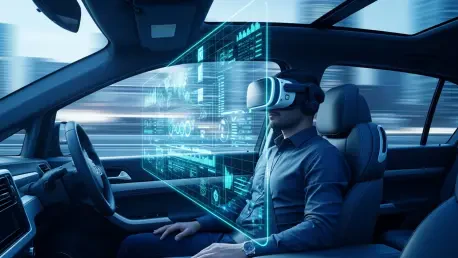

The realization of fully productive autonomous travel hinges significantly on overcoming the physiological discomfort caused by the sensory mismatch between physical movement and visual digital content. This phenomenon, commonly referred to as motion sickness, occurs when the inner ear detects acceleration or turning while the eyes are fixed on a static or poorly synchronized virtual display. Researchers at the Gwangju Institute of Science and Technology, led by Professor Seungjun Kim, have introduced a sophisticated system titled Force Mappings to resolve this conflict. This technology specifically targets the gap between what a passenger feels and what they see by using real-time vehicular data to adjust the virtual environment. Unlike earlier attempts that merely adjusted camera angles, this innovation transforms the entire physics of the digital world to match the kinetic reality of the car. By integrating these forces into the user experience, the system aims to turn transit time into a period of high-quality immersion without the risk of nausea or disorientation.
Kinetic Data and Environmental Synchronization
The technical backbone of the Force Mappings system relies on a combination of high-precision inertial measurement units and Global Positioning System data to capture the vehicle’s dynamics. These sensors provide a continuous stream of information regarding the car’s acceleration, deceleration, and lateral forces during turns. This data is then processed in real time to influence the behavior of objects within the virtual reality landscape. For instance, when a car brakes suddenly, the virtual environment does not just tilt the camera; it might simulate a heavy object falling forward or a gust of wind blowing against the user’s perspective. This method moves beyond simple visual mimicry by creating a dynamic world that reacts to the laws of physics as experienced by the passenger. By ensuring that every physical jolt has a corresponding visual representative, the system minimizes the sensory conflict that typically triggers the brain’s defense mechanism against perceived poisoning, which is the biological root of motion sickness.
Beyond simple physics adjustments, the technology incorporates a variety of environmental cues such as shifting ground inclinations and spatial shaking that correspond precisely to the road conditions. If the vehicle traverses a bumpy path, the virtual ground under the user’s feet might appear to vibrate or shift, providing a visual explanation for the physical sensations being felt. This alignment is critical for the vestibular system, which is responsible for maintaining balance and spatial orientation. When the eyes see a stable horizon but the body feels movement, the brain receives conflicting signals. The GIST researchers have effectively bridged this gap by making the virtual world feel as reactive as the physical one. This allows passengers to engage with complex digital tasks or entertainment without the lingering fear of physical illness. Such a granular level of synchronization represents a significant departure from static VR experiences, making the interior of an autonomous vehicle a viable space for extended digital interaction while the car navigates through diverse and unpredictable traffic patterns.
Cognitive Mapping and Future Applications
Detailed findings presented at the ACM CHI 2026 conference highlighted an unexpected aspect of human perception in virtual environments regarding the mapping of physical forces. The research indicated that user immersion and comfort were not at their highest when virtual forces were mapped with perfect mathematical equivalence to the vehicle’s movement. Instead, the team discovered that immersion significantly improved when virtual forces were slightly amplified to better align with the human brain’s subjective interpretation of motion. By adjusting the direction and intensity of virtual movements to feel more “natural,” the researchers achieved a higher sense of presence and a more substantial reduction in nausea. This insight suggests that effective Extended Reality experiences require a psychological approach rather than just a mechanical one. This amplification compensates for the lack of peripheral vision and other sensory cues that are usually present in the real world but missing in a headset. Consequently, the user perceives the digital environment as more authentic, leading to a smoother transition between the physical car and the virtual workspace.
This technological breakthrough transformed the potential of autonomous vehicles, turning them from mere transport pods into versatile platforms for professional work and high-fidelity gaming. The successful integration of vehicular kinetics and virtual environments paved the way for manufacturers to implement these systems in next-generation fleets. Industry leaders moved toward adopting standardized APIs that allowed third-party developers to access car sensor data for creating immersive educational modules and interactive media. This shift encouraged a new era of mobile infotainment where the journey itself functioned as an active component of the digital narrative. To maximize the utility of these findings, developers focused on creating adaptive profiles that calibrated the force amplification based on individual sensitivity levels. Future research aimed to integrate haptic feedback systems directly into vehicle seating to further enhance the tactile realism of the experience. By solving the persistent problem of motion sickness, the research team established a new baseline for how humans interact with technology while in transit, ensuring that the boundaries between physical travel and digital exploration remained effectively blurred for everyone.